Burp Gun
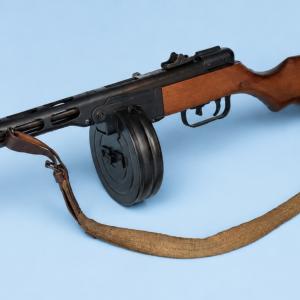
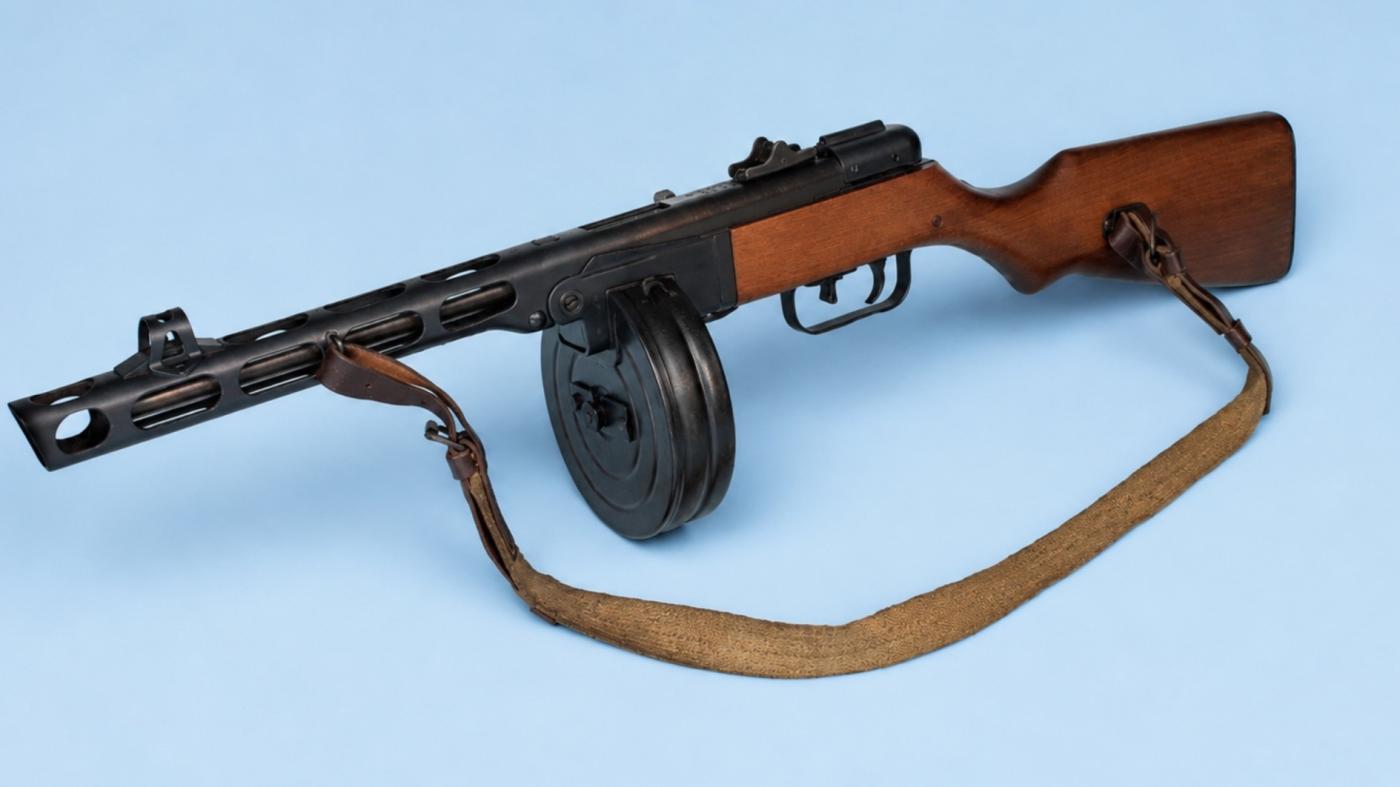
The PPSh-41 was the correct designation and serial model number of the famous Soviet submachine gun nicknamed the “burp gun” by United Nations soldiers during the Korean War. The nickname came from the weapon’s distinctive firing sound. When fired in full automatic mode, the gun produced a rapid, buzzing burst that American and British troops described as sounding like a loud “burp.” During nighttime attacks in Korea, veterans often recalled hearing the sharp rattling roar of the weapon before seeing enemy soldiers emerging from the darkness.
The weapon was originally developed in the Soviet Union during World War II by weapons designer Georgy Shpagin. The Soviet military needed a cheap, durable, and easy-to-manufacture submachine gun that could be produced in enormous numbers during the German invasion. Earlier Soviet designs, especially the PPD-40, were effective but expensive and time-consuming to manufacture. Shpagin’s answer was revolutionary because it relied heavily on stamped steel parts rather than complicated machining. This allowed factories to produce the weapon rapidly and in massive quantities.
By the end of World War II, over six million had been manufactured, making it one of the most-produced military firearms in history. After the war, huge stockpiles were distributed to communist allies around the world, including North Korea and China. As a result, when the Korean War broke out in 1950, it became one of the most common weapons carried by North Korean and Chinese troops.
The gun fired the 7.62×25mm Tokarev cartridge, a powerful pistol-caliber round originally derived from older Mauser ammunition. Compared to many Western submachine guns of the period, the Tokarev round had unusually high velocity. This gave the weapon impressive penetration power. American soldiers discovered that the bullets could punch through thick winter clothing, light cover, and even some helmets under the right conditions.
One of the most feared characteristics was its extremely high rate of fire. The gun could fire roughly 900 rounds per minute, significantly faster than the American Thompson submachine gun or the M3 “Grease Gun.” This rapid firing rate contributed directly to the famous “burping” sound. In close combat, especially during night assaults or trench fighting, it could unleash devastating sprays of bullets in seconds.
The weapon was usually fitted with either a 71-round drum magazine or a 35-round curved box magazine. The large drum magazine became iconic, although it was not always reliable. Drum magazines could be difficult to load properly and sometimes jammed if dirt or dents interfered with feeding. Chinese forces in Korea increasingly preferred the simpler box magazine because it was lighter, quieter, and easier to maintain during long marches through mountainous terrain.
American troops encountered the burp gun in some of the harshest conditions imaginable. Korea’s freezing winters often caused firearms to malfunction, but the Soviet weapon developed a reputation for reliability in snow, mud, and extreme cold. Its loose internal tolerances meant that dirt and ice were less likely to stop it from functioning. Many UN soldiers grudgingly admired its toughness even while fearing its firepower.
Night attacks by Chinese forces became strongly associated with the sound of the burp gun. Chinese infantry tactics often involved infiltration, stealth movement, whistles, bugles, and sudden close-range assaults. When these attacks began, the shrill sound of bugles and whistles was frequently followed by bursts from the weapon echoing across hillsides and frozen valleys. Veterans from battles such as the Battle of Chosin Reservoir often described the terrifying psychological effect of hearing multiple burp guns firing simultaneously in darkness.
The Chosin Reservoir campaign in late 1950 became one of the most famous episodes involving the weapon. During this brutal winter battle, surrounded American Marines and soldiers fought massive Chinese offensives in temperatures that dropped far below zero. Chinese troops armed with burp guns repeatedly launched aggressive close-range attacks against UN positions. Marines later recalled hearing the rapid chatter approaching through snowstorms at night.
The weapon’s simplicity made it ideal for poorly trained conscripts. Unlike more complicated firearms, it could be field stripped quickly and repaired with limited tools. It was designed to survive rough handling by soldiers who might have minimal training. This was particularly important for Chinese communist forces, many of whom came from rural backgrounds and had limited experience with modern weapons.
Although feared, the gun also had limitations. It was not particularly accurate at longer ranges because of its high recoil and rapid firing speed. Korean terrain often involved mountain combat where rifles were more effective than submachine guns. American troops armed with the M1 Garand usually had a significant range advantage. The Garand’s powerful .30-06 cartridge could engage targets much farther away than the Tokarev ammunition.
Despite these drawbacks, the weapon excelled in close combat. In trenches, bunkers, villages, and nighttime engagements, it was extremely dangerous. Chinese and North Korean soldiers often closed the distance quickly before opening fire, maximizing its effectiveness.
Some American soldiers actually preferred captured burp guns over their own submachine guns. Troops occasionally used captured examples during patrols because they appreciated the high firepower and reliability. However, there was a serious risk involved. Friendly forces hearing the distinctive sound might mistake the user for an enemy soldier. There were documented cases where Americans using captured weapons were nearly fired upon by their own side.
The burp gun also became famous because of its rugged appearance. The design featured a wooden stock, perforated barrel shroud, and often the large drum magazine that gave it an unmistakable silhouette. Many wartime photographs from Korea show Chinese or North Korean soldiers carrying the gun slung across heavy winter uniforms.
Another interesting aspect was its role in communist propaganda. Chinese and North Korean posters frequently depicted heroic soldiers charging with the weapon in hand. It became a symbol of revolutionary warfare and communist military strength in Asia during the 1950s.
The gun’s influence extended long beyond Korea. Variants continued serving around the world for decades. Chinese factories produced copies known as the Type 50, while North Korea manufactured its own versions. The weapon later appeared in Vietnam, the Middle East, Africa, and numerous Cold War conflicts. Even in the 21st century, some examples could still occasionally be found in irregular militias and old military stockpiles.