Ohka Flying Bombs
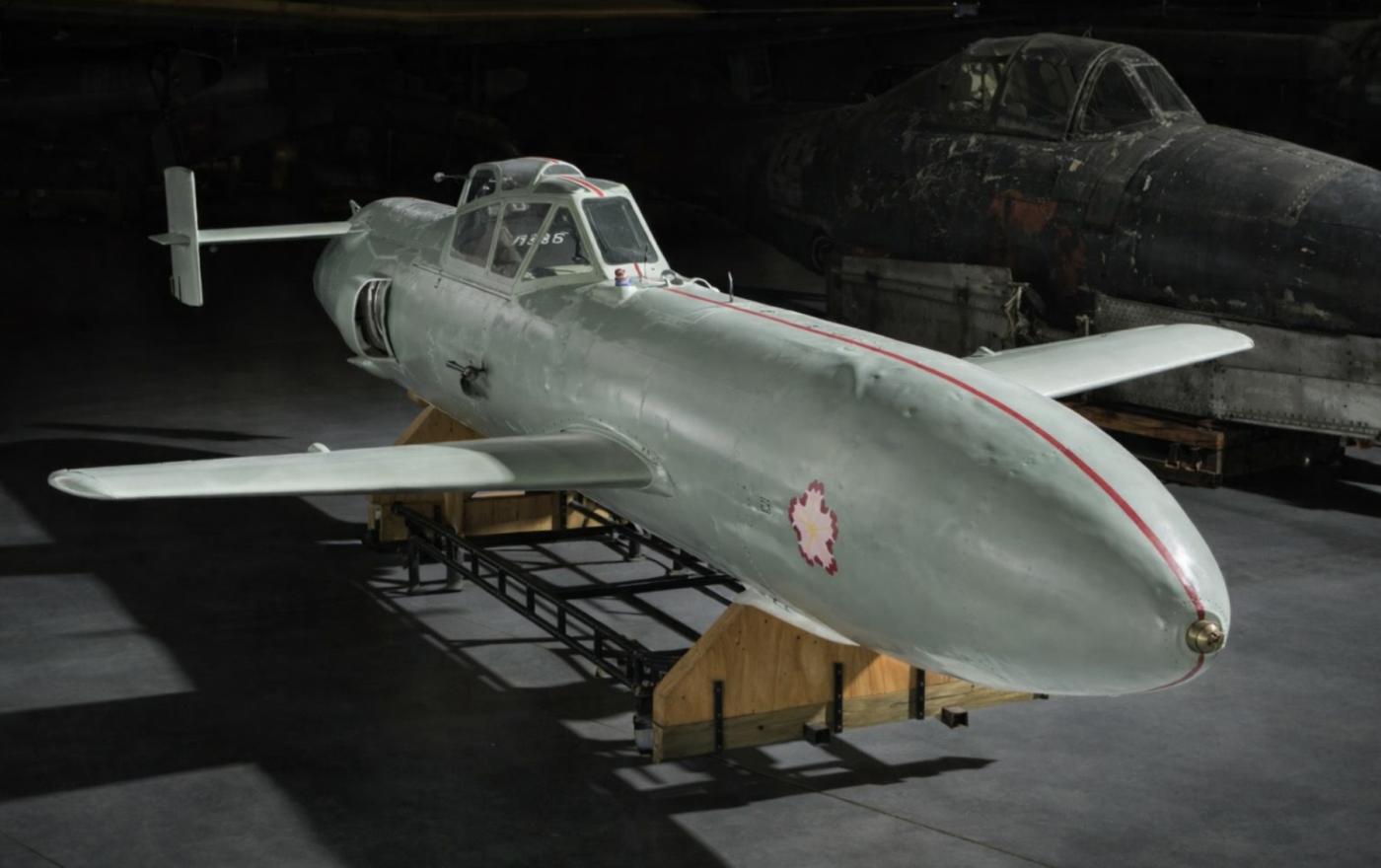
The Japanese Ohka was one of the most unusual and desperate weapons developed during the final stages of the Second World War. Its official designation was the Yokosuka MXY-7 Ohka, and the name “Ohka” means “cherry blossom” in Japanese. It was a rocket-powered, manned flying bomb designed specifically for kamikaze suicide attacks against Allied naval ships. Unlike normal aircraft, it was not designed to return from its mission. The pilot guided the small aircraft directly into an enemy vessel, detonating a massive explosive charge carried in its nose.
The concept for the weapon was originally proposed in 1943 by Imperial Japanese Navy Ensign Mitsuo Ohta. Ohta developed the idea with assistance from students of the Aeronautical Research Institute at the University of Tokyo. The Japanese Navy initially showed little interest, but as the war situation worsened for Japan during 1944 the concept was reconsidered and accepted. Engineers at the Yokosuka Naval Air Technical Arsenal then produced the official design and prototypes for the aircraft. Several engineers worked on the project, including Kyūichirō Washizu, who helped refine the performance and aerodynamics.
The aircraft was manufactured primarily by the Yokosuka Naval Air Technical Arsenal. Production took place between 1944 and 1945 as Japan rushed to deploy new anti-ship weapons. The craft was designed to be simple and cheap to build because Japan was running short of materials and industrial capacity late in the war. Many components were made from wood mounted on an aluminum frame, which reduced the use of scarce metals and allowed rapid production. By the end of the war approximately 852 units had been built. Most of these were the main operational version known as the Model 11.
Physically the weapon was a small aircraft. It measured about 6.06 meters long with a wingspan of roughly 5.12 meters and weighed just over two tonnes when fully loaded. The pilot sat in a cramped cockpit near the front of the fuselage with simple flight controls and a basic instrument panel. The entire nose section contained a very large explosive warhead weighing about 1,200 kilograms, roughly 2,600 pounds of high explosives. When the craft struck a ship this charge detonated, producing a powerful explosion capable of destroying or severely damaging the vessel.
The aircraft had no landing gear and no capability for recovery because it was intended for a one-way mission. It was essentially a guided missile piloted by a human. The vehicle was normally carried underneath a larger bomber aircraft, most commonly the Mitsubishi G4M “Betty.” The bomber would fly toward Allied ships while carrying the weapon attached beneath its fuselage. When the formation approached the target area the pilot inside the small craft would release from the bomber and begin gliding toward the enemy fleet.
After release the pilot initially glided toward the target to conserve rocket fuel. The aircraft was powered by three solid-fuel rocket motors mounted in the rear fuselage. These rockets could be fired individually or together. Once ignited they accelerated the craft extremely quickly, allowing it to reach speeds of more than 400 miles per hour in level flight and over 600 miles per hour in a steep dive toward the target ship. At such speeds the vehicle was extremely difficult for shipboard anti-aircraft guns to intercept during the final approach.
Despite its impressive speed, the weapon suffered from a serious operational weakness. Its range was extremely limited because the rocket engines burned for only a few seconds. The typical operational range of the main Model 11 version was about 36 to 40 kilometers from the point where it was released. This meant that the bomber carrying it had to approach very close to Allied ships before launching the attack craft. As a result many of the carrier aircraft were intercepted and shot down by American fighters before they could release their payload.
Several variants were developed or proposed in an attempt to improve range and effectiveness. The Model 11 was the main operational version, powered by three rocket motors and carrying the large 1,200-kilogram warhead. The Model 21 used steel wings and slightly modified components but was produced only experimentally. Another design, the Model 22, replaced the rocket motors with an Ishikawajima Tsu-11 motorjet engine that gave the craft a longer range of about 130 kilometers, although its speed was lower. Other advanced versions were planned using turbojet engines or submarine launch systems, but most of these never reached production before the war ended.
To train pilots, Japan also produced unpowered trainer versions known as the K-1 training glider. These had no warhead and carried water ballast instead of explosives. They allowed pilots to practice handling the small aircraft and its very high landing speeds. Even these training machines were considered difficult to fly because of their unusual design and fast approach speed.
The weapon first saw combat in March 1945 during attacks against American naval forces near Okinawa. Japanese forces hoped that the extremely high speed of the craft would allow it to penetrate heavy anti-aircraft defenses and sink large warships. Allied forces soon gave it the nickname “Baka bomb,” using the Japanese word “baka,” meaning “foolish,” because they believed the concept was wasteful of both pilots and aircraft.
Although the weapon did succeed in damaging or sinking several Allied ships, its overall impact on the war was limited. The main problem was that the large bomber carrying it had to fly close to enemy fleets before launch. American radar, fighter patrols, and anti-aircraft fire usually destroyed the bombers long before they reached release distance. As a result many of the flying bombs were lost without ever being used.
Despite its limited success, the aircraft remains one of the fastest manned machines of the Second World War during its attack dive. It represents a dramatic example of the extreme measures taken by Japan during the final months of the war, when the country was running out of conventional weapons, trained pilots, and fuel. Several surviving examples can still be seen in museums around the world today as reminders of this unusual and tragic weapon system.