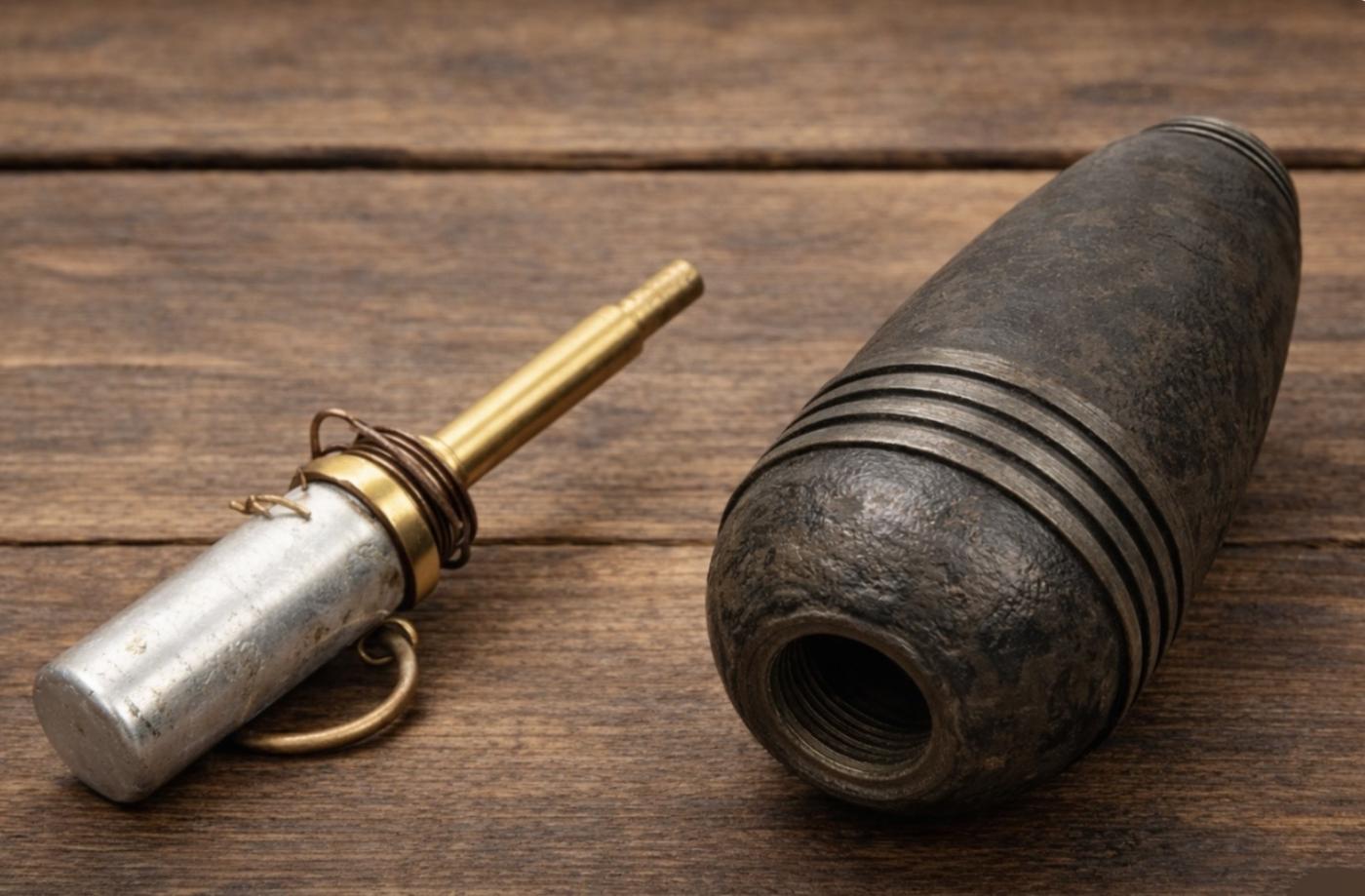
Norwegian WW11 Grenade
The Norwegian M41AS hand grenade is a relatively obscure weapon linked to Norway during the Second World War period, and it must be understood in the context of the country’s limited military preparedness. When Germany invaded in 1940, Norway had very few modern grenades due to weak development and low prioritisation in the interwar years.
Earlier designs, particularly those associated with Nils Waltersen Aasen, had been considered overly complex and sometimes unsafe. Because of this, grenade development stagnated, leaving Norwegian forces short of reliable equipment. During the 1940 campaign, troops often relied on outdated or improvised weapons.
The M41AS appears to have been a later attempt to introduce a more modern and practical grenade. The “M41” designation suggests standardisation around 1941, while “AS” likely refers to a variant or designation system, though its exact meaning is unclear. It may have been developed with Allied influence or produced in limited numbers after liberation.
In design, it would have followed the standard fragmentation grenade pattern of the time. This meant a compact metal body intended to break into lethal fragments when detonated, using a timed fuse with a pin and lever mechanism similar to other Allied grenades.
Although exact specifications are not well recorded, grenades of this type typically contained around 50 to 200 grams of explosive such as TNT or amatol. When detonated, they produced multiple high-velocity fragments. The lethal radius was generally about 5 to 10 metres, with danger extending further depending on conditions.
Production was likely small-scale due to Norway’s limited industrial capacity, especially during occupation. There are no reliable figures for how many were made, suggesting it was not widely produced compared to other wartime grenades.
In terms of effectiveness, it would likely have been a solid but unremarkable design. By the 1940s, most fragmentation grenades were broadly similar, and performance depended mainly on fuse reliability and fragmentation consistency. It was probably simpler and safer than earlier Norwegian designs.