Nero Decree
On 19 March 1945, during the final weeks of the Second World War in Europe, Adolf Hitler issued one of the most extreme and destructive orders of his rule. The directive became known as the “Nero Decree,” a scorched earth policy that demanded the systematic destruction of Germany’s own infrastructure in order to prevent it from falling into Allied hands. The order reflected Hitler’s growing despair and fury as Allied forces closed in on Germany from both the west and the east, and it revealed the degree to which he had come to view the German people themselves as having failed him.
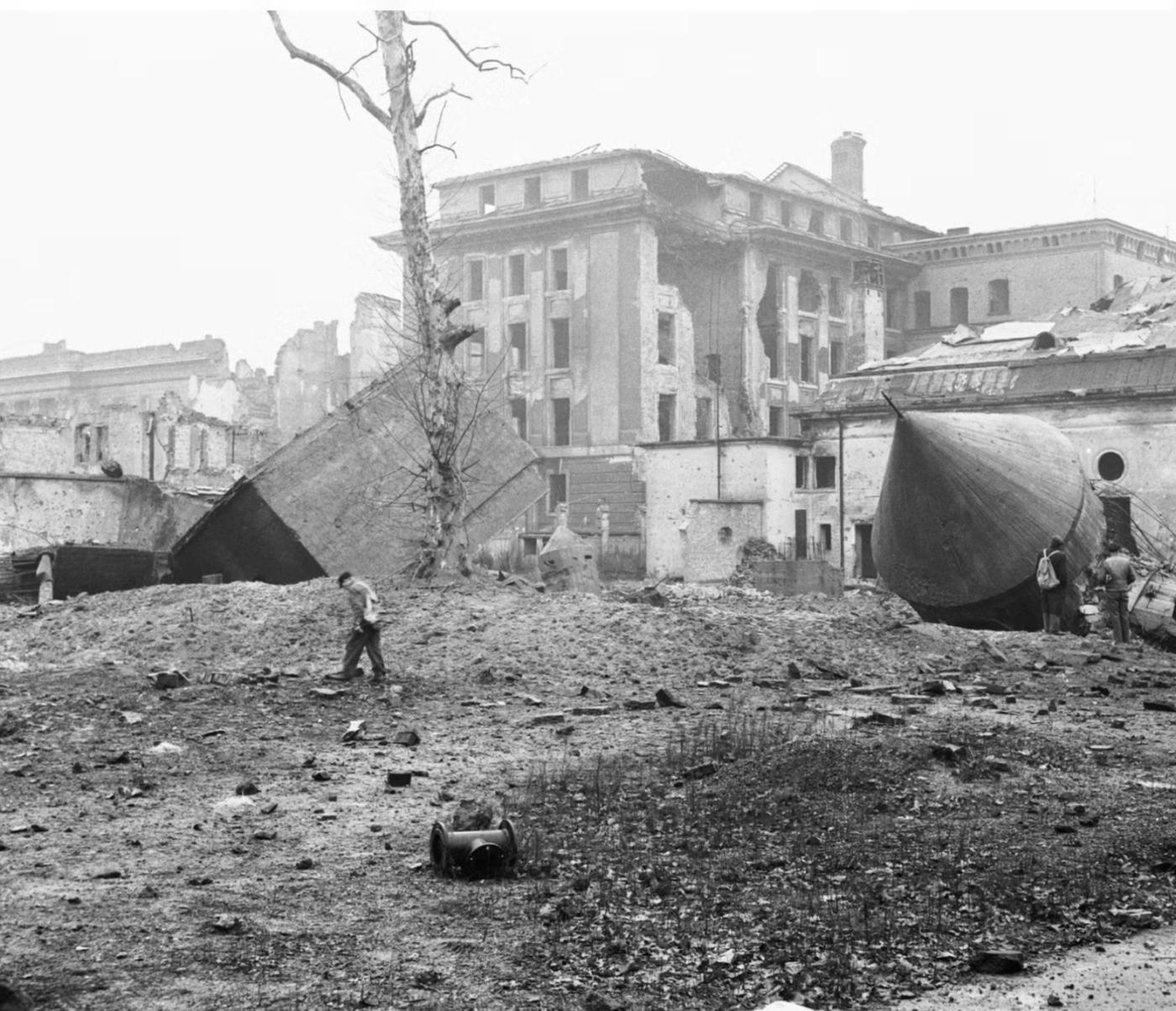
By March 1945 the military situation of Nazi Germany had become catastrophic. Soviet forces were advancing rapidly through eastern Germany after crossing the Oder River, while American, British, and Canadian forces had crossed the Rhine in the west. Major German cities lay in ruins from years of Allied bombing, and the Wehrmacht was exhausted, poorly supplied, and increasingly unable to stop the Allied advance. Hitler, who had largely withdrawn into the Führerbunker beneath the Reich Chancellery in Berlin, was isolated from reality and increasingly prone to issuing harsh and impractical orders.
The decree issued on 19 March 1945 was formally titled “Demolitions on Reich Territory.” Its intention was simple but devastating: if Germany could no longer win the war, then nothing useful should remain for the enemy. Hitler ordered that all industrial facilities, transportation systems, supply depots, communication networks, and public utilities within Germany that could be of value to the advancing Allies were to be destroyed. This included factories, railways, bridges, canals, power stations, waterworks, food stores, and even basic infrastructure that civilians relied upon for survival.
The order was directed to Albert Speer, the Reich Minister for Armaments and War Production, who was responsible for coordinating industrial production and infrastructure. Speer was instructed to ensure that the destruction was carried out systematically as Allied troops approached. The decree effectively demanded that Germany be reduced to ruins by its own government rather than be used by the occupying forces.
The nickname “Nero Decree” came later, referencing the Roman emperor Nero, who according to legend played the lyre while Rome burned in the year 64 AD. Although historians debate whether Nero truly burned Rome deliberately, the comparison captured the sense that Hitler was willing to sacrifice his own country in a final act of vengeance or defiance.
Hitler’s reasoning behind the order was shaped by his ideological worldview. He believed that if the German nation had proven incapable of winning the war, then it did not deserve to survive. In conversations recorded by those around him, Hitler expressed the idea that the German people had shown themselves to be the weaker race compared to the Allies and the Soviet Union. If they were defeated, he argued, the future would belong to stronger nations. In his view, preserving Germany’s infrastructure would only help the enemy and prolong a world dominated by what he saw as inferior or hostile powers.
This brutal logic meant that the order did not distinguish between military and civilian needs. Destroying water supplies, electricity systems, or transportation networks would have caused massive suffering among German civilians already struggling through the devastation of war. Many regions of Germany were facing shortages of food, housing, and medical care, and a complete scorched earth policy would likely have led to widespread famine and humanitarian disaster.
Albert Speer, however, quietly resisted carrying out the order. Although he had been one of the most powerful figures in the Nazi regime and had overseen a massive war production system built partly on forced labour, by 1945 he had begun to realize that the war was lost and that Hitler’s orders would bring pointless destruction. Speer later claimed that he deliberately sabotaged the implementation of the decree by instructing regional authorities to ignore or delay demolitions. He also made efforts to preserve essential infrastructure wherever possible.
Speer even confronted Hitler about the policy in person. During a meeting in late March 1945, Speer reportedly argued that Germany would need its infrastructure to survive after the war and that destroying it would condemn the population to unnecessary suffering. Hitler rejected this argument and insisted that the destruction should go ahead. Despite this, Speer continued to obstruct the policy in practice by issuing vague instructions and relying on local officials who were also reluctant to destroy their own communities.
Another factor that limited the decree’s implementation was the rapidly collapsing German command structure. By the spring of 1945, communication networks were disrupted, military units were retreating chaotically, and many local commanders were making their own decisions in order to protect civilians or avoid meaningless destruction. Some bridges and factories were destroyed in accordance with scorched earth tactics, but the widespread devastation envisioned by Hitler never fully occurred.
In several places German engineers were ordered to demolish key bridges over major rivers such as the Rhine, but even these efforts were inconsistent. In some cases demolition charges failed to destroy structures completely; in others local officials delayed the destruction until Allied forces arrived and took control. The chaos of the final weeks of the war meant that many orders from Berlin were ignored or simply could not be carried out.
The Nero Decree also revealed the deepening divide between Hitler and many members of his own government. Some Nazi officials remained fanatically loyal and attempted to follow the order, but others increasingly prioritized the survival of their regions or the welfare of civilians. By this stage the Nazi regime was fragmenting, and authority from Berlin had weakened significantly.
One of the most striking aspects of the decree is how openly it reflected Hitler’s fatalistic thinking. Earlier in the war he had repeatedly spoken about either total victory or total destruction. As defeat became inevitable, he moved toward the latter option, showing little concern for the millions of Germans who would have to live in the aftermath. His willingness to sacrifice the country itself demonstrated how completely his ideology placed loyalty to his vision above the survival of the nation.
Historians often view the Nero Decree as one of the clearest signs of the regime’s collapse and Hitler’s detachment from reality. Rather than attempting to preserve what remained of Germany, he chose to threaten its complete destruction. The order symbolized a regime that had become willing to destroy its own society rather than admit defeat.
The war in Europe ended less than two months later. On 30 April 1945, Adolf Hitler committed suicide in the Führerbunker in Berlin as Soviet forces fought their way into the city. Germany formally surrendered on 8 May 1945. Because of the resistance from officials like Albert Speer and the reluctance of many local authorities, the Nero Decree was only partially implemented. Much infrastructure survived, which played an important role in Germany’s eventual reconstruction after the war.
Despite this, the decree remains a powerful example of the destructive mindset that dominated the final phase of the Nazi regime. It showed how, in its final days, the government was prepared to sacrifice its own people and its own country in pursuit of ideological fanaticism and the refusal to accept defeat.