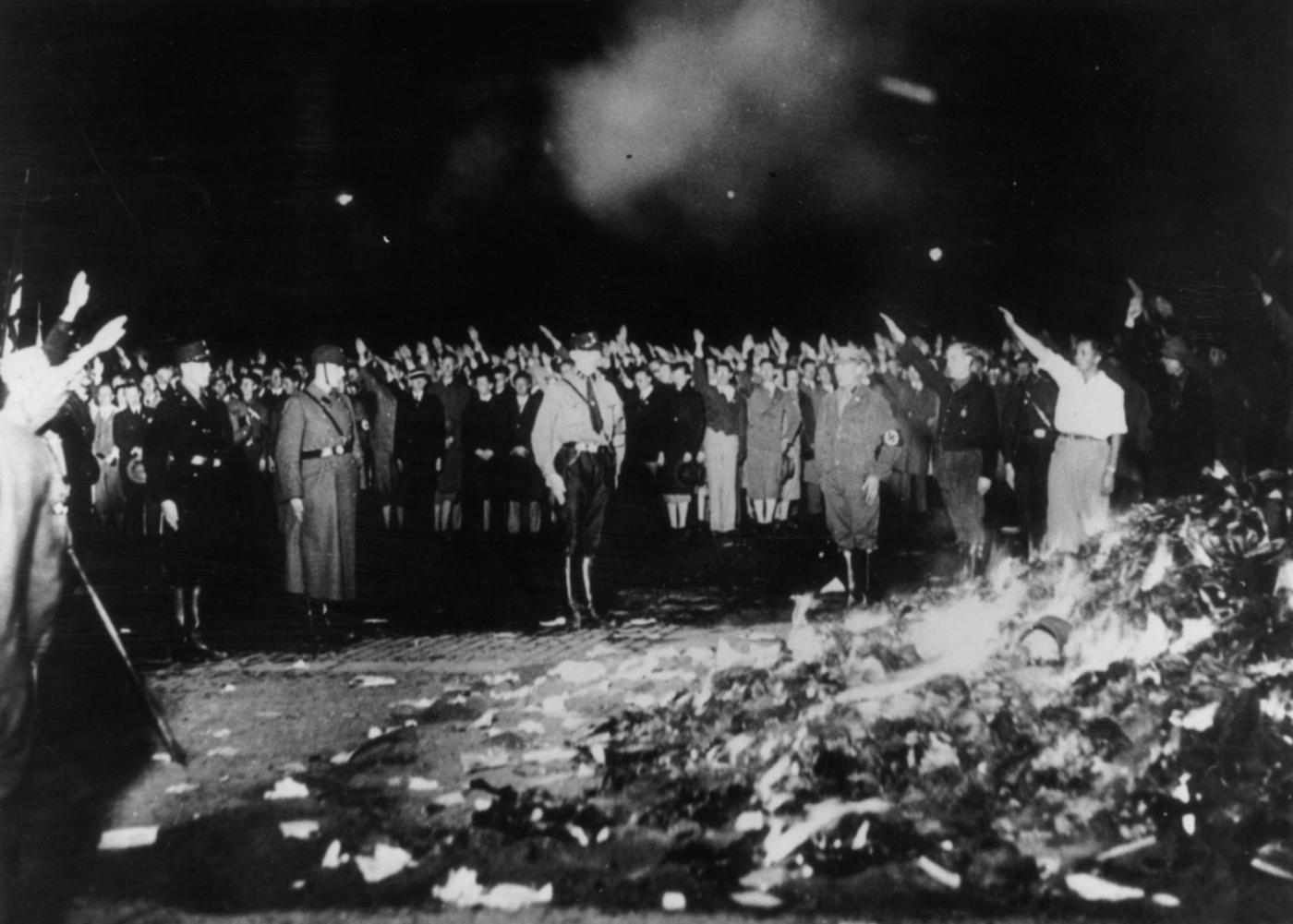
Nazi book burning
The Nazi book burnings of 10 May 1933 were among the earliest and most symbolic acts of cultural repression carried out by the Nazi regime. They represented not just censorship, but a public declaration that intellectual freedom, dissenting ideas, and entire branches of thought would be violently erased from German society. These burnings took place only months after Adolf Hitler became Chancellor of Germany in January 1933, at a time when the regime was rapidly consolidating power and reshaping the country into a totalitarian state.
The burnings were primarily organised by the German Student Union, a body that had become increasingly aligned with Nazi ideology. University students, professors, and Nazi officials collaborated in a coordinated campaign called the “Action against the Un-German Spirit.” This campaign sought to purge German culture of works considered “degenerate,” “Jewish,” “Marxist,” or otherwise opposed to Nazi beliefs. The students compiled blacklists of authors and books that were deemed dangerous, drawing heavily on earlier nationalist and antisemitic traditions.
The most famous and largest of the burnings took place in Berlin, specifically at the Opernplatz (now Bebelplatz), where around 25,000 books were thrown into a massive bonfire. Similar events occurred in more than 30 university towns across Germany, including Munich, Frankfurt, and Bonn. The burnings were not spontaneous acts of mob violence but carefully staged spectacles, complete with torchlight parades, music, and speeches designed to attract large crowds and media attention.
A central figure in the Berlin event was Joseph Goebbels, who delivered a fiery speech to thousands of spectators. As the Reich Minister of Propaganda, Goebbels played a crucial role in shaping the ideological narrative of the Nazi regime. In his speech, he framed the book burning as a necessary cleansing of German culture, declaring that “the era of extreme Jewish intellectualism is now at an end.” His words reflected the regime’s broader goal of controlling not just political power but also thought, education, and artistic expression.
The authors targeted in the burnings included many of the most influential thinkers of the 19th and 20th centuries. Works by Albert Einstein, Sigmund Freud, Karl Marx, and Erich Maria Remarque were among those destroyed. Jewish writers were especially targeted, but the purge also included political opponents, pacifists, socialists, and anyone whose ideas conflicted with Nazi ideology. Even some German authors who were not Jewish but were considered critical of nationalism or militarism were included.
An interesting and often noted aspect of the book burnings is their eerie connection to a much earlier warning by the German-Jewish poet Heinrich Heine, who wrote in 1821, “Where they burn books, they will also ultimately burn people.” This quote later gained tragic significance in light of the The Holocaust, which would begin less than a decade later.
The burnings were highly ritualised. Students would often recite so-called “fire oaths” as they threw books into the flames, condemning the ideas contained within them. These declarations targeted specific ideologies such as class struggle, pacifism, and liberalism. The theatrical nature of the events was deliberate, designed to create a sense of unity and purpose among participants while intimidating anyone who might oppose the regime.
The international reaction was one of shock and condemnation. Many observers outside Germany saw the burnings as a clear sign of the regime’s authoritarian and anti-intellectual direction. In response, protests and counter-events were held in other countries, particularly in the United States and Britain, where academics and writers spoke out against Nazi censorship. However, within Germany, open opposition was extremely dangerous due to increasing repression by the state.
The book burnings also had a long-term cultural impact. Many of the targeted authors fled Germany, contributing to a significant intellectual and artistic exile. This “brain drain” weakened German academia and culture while enriching other countries, especially the United States. Universities, publishing houses, and libraries were reshaped to align with Nazi ideology, and alternative viewpoints were systematically eliminated.
In retrospect, the events of 10 May 1933 were not just about books. They were an early and highly visible step in the Nazis’ broader campaign to control every aspect of life, from politics to culture to personal belief. The destruction of literature symbolised the destruction of free thought itself, setting the stage for the far more extreme acts of repression and violence that would follow in the years leading up to and during World War II.