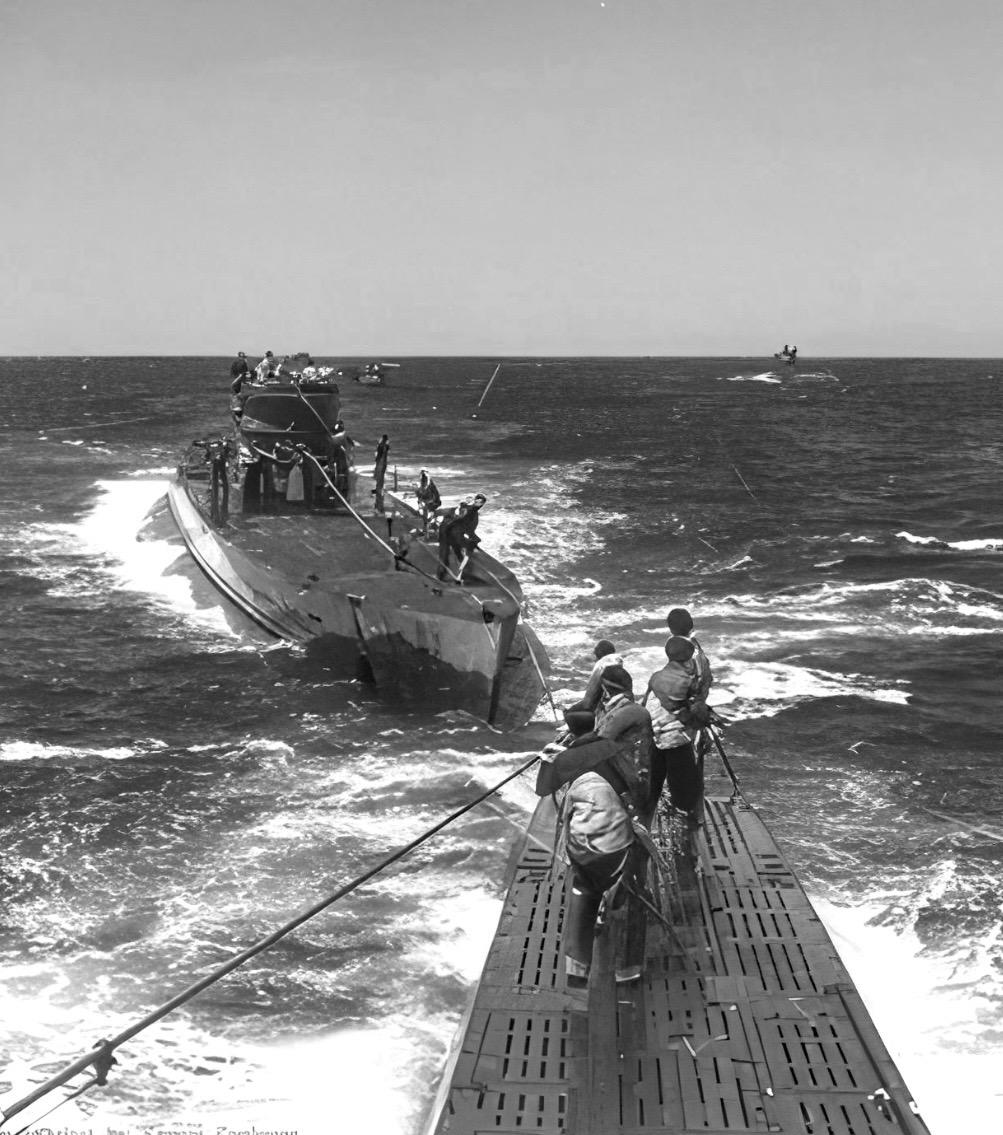
Milk Cow resupply u-boat
The so-called “milk cow” U-boats of the Second World War were officially the German Type XIV submarine tankers, a highly specialised class created to solve one of the biggest limitations facing the German submarine force: endurance. Standard attack submarines such as the Type VII and Type IX could only remain on patrol for a limited time before they ran out of fuel, torpedoes, or food. The milk cows were designed to change that completely by acting as mobile supply ships hidden beneath the surface of the Atlantic.
The idea of submarine supply vessels had been considered even before the war. German naval planners recognised as early as the mid-1930s that if U-boats could be resupplied at sea, they could operate much farther from home bases and remain on patrol for far longer periods. As tensions in Europe increased, the concept was pushed forward, and under the leadership of Erich Raeder the design was approved and construction began in 1940.
The Type XIV boats were based on the larger Type IX submarines but were heavily modified for their new role. They had a wider and deeper hull to accommodate fuel tanks and storage spaces, and unlike combat U-boats they were not equipped with torpedo tubes or deck guns. Every available space was used for carrying supplies instead of weapons, turning them into floating depots rather than fighting vessels.
Each milk cow could carry roughly 600 tons of fuel, along with lubricating oil, food, spare parts, ammunition, and even replacement torpedoes. This meant that a single Type XIV could refuel and resupply several attack submarines during one patrol. In addition to fuel, they carried fresh food and water, which was especially valuable for crews who had been at sea for weeks. Some even had refrigerated storage, allowing them to deliver items that would otherwise spoil quickly.
They were also surprisingly well equipped internally. Many had a small bakery to provide fresh bread, something almost unheard of on submarines, and they carried a doctor and medical supplies to treat injured or sick crewmen from other boats. There was even a small holding cell for discipline cases. In effect, they functioned not just as supply ships but as support hubs for entire groups of U-boats operating far from Europe.
The crew of a Type XIV typically numbered around 53 men, including officers and enlisted sailors. Because they lacked offensive weapons, their only real defence came from anti-aircraft guns mounted on the deck. This made them particularly vulnerable when surfaced, which they had to be during resupply operations.
These operations were complicated and dangerous. U-boats would rendezvous at pre-arranged positions in the Atlantic, often in remote areas beyond the reach of Allied aircraft early in the war. Once together, both submarines would surface and spend hours transferring fuel through hoses, moving supplies across by hand or small boats, and sometimes even transferring crew members. During this time, they were extremely exposed to detection and attack.
The milk cows played a crucial role in extending German submarine operations, particularly during 1942 when U-boats were operating along the American coast and deep into the Atlantic. With the support of these supply submarines, patrol times could be extended dramatically, allowing U-boats to remain in hunting areas far longer than previously possible.
However, their importance also made them prime targets. As Allied intelligence improved, especially through codebreaking, the locations of supply rendezvous became known. At the same time, the Allies closed the mid-Atlantic gap with long-range aircraft and escort carriers, removing the safe zones the milk cows had relied on.
Because each milk cow supported multiple combat submarines, the loss of even one had a significant impact. By 1943, they were being hunted aggressively, and their lack of offensive capability made them easy prey once detected. One by one, all ten Type XIV submarines were sunk, often with heavy loss of life.
These vessels operated primarily from bases along the Atlantic coast of occupied France. Ports such as Bordeaux, Lorient, Saint-Nazaire, and Brest served as departure points, where massive reinforced submarine pens protected them from air attack before they set out into the ocean.
Despite their relatively short operational life, the milk cow U-boats were an innovative solution to the problem of long-range submarine warfare. They transformed the Atlantic into a connected operational zone where submarines could remain at sea for extended periods. At the same time, their vulnerability showed the risks of concentrating so much logistical importance into a small number of specialised vessels.