
M3 Lee Tank
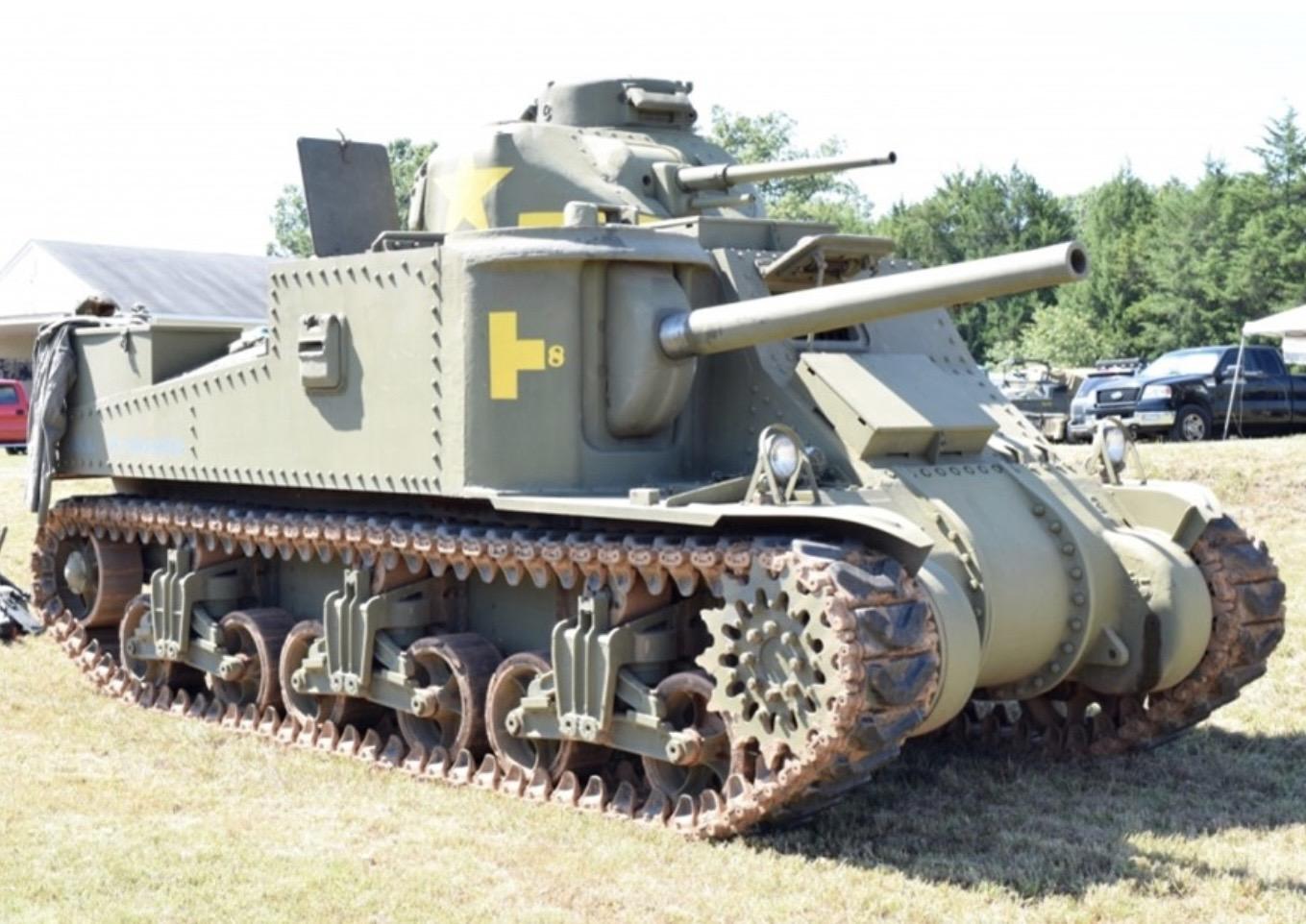
The M3 Lee was an American medium tank developed during the early years of the Second World War when the United States urgently needed a vehicle capable of mounting a powerful 75 mm gun. At the time American tank designers had not yet produced a turret large enough to hold such a weapon, so the design used an unusual arrangement where the 75 mm cannon was mounted in a sponson on the right side of the hull while a smaller 37 mm gun sat in a rotating turret on top. In American service the vehicle was named after Confederate general Robert E. Lee, while the British operated a modified version called the Grant, named after Union general Ulysses S. Grant.
The vehicle was designed in 1940 by engineers of the U.S. Army Ordnance Department working alongside several American industrial companies. The design evolved from the earlier M2 medium tank but was modified so it could carry the larger 75 mm weapon needed to deal with German armour and defensive positions. Development took place quickly because the United States expected to enter the war and required modern armoured vehicles as soon as possible. Because of this urgency the finished tank had a tall profile and somewhat awkward layout, yet it provided important firepower at a time when many Allied tanks were still undergunned.
Production began in 1941 and continued until late 1942. Around 6,258 were built in total. Several major American manufacturers took part in production including the Chrysler Corporation, Baldwin Locomotive Works, American Locomotive Company, Pullman Standard, and Pressed Steel Car Company. The project became one of the first examples of large scale American wartime tank manufacturing.
The vehicle had a crew of six men consisting of a commander, gunner, loader, driver, co-driver, and hull gunner. The commander and gunner operated from the turret with the 37 mm gun. The driver and co-driver sat in the front of the hull while the loader handled ammunition. The hull gunner aimed and fired the main 75 mm weapon mounted in the side of the hull.
The main armament was the 75 mm M2 or later M3 cannon mounted in the hull sponson. This gun was effective against fortified positions and early German tanks and could fire both high explosive and armour-piercing shells. A 37 mm M5 or M6 gun was installed in the turret and was mainly intended for engaging armoured vehicles and lighter targets. Several machine guns were also fitted. Normally there was a coaxial .30 calibre machine gun beside the 37 mm gun, another .30 calibre weapon in the hull, and sometimes additional machine guns for anti-aircraft or defensive purposes. The vehicle could carry thousands of rounds of machine gun ammunition along with around 46 rounds for the 75 mm cannon and roughly 128 rounds for the 37 mm gun depending on configuration.
Armour thickness varied across different areas. The front hull armour measured about 51 mm while the turret protection ranged between 38 and 51 mm. Side armour generally ranged from 32 to 38 mm. This level of protection was considered adequate during 1941 and early 1942 but gradually became less effective as stronger German anti-tank weapons appeared on the battlefield.
Power came from several possible engines depending on the version. The most common was the Wright R-975 radial aircraft engine producing about 400 horsepower. Some variants used diesel engines while others used a Chrysler multibank engine made from five car engines combined into a single power unit. Weight ranged between roughly 27 and 30 tons depending on the variant.
Maximum road speed was about 26 miles per hour, or roughly 42 kilometres per hour. Operational range was between 120 and 190 kilometres depending on terrain and fuel supply. These characteristics allowed it to operate effectively with mechanized formations and to cover large distances, particularly across the wide desert battlefields of North Africa.
Accuracy of the main weapons depended largely on crew skill and battlefield conditions. The 75 mm cannon had limited horizontal movement because it was mounted in the hull, so the entire vehicle often had to turn in order to aim. Despite this limitation it could accurately hit targets at distances of around 1,500 metres when properly aimed. The turret mounted 37 mm gun was easier to aim because the turret could rotate, allowing crews to track moving targets more effectively.
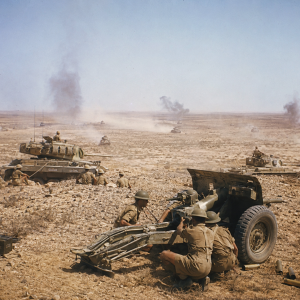
The tank first saw combat with British forces in North Africa during 1942. At that time many British tanks were equipped with smaller guns, so the powerful 75 mm weapon gave them the ability to fire strong high explosive shells against German anti-tank guns and defensive positions. This proved valuable during battles such as Gazala and the early fighting around El Alamein.
However there were several weaknesses. The vehicle stood about 3.1 metres tall, making it easier for enemy gunners to detect and hit. The side mounted main gun limited flexibility in combat situations, especially in confined terrain. In addition the riveted armour construction sometimes caused dangerous metal fragments inside the vehicle when struck by enemy shells.
The design was always intended as a temporary solution while engineers worked on a new tank with a fully rotating turret capable of mounting the same 75 mm gun. That successor became the M4 Sherman, which entered production in 1942 and soon replaced the earlier vehicle in frontline service.
Even though it was quickly superseded, the design played an important role during a crucial period of the war. It provided Allied forces with a tank capable of challenging German armour at a time when many other Allied vehicles were outdated. The experience gained during its production also helped American industry prepare for the massive manufacturing effort required for later wartime tanks.
Some vehicles were converted into specialized versions such as recovery vehicles, command tanks, and experimental self propelled artillery platforms. Others continued to serve in training or secondary duties after being replaced by more modern designs.
Several surviving examples are preserved in museums today. Although the design looks unusual compared with later tanks, it represents an important step in the rapid development of Allied armoured warfare during the early stages of the Second World War.