M22 Airborne Tank
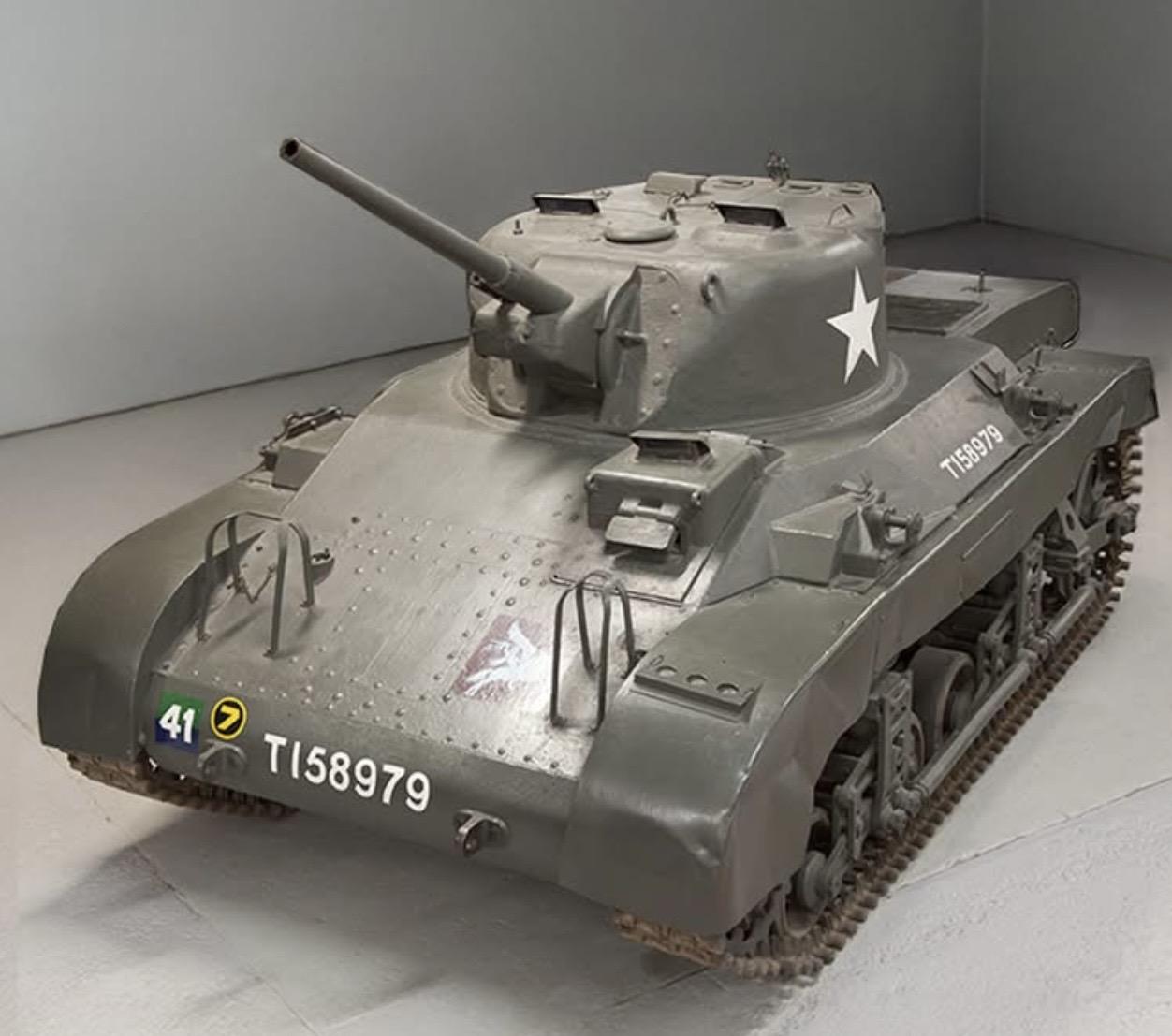
The M22 Locust was a very small airborne light tank developed during the Second World War to provide armored support to airborne troops. Its creation came from a growing belief among Allied planners that parachute and glider forces would need some form of armored protection once they landed behind enemy lines. Paratroopers could capture key objectives such as bridges or airfields, but without armor they were vulnerable to counter-attacks by enemy infantry, artillery, or tanks. British military planners in particular were concerned about this problem in the early years of the war and began searching for a way to deliver tanks by air alongside airborne troops.
By 1941 Britain was forming several airborne divisions and experimenting with large transport gliders capable of carrying heavy equipment. However, the British Army did not have a tank small enough to be transported in this way. The British War Office therefore approached the United States and asked if an extremely lightweight tank could be designed specifically for airborne operations. The United States agreed to develop such a vehicle and the project was taken up by the U.S. Ordnance Department.
The requirement called for a tank that was compact, light enough to be carried by aircraft or glider, and still capable of supporting infantry in combat. Several companies were invited to submit designs. Among those involved were General Motors, J. Walter Christie, and the Marmon-Herrington Company. After reviewing the proposals, the Ordnance Department selected the Marmon-Herrington design as the most promising. This design was given the experimental designation T9 Airborne Light Tank.
Development began during 1941. Engineers had to design the vehicle within extremely strict weight and size limits. The tank needed to be light enough to be transported by aircraft or carried inside a large assault glider. Some early concepts even involved carrying the tank suspended beneath large transport aircraft, although this method proved impractical. Eventually the main method envisioned for combat use became transport inside the British Hamilcar glider, one of the largest gliders used during the war.
The tank that emerged from this process was one of the smallest tanks fielded by the Allies during the war. It weighed about 7.4 tonnes and had a very compact hull and turret. The overall height was only about six feet, making it a small target on the battlefield but also creating cramped working conditions for the crew.
The crew consisted of three men. The driver sat in the front of the hull and controlled the vehicle. Inside the turret were the commander and the gunner. The commander also served as the loader for the main gun, meaning he had to direct the tank, observe the battlefield, and load ammunition during combat.
The main weapon of the M22 Locust was a 37 mm M6 cannon mounted in the turret. This was the same type of gun used on several early American light tanks. The gun could fire armor-piercing and high-explosive rounds and was effective against lightly armored vehicles, infantry positions, and field fortifications. It was paired with a .30 calibre Browning M1919A4 machine gun mounted coaxially with the main cannon. The tank usually carried about fifty rounds of ammunition for the main gun and several thousand rounds for the machine gun.
Because the tank had to remain extremely lightweight, its armor protection was very thin. Armor thickness ranged from roughly 9.5 mm to about 12.5 mm on most surfaces. This meant the vehicle could only protect its crew against small arms fire and shell fragments. Heavy machine guns, anti-tank rifles, and most anti-tank guns could penetrate its armor easily. The tank was never intended to fight heavily armored vehicles and instead was meant to provide mobile firepower in support of airborne infantry.
Power for the tank came from a Lycoming O-435 six-cylinder air-cooled petrol engine that produced about 165 horsepower. Even though this engine was not extremely powerful by tank standards, the vehicle’s low weight gave it good mobility. The Locust could reach speeds of around 40 miles per hour on roads and had an operational range of roughly 135 miles. The suspension system used vertical volute spring suspension, a common design used on several American tanks of the period.
After testing and development, the T9 design was officially standardized in 1943 as the M22 Light Tank. Production began soon afterward at the Marmon-Herrington company in the United States. The original production plans called for nearly 1,900 vehicles, but the order was reduced significantly as doubts began to appear about the tank’s effectiveness and usefulness.
In total, 830 M22 tanks were built between 1943 and early 1945. Although the tank had been designed and produced in the United States, the American Army ultimately decided not to use it in combat. Several airborne tank units were formed and trained with the vehicle, but American planners eventually lost confidence in the concept of airborne tanks and these units never saw combat with the M22.
The majority of the tanks were instead supplied to Britain through the Lend-Lease program. The British Army accepted them and gave the vehicle the name “Locust.” British airborne forces still believed that a tank delivered by glider could provide valuable firepower during airborne operations.
The British intended to use the Locust in combination with the large Hamilcar glider. This glider was capable of carrying vehicles, artillery, and other heavy equipment directly onto the battlefield. The tank would be loaded into the glider before takeoff, towed behind a transport aircraft, and released near the battlefield where it would land and unload.
Despite the promising concept, the M22 Locust had several weaknesses. Its thin armor and relatively weak 37 mm gun were already becoming outdated by the later stages of the war. Many German tanks and armored vehicles had thicker armor that the Locust’s gun struggled to penetrate. The vehicle also suffered from mechanical reliability issues and the logistics of transporting tanks by glider proved difficult and risky.
Because of these problems, the Locust saw very limited combat use. Its only significant combat deployment occurred during Operation Varsity in March 1945. This operation was the Allied airborne assault across the Rhine River into Germany. During the operation several British Locust tanks were carried into battle by Hamilcar gliders.
The landing was dangerous and some of the tanks were damaged during the glider landings. A few of the vehicles managed to reach their assigned positions and provide support for airborne infantry during the fighting, but the small number of tanks and the risks involved meant their impact was limited.
After the war the M22 Locust was quickly considered obsolete. Advances in tank design and the changing nature of airborne warfare made such small airborne tanks less useful. Many of the vehicles were scrapped, although a number survived in museums and collections.