M1907 Field Cap
Before the introduction of field-grey clothing, German soldiers wore uniforms that were colourful, highly distinctive and closely connected to their state, regiment and branch of service. Prussian infantrymen, for example, were generally associated with dark blue tunics, while the armies of Bavaria, Saxony, Württemberg and Baden maintained their own traditions and insignia. These uniforms looked impressive on parade but were increasingly unsuitable for a battlefield dominated by smokeless powder, rapid-firing artillery, machine guns and long-range rifles. Experiments with less conspicuous clothing eventually produced the greenish-grey colour known as feldgrau, which began appearing in experimental form in 1907 and was formally adopted more widely with the field uniform regulations of 1910.
The new Feldmütze was a simple, round, peakless cap intended for ordinary duties, resting, marching and occasions when the heavier leather Pickelhaube helmet was unnecessary. It was not designed to provide protection in battle, but it was lighter, more comfortable and easier to carry than the spiked helmet. Soldiers could fold it or place it inside their equipment when wearing the Pickelhaube or, later, the steel helmet. Period photographs frequently show German troops wearing their Feldmützen behind the lines, in billets, during training and while resting in trenches.
The cap was sometimes called the Krätzchen, a nickname that had been used for earlier German military forage caps. Its low cylindrical shape, flat or slightly rounded crown and absence of a peak made it instantly recognisable. Although modern sellers sometimes call it a “Feldmaster” cap, this is normally a misunderstanding or misspelling of Feldmütze, which simply means field cap.
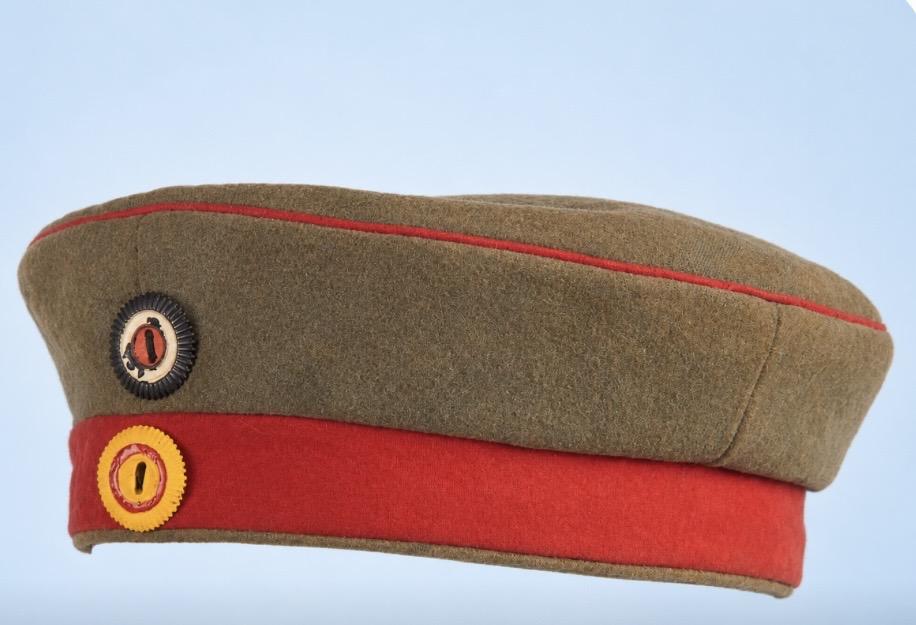
A typical M1907/10 infantry Feldmütze was manufactured from feldgrau wool cloth. The shade could vary considerably, ranging from a relatively green grey to a darker or more brownish grey. These variations occurred because of differences in cloth batches, dyes, manufacturers, storage conditions and wartime shortages. The crown was usually made from several shaped pieces of wool sewn together, with a coloured cloth band running around the lower part of the cap. Coloured piping was placed around the upper edge of the crown.
On the standard infantry version, the band and piping were red. The bright red trimming continued an older German tradition in which the colours of a cap helped identify the wearer’s branch of service. Other branches could have different colours. Jäger and rifle units were often associated with green, while artillery, pioneers and certain technical troops used darker or black distinctions. Consequently, the colour of the band is an important feature when identifying an original cap, although wartime replacement caps and privately purchased examples do not always conform perfectly to regulations.
Inside, the cap was commonly lined with cotton, linen or a similar lightweight fabric. Some examples have full linings, while others show simpler construction. The lining might carry an army clothing-depot stamp, size mark, date, manufacturer’s mark or regimental identification. However, many markings have faded or disappeared through wear, sweat, cleaning and more than a century of storage. The absence of a visible marking does not automatically mean that a cap is not genuine, although clear original markings can greatly increase its historical and financial interest.
The most important identifying features on the front were the two cockades. The upper cockade was the Reichskokarde, representing the German Empire. It carried the imperial colours of black, white and red. Directly beneath it was the state cockade, showing the German state from which the soldier or his unit originated. This arrangement reflected the unusual organisation of Imperial Germany, which was a united empire but still contained kingdoms, grand duchies, duchies and principalities with their own military traditions.
A Baden Feldmütze carried the distinctive red and yellow cockade of the Grand Duchy of Baden. The precise appearance can vary slightly according to the material and period of manufacture, but Baden’s colours were yellow and red. On an original cap, the Baden cockade was normally positioned on the coloured band, with the imperial cockade immediately above it on the feldgrau crown. The cockades were commonly made from stamped and painted metal, although embroidered cloth examples and privately purchased variations are also encountered.
These cockades were more than decorative badges. They identified the wearer’s allegiance both to the German Empire and to his home state. A soldier from a Baden regiment therefore served the emperor as part of the Imperial German Army while continuing to wear the colours and traditions of Baden. This state identity remained important throughout the war, particularly in regimental titles, uniform distinctions, recruiting areas and military administration.
Baden troops formed part of the Prussian-led army structure, with most of the grand duchy’s units serving within the XIV Army Corps. The corps was strongly associated with Baden and recruited heavily from the region. Among its best-known formations were Baden infantry, grenadier, dragoon, artillery and pioneer regiments. A red-banded Feldmütze with a Baden cockade would most commonly have been worn by an infantry soldier from one of these Baden formations.
Regiments associated with Baden included the 1st Baden Leib-Grenadier Regiment No. 109, the 2nd Baden Grenadier Regiment Kaiser Wilhelm I No. 110, the 3rd Baden Infantry Regiment Markgraf Ludwig Wilhelm No. 111, the 4th Baden Infantry Regiment Prinz Wilhelm No. 112, the 5th Baden Infantry Regiment No. 113 and the 6th Baden Infantry Regiment Kaiser Friedrich III No. 114. Further Baden infantry regiments were raised or incorporated as the army expanded. The exact regiment of a cap can sometimes be established through ink stamps inside the lining, although these must be studied carefully because depot marks and later collector additions can be confused with genuine regimental markings.
One surviving 1914-dated example has been associated with the 4th Baden Infantry Regiment Prinz Wilhelm No. 112. Such an attribution makes a cap particularly desirable because it connects an otherwise anonymous item of clothing to a specific regiment. However, collectors should be cautious when accepting claims based only on loose labels or undocumented stories. A clear period stamp, known provenance or an accompanying photograph offers much stronger evidence.
The cap was worn by ordinary enlisted soldiers and non-commissioned officers. Officers generally purchased better-quality versions of their uniforms and headgear privately, and their caps could be made from finer wool with improved linings and higher-quality cockades. Officers were more commonly seen in peaked service caps, but field and privately purchased variations existed. Consequently, two caps made to represent the same state and branch can differ considerably in shape, cloth and finish.
There was no single national factory responsible for manufacturing every M1907/10 Feldmütze. The enormous Imperial German Army obtained clothing through a broad system of state clothing depots, military workshops and civilian contractors. Established uniform makers, tailoring companies and regional clothing manufacturers produced caps under government contracts. Army clothing depots then inspected, marked and distributed them to units. Some caps were also produced or altered by regimental tailors, while officers and wealthier soldiers could buy privately manufactured examples.
This decentralised production explains why original caps are not completely uniform. Small differences can be found in the height of the crown, width of the band, thickness of the piping, stitching, lining material and shape of the top. A cap made by one contractor in 1911 may look noticeably different from one manufactured by another company in 1915. Wartime economy measures created even greater variation as experienced workers, quality dyes and suitable cloth became more difficult to obtain.
When the First World War began in August 1914, German soldiers marched to war wearing the field-grey uniform and the colourful M1907/10-style cap. The red band and piping were still prominent, especially when seen from a distance. Although far less conspicuous than the pre-war blue uniform, these coloured distinctions were not ideal for modern warfare. Mud, dust, rain and prolonged wear often dulled the colours naturally, while some soldiers used field-made covers or acquired later caps with reduced ornamentation.
The Feldmütze remained widely used throughout the war, but its design and colouring were progressively simplified. By 1915 and 1916 the German Army faced severe shortages of high-quality wool and dye. Substitute materials appeared, shades became less consistent and construction standards declined. Caps made later in the war can therefore have coarser cloth, cheaper linings and less careful stitching than pre-war examples.
A more subdued universal field cap was introduced in 1917. This version was generally produced in plain feldgrau, often with a dark green band rather than the brightly coloured branch bands of earlier caps. The change reduced the range of coloured materials required and made the cap less visible in the field. The older red-banded infantry caps did not disappear immediately. Existing stocks continued to be worn, particularly by replacement units, depot troops, men serving away from the front and soldiers who had not yet received the newer pattern.
For this reason, it is possible to see M1907/10-style caps in photographs taken late in the war. German military clothing was not replaced everywhere on a single date. A cap issued in 1914 could remain in service for years if it was still usable, while rear-area troops might continue receiving older items after front-line units had moved to simplified equipment. The colourful cap can therefore be associated with the whole 1914–18 period, although it is most characteristic of the opening and middle years of the conflict.
After the Armistice of 11 November 1918 and the collapse of the German Empire, the imperial and state cockade system lost its official purpose. The monarchy in Baden ended when Grand Duke Frederick II abdicated in November 1918. The small post-war German armed forces adopted different uniforms and insignia, although older imperial clothing continued to appear temporarily among demobilised soldiers, volunteer formations and veterans.
Original Baden M1907/10 Feldmützen are now highly collectable. Imperial German cloth headgear is far less likely to survive than metal helmets, bayonets or badges because wool is vulnerable to moth damage, damp, sweat, sunlight and poor storage. Many caps were worn until they became unusable, converted for civilian purposes, discarded after the war or destroyed during the political upheavals and bombing of the following decades.
The presence of both original cockades is extremely important. Cockades were small, easily removed and frequently lost. They were also collected as souvenirs, meaning that many surviving caps are now missing one or both. Replacement cockades are widely available, and some original caps have been fitted with incorrect state cockades to make them appear rarer. A cap with stitching, wear and cockades that have clearly remained together for many years is generally more desirable than one that appears recently assembled.
The Baden cockade gives the cap additional interest because Baden material is encountered less frequently than Prussian equipment. Prussia supplied the largest part of the Imperial German Army, so Prussian cockades and marked items are naturally more common. A well-preserved cap with genuine Baden and imperial cockades, a readable depot mark and a regimental stamp can command considerable attention from serious collectors.
Condition has a major effect on value. Light moth tracking, small holes and faded lining marks are common and may be acceptable on a genuine wartime cap. Extensive restoration, replaced cloth, modern stitching or added insignia will reduce its desirability. Collectors usually prefer an honest, untouched cap showing normal service wear rather than a heavily repaired example made to look perfect.
The smell, feel and colour of old wool are sometimes considered by experienced collectors, but they should never be treated as proof on their own. Modern reproductions can be artificially aged, stained and damaged. The construction should be compared with accepted originals, paying particular attention to the weave of the wool, stitching thread, seams, lining, shape, cockade attachment and markings. Ultraviolet light can sometimes reveal modern fibres or dyes, although this test is not infallible.
Regimental markings are especially valuable when they can be verified. A marking may contain an abbreviation for a clothing depot, regiment, battalion or company, together with an issue date and size. The cap might then be connected to a particular Baden regiment and, through surviving regimental histories, to the campaigns in which that unit fought. Baden formations served on both the Western and Eastern Fronts and took part in many of the major operations of the war.
An original cap should not normally be cleaned aggressively. Water, detergents and modern chemicals can damage old wool, dissolve markings and cause colours to run. Cockades should not be polished because this can remove their original paint and patina. The safest storage method is generally in a stable, dry environment, supported so that the crown does not collapse and protected from moths, direct sunlight and excessive handling.
The M1907/10 Feldmütze may appear to be a modest item compared with the famous Pickelhaube or Stahlhelm, but it tells an equally important story. Its field-grey cloth represents Germany’s reluctant acceptance that modern war required camouflage and practicality. Its bright red infantry band preserves the colourful traditions of the nineteenth-century army, while its two cockades reveal the complicated relationship between the German Empire and its individual states.