On this day in military history…
On 18 July 1944, the fields and villages east of Caen were shaken by one of the greatest concentrations of Allied air and armoured power seen during the Normandy campaign. Operation Goodwood was the latest British attempt to break the stubborn German defensive line around Caen, draw enemy armoured divisions into battle and create the conditions for the Allied armies to escape from the confined Normandy bridgehead. It developed into the largest British tank operation of the campaign and one of the biggest armoured battles fought in Normandy.
Caen had been one of the principal British objectives on D-Day, 6 June 1944. The city dominated the road network of eastern Normandy and controlled routes leading south towards Falaise and the open country beyond. British and Canadian forces had intended to capture it quickly, but strong German resistance prevented them from doing so. Instead, the fighting around Caen developed into a prolonged struggle involving infantry, tanks, artillery and aircraft.
The terrain east and south of Caen was generally more suitable for armoured movement than the dense hedgerow country facing the Americans farther west. However, this apparent advantage was deceptive. The open fields offered long lines of fire to German anti-tank guns, while villages built of thick stone could be turned into strongpoints. Railway embankments, minefields, sunken roads and industrial areas created additional obstacles. To the south, the dominating ground of the Bourguébus Ridge provided the Germans with excellent observation over the approaches from Caen.
By the middle of July, the northern part of Caen had fallen following Operation Charnwood, but German forces still held the southern districts and the high ground beyond the city. Field Marshal Bernard Montgomery, commanding the Allied ground forces in Normandy, wanted to maintain pressure on the Germans in the east. Lieutenant-General Miles Dempsey, commander of the British Second Army, proposed a major armoured thrust from the bridgehead east of the River Orne.
The operation was entrusted to Lieutenant-General Richard O’Connor’s VIII Corps. O’Connor was one of Britain’s most experienced armoured commanders and had achieved major victories against the Italians in North Africa during the opening years of the war. For Goodwood, he was given three British armoured divisions: the 11th Armoured Division, the Guards Armoured Division and the 7th Armoured Division, better known as the Desert Rats.
The plan called for the British armour to pass through the narrow Orne bridgehead established by the airborne forces on D-Day. The tanks would then advance south across the Caen plain towards Cagny, Vimont and the Bourguébus Ridge. The 11th Armoured Division would lead the attack, followed by the Guards Armoured Division and the 7th Armoured Division.
On the western flank, Canadian forces launched Operation Atlantic to clear the remaining German positions in southern Caen and capture the industrial area of Colombelles. The British 3rd Infantry Division protected the eastern side of the armoured advance. These supporting operations were essential because the tanks could not safely advance while strong German forces remained on either flank.
Goodwood was unusual because the armoured divisions were expected to lead the assault rather than closely following infantry formations. British infantry losses in Normandy had been severe, and Montgomery was increasingly concerned about preserving trained infantrymen. Tanks were more readily replaceable than experienced soldiers, but committing armour in such strength also carried considerable risks.
The offensive was supported by an extraordinary concentration of air power. During the early hours of 18 July, waves of RAF and United States Army Air Forces aircraft appeared over the battlefield. Heavy and medium bombers attacked German headquarters, gun positions, villages and defensive areas along the planned route of the advance. More than 2,000 Allied aircraft were involved in the overall air plan, including hundreds of RAF heavy bombers.
Lancasters and Halifaxes dropped thousands of tons of high explosive bombs on German positions around Cagny, Émiéville, Cuverville, Colombelles and the southern approaches to Caen. American heavy bombers attacked positions farther south, while medium bombers struck additional targets. Fighter-bombers were prepared to intervene once the ground battle began.
The sight and sound of the bombardment was overwhelming. The sky filled with aircraft while the ground disappeared beneath great clouds of smoke, dust and flame. Entire areas were churned by explosions, communications were cut and some German units were temporarily stunned. Vehicles were overturned, gun positions were buried and headquarters lost contact with their troops.
The bombing caused serious disruption, particularly among elements of the 16th Luftwaffe Field Division and the 21st Panzer Division. Some German tanks, assault guns and artillery pieces were destroyed or damaged before the British advance began. However, the bombardment did not eliminate the German defences. Many troops survived in slit trenches, dugouts and fortified positions, while several important anti-tank gun lines were either missed or recovered quickly.
One difficulty was that the bombing created enormous craters and piles of rubble, which obstructed the advance of the British tanks. Dust and smoke reduced visibility, making navigation difficult. The ground forces were also forced to wait until the final waves of aircraft had cleared before moving into the bombed area, giving surviving German defenders some time to recover.
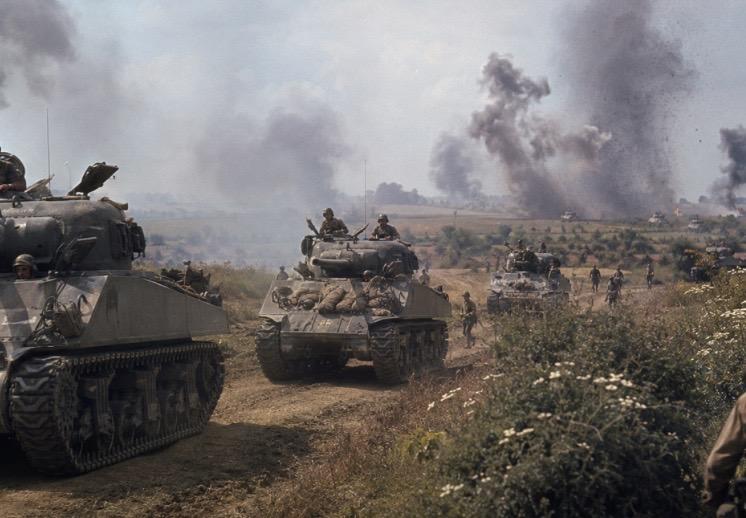
At around 7.45 in the morning, the leading tanks of the 11th Armoured Division began their advance. Among them were Sherman tanks, including Sherman Fireflies armed with the powerful British 17-pounder gun, and Cromwell tanks used by armoured reconnaissance units. Specialist vehicles, engineers and artillery followed behind.
Before reaching open country, the entire attacking force had to pass through a restricted corridor containing bridges over the Orne River and Caen Canal. The movement of hundreds of tanks, vehicles and guns through this confined area caused serious congestion. Minefields and railway crossings slowed the advance further, while some supporting artillery and infantry units struggled to keep pace.
The 11th Armoured Division nevertheless made impressive early progress. Its leading units passed through the battered German forward positions and advanced several miles. The village of Cagny became one of the key points on the battlefield. Although it had been heavily bombed, German anti-tank guns remained active in and around the village.
A group of German 88mm guns near Cagny opened fire on the advancing British tanks. The famous 88mm weapon had originally been designed as an anti-aircraft gun but had proved devastating against armour. From concealed or protected positions, its crews could destroy Allied tanks at long range.
British tanks were knocked out as they crossed the open fields. Some attempted to manoeuvre around Cagny, while others returned fire or called for artillery support. The village and its surrounding gun positions delayed the advance and forced the British armoured regiments into a series of costly local battles.
Farther south, the leading elements of the 11th Armoured Division reached the area around Bras, Hubert-Folie and Soliers. For a time, it appeared that the scale of the bombing and the speed of the armoured advance might cause the German line to collapse. British tanks had penetrated much farther than in many previous attacks around Caen.
The Germans, however, had constructed a defence in depth. Rather than relying upon one continuous front line, they had positioned anti-tank guns, infantry strongpoints and armoured reserves across several defensive belts. The villages south of Caen had been prepared for defence, while guns on and around the Bourguébus Ridge commanded the open ground below.
The German defenders included elements of the 21st Panzer Division, the 1st SS Panzer Division Leibstandarte SS Adolf Hitler and other formations available to Panzer Group West. Tanks and assault guns were brought forward to meet the British advance. Panthers, Panzer IVs and Tiger tanks were used alongside towed anti-tank guns and self-propelled weapons.
The British crews found themselves advancing across exposed ground against an enemy who often remained concealed until the tanks entered effective range. German Panthers possessed powerful long-barrelled 75mm guns capable of penetrating a Sherman’s armour at considerable distance. Tiger tanks, armed with the 88mm gun and protected by heavy armour, were even more dangerous.
The Sherman Firefly gave British units an effective answer to the German heavy tanks. Its 17-pounder gun could destroy Panthers and Tigers, but Fireflies were normally distributed in limited numbers among troops of standard 75mm Shermans. German crews quickly learned to identify the longer gun barrel and distinctive appearance of the Firefly and often attempted to destroy it first.
As the leading British units approached the Bourguébus Ridge, German resistance intensified. Anti-tank fire struck the advancing formations from several directions. Tanks burned in the fields, sending tall columns of black smoke into the sky. Crews who escaped from disabled vehicles had to seek cover while artillery and machine-gun fire swept the open ground.
The Guards Armoured Division followed the 11th Armoured Division into the battle but suffered from congestion and delays along the narrow approach routes. By the time its tanks reached the main battlefield, the Germans were recovering from the bombing and strengthening their defences. The Guards advanced towards Cagny and Vimont but encountered minefields, anti-tank guns and determined resistance.
The 7th Armoured Division entered the operation later. The famous Desert Rats had considerable experience of mobile warfare in North Africa, but Normandy presented a very different battlefield. Movement was restricted, German positions were difficult to locate and the armoured formations had limited room in which to manoeuvre.
The narrow frontage contributed greatly to Goodwood’s difficulties. Hundreds of tanks were channelled through a relatively confined area, making it difficult for commanders to deploy their full strength. The leading divisions blocked routes needed by those behind them, while damaged tanks and vehicles created additional congestion.
Communication between tanks, infantry, artillery and aircraft was also imperfect. Some British tanks advanced beyond the effective support of their infantry. Once separated from accompanying soldiers, armour became vulnerable to concealed anti-tank guns, Panzerfausts and German infantry occupying villages and field positions.
Despite these problems, the British advance forced the Germans to commit powerful armoured formations to the battle. German commanders could not ignore the threat to the Bourguébus Ridge and the roads leading towards Falaise. Tanks, assault guns and reinforcements that might otherwise have been sent west against the Americans were retained around Caen.
Fighting continued throughout 18 July and into the following two days. British and Canadian infantry cleared additional districts of Caen and captured ground south of the River Orne. The armoured divisions attempted to improve their positions and overcome German strongpoints, but the opportunity for a rapid breakthrough had passed.
Heavy rain arrived on the evening of the first day, turning dust into mud and making movement more difficult. It also reduced the ability of Allied aircraft to provide the same level of close support. Without clear skies, one of the Allies’ greatest advantages was temporarily weakened.
On 19 July, attacks continued around Bras, Hubert-Folie, Bourguébus and the surrounding villages. The Germans launched local counter-attacks while strengthening the ridge. British artillery inflicted losses on German concentrations, but the tanks could not secure the dominating high ground.
Canadian forces made important progress during Operation Atlantic, capturing much of southern Caen and pushing towards Verrières Ridge. Their advance was also met by strong German resistance. The fighting south of Caen would continue after Goodwood and lead to further costly Canadian operations against the Verrières position.
By 20 July, Operation Goodwood was coming to an end. British forces had advanced approximately seven miles at their furthest point, secured additional ground east and south of Caen and seriously disrupted the German defensive system. However, the Bourguébus Ridge remained largely in German hands and there had been no decisive breakout towards Falaise.
British tank losses were substantial. The precise number has been debated because many damaged tanks were recovered and repaired, while others were complete losses. Several hundred tanks were temporarily put out of action during the operation, although a significant number later returned to service. The 11th Armoured Division suffered particularly heavily during the first day.
The German forces also suffered serious losses in men, equipment and defensive positions. The enormous bombing raids caused destruction that could not easily be replaced, and German armoured units were forced to remain committed around Caen. At this stage of the war, Germany had far greater difficulty replacing tanks, trained crews, guns and fuel than the Allies.
Operation Goodwood became controversial almost immediately. Some observers believed Montgomery had intended to achieve a major breakout and that the operation had failed because the armoured divisions did not reach Falaise. Montgomery later described Goodwood as a more limited operation intended to gain ground, reduce German strength and keep enemy armour concentrated in the east.
The orders and statements issued before the attack have allowed historians to argue both sides. Senior commanders spoke of using armoured power boldly and taking advantage of any German collapse, but the operation also had clear limited objectives connected with securing Caen and the Bourguébus area. It is possible that Montgomery hoped for a breakthrough if conditions allowed while accepting that the minimum result would be to draw German armour into a destructive battle.
Judged solely as an attempt to seize the Bourguébus Ridge and break into open country, Goodwood did not achieve all its objectives. The Germans retained important high ground, and the British armoured divisions suffered painful losses. The preliminary air attack, despite its unprecedented scale, had not destroyed the defence in sufficient depth to permit an uncontested advance.
Yet the operation cannot be understood by looking only at the ground captured. The British and Canadians had fixed the majority of the German armoured strength in Normandy around Caen. The Germans continued to believe that the main Allied breakout attempt would come from the eastern sector and were compelled to keep powerful formations facing Montgomery’s armies.
This was of enormous importance to the Americans preparing Operation Cobra near Saint-Lô. When the United States First Army launched its offensive on 25 July, the Germans had few armoured reserves available to stop it. The American breakthrough opened the road into Brittany and central France and eventually forced the German armies in Normandy into a desperate retreat.
Goodwood therefore played an important part in the wider Allied strategy. It inflicted pressure on German forces, completed much of the capture of Caen and prevented enemy commanders from shifting their strongest formations westward at the crucial moment. The British tank crews who advanced across the Caen plain fought one of the hardest armoured battles experienced by the British Army during the Second World War.
For the men inside the tanks, strategic arguments meant little. Sherman, Cromwell and Firefly crews entered a battlefield filled with dust, bomb craters, wrecked vehicles and burning villages. Many faced German guns that could destroy their tanks before they were close enough to identify the enemy position. Drivers attempted to find routes through minefields, commanders stood exposed in their turrets to navigate, and wireless operators struggled to maintain contact amid the confusion.
The huge air bombardment that opened Goodwood demonstrated the Allies’ growing ability to concentrate air and ground power on a single battlefield. It also revealed the limitations of strategic bombers when used against deeply prepared tactical positions. Bombing could stun defenders, destroy equipment and tear apart communications, but it could not guarantee that every concealed gun or dugout would be eliminated.
Operation Goodwood ended without the dramatic armoured breakthrough its planners may have hoped to exploit, but it changed the battle around Caen and contributed to the eventual collapse of the German position in Normandy. It remains remembered for the extraordinary sight of hundreds of British tanks advancing beneath a sky filled with Allied aircraft and for the violent confrontation that followed on the approaches to Bourguébus Ridge.
Beginning on 18 July 1944 and continuing for three days, Goodwood brought together enormous numbers of tanks, guns, aircraft and men in a confined area east of Caen. It was the greatest British armoured assault of the Normandy campaign and marked the beginning of one of the largest tank battles fought on French soil. Although costly and incomplete in its immediate achievements, it helped hold Germany’s strongest armoured formations in place while the Americans prepared the blow that would finally break open the Normandy front.