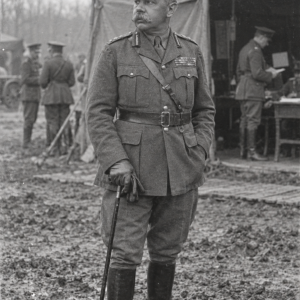
Brigadier General Henry Timson Lukin
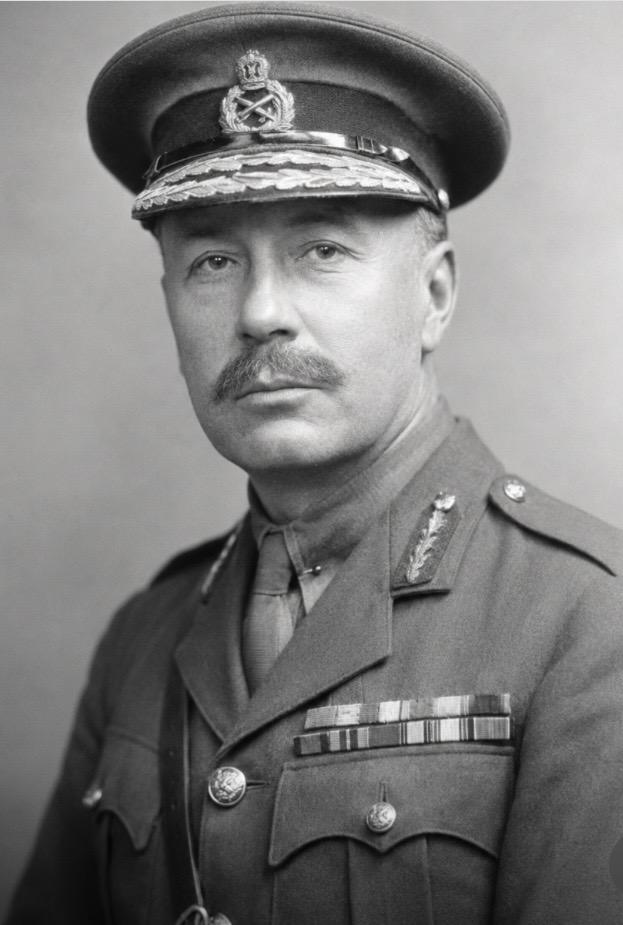
Major-General Sir Henry Timson Lukin was one of the most experienced and respected South African commanders of the First World War, a soldier whose long career stretched from the colonial campaigns of the late nineteenth century to the terrible fighting on the Western Front. Best remembered as the commander of the 1st South African Infantry Brigade at Delville Wood, he had already spent more than thirty years in uniform before leading South African troops into one of the most famous and costly battles in their country’s military history.
Henry Timson Lukin was born at Fulham in London on 24 May 1860, the only son of Robert Henry Lukin, a barrister associated with the Inner Temple. Known to his family and friends as Harry or Tim, he was educated at Merchant Taylors’ School and hoped to follow the military traditions of his family by entering the Royal Military College at Sandhurst. He was unsuccessful in the entrance examination, but this disappointment did not end his determination to become a soldier. He received instruction in riding and military subjects before deciding to seek a career in southern Africa, where conflict along the frontiers offered opportunities to young men prepared to endure the hardships of colonial campaigning.
In January 1879, at the age of eighteen, he sailed from Southampton for South Africa aboard the Union Mail steamer Nyanza. He arrived during the Anglo-Zulu War and obtained a commission as a lieutenant in Bengough’s Horse, a locally raised mounted unit. Although still a very young and inexperienced officer, he soon found himself on active service. He took part in the closing stages of the campaign and was seriously wounded during the Battle of Ulundi on 4 July 1879, when the main Zulu army was defeated by the British square commanded by Lord Chelmsford. His survival and return to duty marked the beginning of a reputation for personal courage and resilience that would remain with him throughout his career.
After recovering from his wounds, he continued serving in southern Africa. In March 1881 he joined the Cape Mounted Riflemen, a permanent colonial regiment that combined the mobility of mounted infantry with the discipline of a regular force. The regiment frequently operated in difficult and remote country, and its officers were expected to understand horsemanship, fieldcraft, scouting, signalling and the movement of small columns over great distances. He took part in the Basutoland Gun War of 1880–81, gaining further experience in the demanding conditions of frontier warfare.
The Cape Mounted Riflemen became the centre of his military life. He developed into a capable organiser and a particularly knowledgeable artillery and signalling officer. In 1893 he travelled to Britain to attend specialist gunnery and signalling courses at Woolwich and Shoeburyness. The training gave him a more professional understanding of modern weapons, communications and battlefield organisation at a time when many colonial officers still depended heavily upon practical experience rather than formal military education. He was promoted to captain in 1894 and later participated in operations connected with the Bechuanaland campaign of 1897.
When the Second Boer War began in October 1899, he went into the field with the Cape Colonial forces. He commanded the artillery and signalling elements of the Cape Mounted Riflemen and served with the Colonial Division during operations in the Cape Colony and the Orange Free State. One of his most notable actions came during the defence of Wepener in April 1900, when a mixed colonial force under Colonel Edmund Dalgety was surrounded by Boer commandos at Jammersberg Drift.
For more than two weeks the defenders endured rifle fire, artillery bombardment, rain, cold and shortages of supplies. His handling of the colonial artillery helped support the defence and prevent the Boer forces from overwhelming the position. The stubborn resistance at Wepener tied down substantial enemy forces until relief arrived. His conduct during the campaign brought him recognition as a determined and dependable battlefield commander, and he was subsequently awarded the Distinguished Service Order.
On 13 October 1900 he was appointed commanding officer of the Cape Mounted Riflemen with the rank of lieutenant-colonel. He later served as second-in-command of Colonel Henry Scobell’s mobile column, which hunted Boer commandos across the Cape. He was mentioned by Lord Kitchener for gallantry during an attack on a Boer laager in June 1901 and later commanded a column associated with Lieutenant-Colonel George Gorringe. By the end of the war he had become one of the most prominent officers in the Cape Colonial forces.
For his services during the conflict he was appointed a Companion of the Order of St Michael and St George. In 1904 he became Commandant-General of the Cape Colonial Forces with the rank of colonel. His responsibilities now extended far beyond commanding troops in the field. He was involved in training, administration, mobilisation planning and the difficult process of bringing colonial military organisations into a more modern and unified system.
The creation of the Union of South Africa in 1910 brought together the Cape Colony, Natal, the Transvaal and the Orange River Colony. He commanded the military escort at the opening of the first Union Parliament and in 1911 led the South African military contingent sent to Britain for the coronation of King George V. These ceremonial duties reflected the high regard in which he was held, but his greatest responsibilities were still to come.
On 1 July 1912 he was appointed Inspector-General of the Permanent Force of the newly created Union Defence Force, holding the rank of brigadier-general. He played an important part in establishing standards of discipline and training within the new South African military organisation. The task was politically sensitive because the country remained deeply divided following the Second Boer War. English-speaking South Africans and Afrikaners had fought against each other only a decade earlier, and building a force in which both could serve required patience, diplomacy and professional authority.
When the First World War began in August 1914, the South African government agreed to undertake operations against neighbouring German South West Africa. He was given command of a force that included units of the South African Mounted Rifles. The early campaign did not go according to plan. At Sandfontein on 26 September 1914, a South African force operating in an isolated position was surrounded by German colonial troops. After a determined defence and the exhaustion of much of its ammunition and water, the South African detachment was forced to surrender.
Sandfontein was one of the most serious early reverses suffered by South Africa during the campaign and became a controversial episode in his career. The defeat resulted from a mixture of inadequate intelligence, divided command arrangements, difficult terrain, poor communications and the decision to expose troops too far from reliable support. Although he did not personally command the surrounded detachment during the final action, his wider responsibility for the deployment meant that the disaster remained associated with his name. It was a painful lesson in the dangers of extending forces across the immense and waterless distances of South West Africa.
The campaign was further complicated by the Maritz Rebellion, when a number of Afrikaner officers and former Boer fighters rose against the South African government. He participated in operations against the rebels during the final months of 1914. Once the rebellion had been suppressed, the campaign against German South West Africa resumed under the leadership of General Louis Botha and General Jan Smuts. German resistance finally collapsed in July 1915, and he was placed in command of troops involved in the demobilisation process.
His experience and reputation led to his appointment on 11 August 1915 as commander of the newly formed 1st South African Infantry Brigade. The brigade was composed of four infantry battalions raised from volunteers across the Union. The 1st Regiment recruited largely from the Cape, the 2nd from Natal and the Orange Free State, the 3rd from the Transvaal and Rhodesia, while the 4th South African Infantry, known as the South African Scottish, drew heavily upon men with Scottish connections. Because South African law restricted the use of the Union Defence Force outside southern Africa, the volunteers enlisted separately for overseas service and served under British operational command.
He took the brigade to Britain in 1915, where the men trained before being sent to Egypt. There they joined operations against the Senussi, a religious and political movement encouraged by the Ottoman Empire and Germany to attack British-controlled Egypt from the Western Desert. He briefly acted as commander of the Western Frontier Force in February 1916 and directed operations that helped drive the Senussi away from the Egyptian coastal region. His South Africans fought at Agagia on 26 February 1916, where British and South African troops defeated the main Senussi force and captured its commander, Jaafar Pasha.
The desert campaign provided valuable active-service experience, but the brigade was soon required for a far more brutal theatre of war. In April 1916 it sailed from Alexandria, landed at Marseille and travelled north to join the 9th (Scottish) Division on the Western Front. Within a few months he and his men would become permanently associated with Delville Wood.
The Battle of the Somme had begun on 1 July 1916. During the second major phase of the offensive, British forces attempted to capture the high ground around the villages of Longueval and Bazentin. Delville Wood, immediately east of Longueval, formed a vital part of the German defensive position. Unless it was secured, German troops could use the trees, trenches and concealed machine-gun positions to threaten the British flank.
On 14 July he received orders for the 1st South African Infantry Brigade to capture and hold the wood. Brigadier-General William Furse, commanding the 9th Division, instructed him that the position was to be held at all costs. He passed the responsibility for the direct defence of the wood to Lieutenant-Colonel William Tanner of the 2nd South African Infantry, while maintaining brigade headquarters outside the most heavily contested area and attempting to coordinate reinforcements, ammunition and communications.
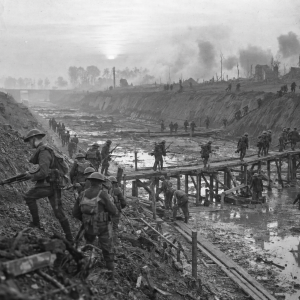
The South Africans entered Delville Wood on 15 July and initially occupied much of it, but the Germans quickly counter-attacked. For nearly a week the wood was swept by artillery fire of extraordinary intensity. Trees were shattered into splinters, trenches collapsed and paths disappeared beneath shell holes and bodies. German infantry attacked from several directions, often reaching close enough for grenades, bayonets and hand-to-hand fighting.
Telephone lines were repeatedly cut, runners were killed and reliable communication became almost impossible. He struggled to obtain accurate information about the condition of his battalions while trying to send forward water, ammunition and reinforcements. The men inside the wood were gradually reduced to isolated groups holding fragments of trenches among the broken trees. Despite enormous losses they prevented the Germans from completely recovering the position.
When the surviving South Africans were finally relieved on 20 July, the brigade had been devastated. Of approximately 3,150 officers and men who had entered the battle, only about 750 emerged when the brigade was assembled afterwards, although the exact figures vary according to how casualties and attached personnel are counted. He stood as the remnants marched past him. Contemporary accounts described him as visibly overcome by the sight of the exhausted and wounded survivors of the formation he had trained and led from South Africa.
Delville Wood became a defining event in South African military history. It was remembered not simply as a battle but as a national ordeal in which men from different provinces and backgrounds fought together under the Springbok emblem. His order to hold the wood was carried out with extraordinary determination, although later historians have debated the tactical value of keeping badly depleted troops in such an exposed position for so long. The decision was influenced by the wider demands of the Somme offensive and by orders from divisional command rather than by him alone.
Despite the destruction of his brigade, his leadership and the endurance of the South Africans brought him considerable recognition. In November 1916 he was promoted to temporary major-general and appointed General Officer Commanding the 9th (Scottish) Division. This was a notable achievement for an officer whose career had begun in a locally raised mounted unit during the Zulu War. He was now responsible for a British division containing several experienced Scottish formations as well as the South African Brigade.
Under his command the 9th Division fought during the difficult operations of 1917, including phases of the Arras offensive and the fighting in Flanders. Divisional command required him to direct infantry, artillery, engineers, transport and supply services across a battlefield dominated by heavy guns, machine guns, mud and complex communications. It was a very different form of warfare from the mounted colonial campaigns in which he had learned his profession, yet his promotion demonstrated the confidence placed in his ability.
For his wartime services he was appointed a Knight Commander of the Order of the Bath, giving him the title Sir Henry Lukin. He was also made a Chevalier of the French Legion of Honour and received the Egyptian Order of the Nile. In April 1918 he left the Western Front and took command of the 64th (2nd Highland) Division in Britain. The division was involved primarily in home defence and training duties rather than front-line operations.
He retired from military service shortly after the war, bringing to an end a career that had lasted approximately forty years. He had risen from a teenage lieutenant in a colonial mounted unit to the rank of major-general and command of a British infantry division. His service had taken him through the Anglo-Zulu War, the Basutoland Gun War, the Bechuanaland operations, the Second Boer War, the German South West Africa campaign, the Egyptian desert and the battlefields of France and Flanders.
He eventually returned to South Africa and remained closely connected with veterans and military affairs. In 1921 he became the first president of the South African branch of the British Empire Service League, an organisation established to support former servicemen and their families. He also served as deputy chairman of the Delville Wood Memorial Committee, helping to preserve the memory of the men who had fought and died under his command.
The memorial at Delville Wood in France became one of South Africa’s most important sites of remembrance. His involvement carried considerable emotional weight because he had personally witnessed the creation and destruction of the brigade whose sacrifice the memorial represented. He also served as a member of the South African Defence Council and in 1924 became president of a commission appointed to investigate defence organisation.
The disbandment of the Cape Mounted Riflemen, the regiment with which he had spent so much of his life, affected him deeply. To him it represented the disappearance of a military institution that had shaped both his character and his career. Even after reaching general officer rank, he retained a powerful attachment to the regiment and to the men with whom he had served during the earlier campaigns of southern Africa.
Sir Henry Timson Lukin died at his home in the Cape Peninsula on 15 December 1925, aged sixty-five. He was buried in the military section of Plumstead Cemetery near Cape Town. Many of the men involved in his funeral had served in the Cape Mounted Riflemen, providing a final link with the regiment that had dominated his professional life.
His reputation rests above all upon Delville Wood, but his career was far broader than that single battle. He experienced both victory and defeat, from being wounded at Ulundi and decorated after Wepener to facing criticism following Sandfontein and witnessing the destruction of the South African Brigade on the Somme. He was not untouched by controversy and, like many commanders of the First World War, he was required to carry out operations in which determined soldiers suffered appalling losses for limited gains.
Nevertheless, his rise through the ranks was an exceptional achievement. Without graduating from Sandhurst or beginning his career in a prestigious British regular regiment, he built his reputation through active service, professional study and long experience. His men remembered a strict and sometimes reserved officer, but also one who possessed great personal courage and a profound sense of responsibility towards the formations he commanded.
The image of him standing before the survivors of Delville Wood remains one of the most powerful scenes in South African military history. The battle had transformed the 1st South African Infantry Brigade into a national legend, but it had also left its commander facing the human cost of the orders he had been required to give. His life, stretching from the mounted campaigns of the Victorian Empire to the industrial warfare of the Somme, reflected the enormous changes that took place in warfare during his generation.