M1 Garand Rifle
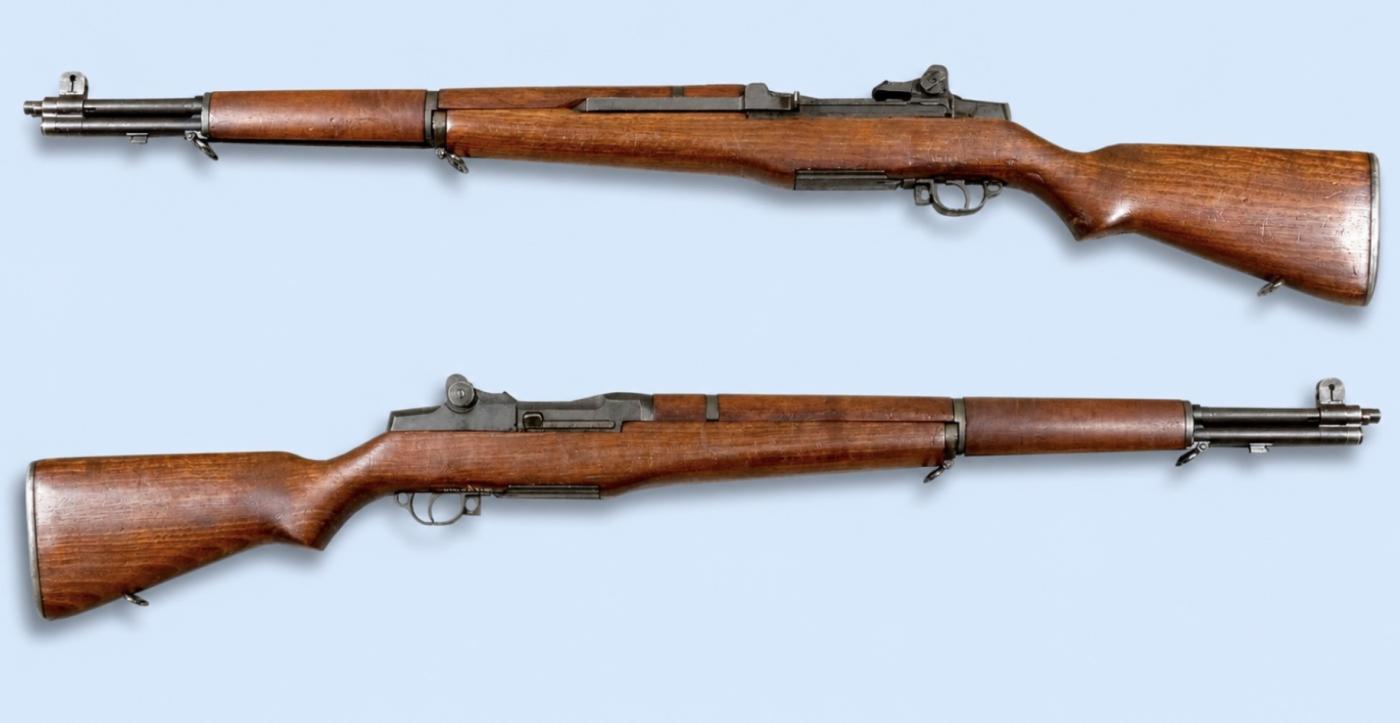
The U.S. rifle officially known as the United States Rifle, Caliber .30, M1, is one of the most famous military arms of the twentieth century. It became the standard American service rifle during the Second World War and continued in major use through the Korean War. To soldiers, collectors, and historians, it represents a turning point in infantry weapons because it gave the ordinary rifleman a reliable semi-automatic arm at a time when many armies still depended on bolt-action rifles.
The rifle is best known by the name of its chief designer, John Cantius Garand. He was born in Canada in 1888 and later moved to the United States, where he worked as a toolmaker and mechanical designer. After the First World War, the U.S. Army wanted a replacement for the bolt-action M1903 Springfield. Trench warfare had shown the value of rapid fire, and the Army wanted a weapon that could increase a soldier’s firepower without the weight of a machine gun.
John Garand worked at Springfield Armory in Massachusetts, the U.S. government’s main small-arms development and manufacturing centre. His design went through years of testing during the 1920s and early 1930s. It faced competition from other semi-automatic designs, especially John D. Pedersen’s rifle. For a time, the Army considered changing to a .276 calibre cartridge, but that idea was eventually dropped.
The decision to keep the .30-06 Springfield cartridge was very important. General Douglas MacArthur, then U.S. Army Chief of Staff, opposed adopting a new round partly because America already held large stocks of .30-06 ammunition from the First World War. The final rifle was therefore refined around that cartridge, and in 1936 it was officially adopted as the M1.
It was gas-operated, semi-automatic, and fed by an eight-round en bloc clip. The whole clip was pressed into the rifle’s internal magazine. After the eighth shot, the empty clip was thrown out with the famous metallic “ping.” Many stories claim enemy soldiers listened for that sound before attacking. In reality, this was probably exaggerated. In battle there was too much noise, too many men firing, and a trained soldier could reload very quickly.
Its main cartridge was the .30-06 Springfield, especially the M2 Ball loading used during the Second World War. This fired a .308-inch bullet, usually around 150 grains, at roughly 2,700 to 2,800 feet per second. It was powerful, flat-shooting, and effective at long range. The same family of ammunition was also used in the M1903 Springfield, Browning Automatic Rifle, and several American machine guns.
The rifle could also use other military .30-06 loads, including armour-piercing, tracer, and blanks when properly equipped. The M2 armour-piercing round was especially respected because it could penetrate light cover, vehicles, and harder targets better than ordinary ball ammunition. Modern shooters have to be careful with commercial hunting ammunition, as some loads can put too much strain on the gas system and operating rod unless the rifle is properly adapted.
After the Second World War, some examples were converted to fire 7.62×51mm NATO. The U.S. Navy used these conversions during the transition to NATO ammunition. Civilian conversions also exist, but the classic chambering will always be .30-06 Springfield.
The main wartime manufacturers were Springfield Armory and Winchester Repeating Arms. Springfield was the government arsenal where the weapon was developed, while Winchester was brought in to increase production as war approached. After the war, Harrington & Richardson Arms Company and International Harvester also made rifles during the 1950s. International Harvester is interesting because it was better known for tractors and agricultural machinery, showing how wide American industrial mobilisation became.
Total production was about 5.4 million rifles, often given as roughly 5,468,000. Springfield Armory made the largest number, around four million. Winchester produced over half a million during the war. Harrington & Richardson and International Harvester each produced several hundred thousand after the war. Exact figures vary slightly, but the accepted total is just under five and a half million.
The M1 was not the first semi-automatic rifle ever made, but it was the first to be issued widely as the standard service rifle of a major power. That made it revolutionary. German infantry usually carried the Karabiner 98k, British and Commonwealth troops used the Lee-Enfield, Soviet troops still relied heavily on the Mosin-Nagant, and Japanese troops carried Arisaka rifles. Most of these were bolt-action. The American soldier therefore had a serious advantage in rate of fire.
A trained man with a bolt-action rifle might fire around 10 to 15 aimed shots per minute. With the American semi-automatic, he could fire faster while keeping his position and sight picture. It was still meant for aimed fire, not wild shooting, but in combat the ability to fire quick follow-up shots mattered greatly.
The action used gas tapped near the muzzle to drive a long operating rod. Early rifles used a gas-trap system, but this was replaced by the more reliable gas-port system. Many early examples were later converted. The improved design was easier to manufacture, simpler to maintain, and more dependable.
The sights were excellent. The rear sight was an aperture type adjustable for windage and elevation, and the front sight was a protected blade. These sights, combined with a long sight radius and decent trigger, made the rifle accurate for military use. It weighed about 9.5 pounds unloaded, so it was not light, but the weight helped control recoil from the powerful .30-06 round.
A standard service rifle usually produced about 3 to 4 minute-of-angle accuracy with military ball ammunition. That means roughly 3 to 4 inch groups at 100 yards under good conditions. Some rifles did better, especially with good barrels and selected parts. National Match versions, prepared for competition, could be much more accurate.
The practical effective range was usually around 500 yards against point targets, although the cartridge could travel much farther and remained dangerous well beyond that. In skilled hands it could give accurate fire at several hundred yards. For ordinary infantry fighting, it was most useful between about 100 and 400 yards.
The rifle earned great praise from American soldiers and commanders. General George S. Patton famously called it “the greatest battle implement ever devised.” That may have been patriotic enthusiasm, but it reflected the genuine confidence many soldiers had in the weapon. It offered power, range, reliability, and rapid fire in one strong package.
It had drawbacks too. It was heavy, and the eight-round clip was not as flexible as a detachable box magazine. It could be topped off, but not as simply as some later magazine-fed rifles. The clip was also essential to normal operation. Without clips, it was awkward as a single-loader. The operating rod could be damaged by unsuitable ammunition or rough treatment.
Even so, the rifle was highly successful. It served in North Africa, Italy, France, Germany, the Pacific, and later Korea. It worked in desert, snow, mud, jungle, and mountain country. Like any weapon, it needed cleaning and care, but it earned a reputation for being tough and dependable.
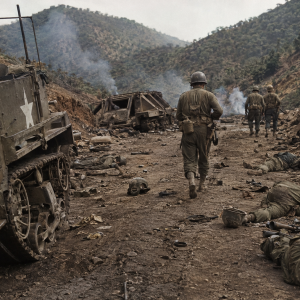
In the Pacific, American soldiers and Marines valued its firepower against Japanese forces. In Europe, it gave infantry squads strong rifle fire alongside the Browning Automatic Rifle, carbines, submachine guns, and machine guns. In Korea, the .30-06 round’s range and power were useful in the harsh winters and mountainous terrain, though the war also showed the need for lighter rifles and larger magazines.
Its eventual replacement was the M14, adopted in the late 1950s. The M14 was closely related in design, using a similar operating system but with a detachable magazine and the 7.62×51mm NATO cartridge. It was meant to modernise the old system, though it brought its own problems.
The influence of the M1 was enormous. It proved that a semi-automatic rifle could be issued in huge numbers and maintained by ordinary infantrymen. It pushed armies further away from bolt-action rifles and toward self-loading weapons. Later assault rifles firing intermediate cartridges would change warfare again, but this rifle was a vital step between the old and modern eras.
Many were supplied to American allies after the war, including Greece, Denmark, Italy, South Korea, Turkey, and others. Some were rebuilt, refinished, converted, or modified. Italy’s Beretta and Breda developed rifles based on the same system, including the BM59, which used 7.62 NATO and a detachable magazine.
Collectors today look closely at maker markings, serial numbers, barrel dates, stock stamps, rebuild marks, and part numbers. An untouched wartime rifle can be valuable, but many genuine service rifles were rebuilt in arsenals and contain mixed parts. That is part of their history. They were working military arms, not museum pieces at the time.
One of the most interesting things about the rifle is what it says about American industry. Producing millions of semi-automatic rifles required precision machining, heat treatment, inspection, skilled labour, and huge organisation. The United States made them while also producing aircraft, tanks, ships, trucks, artillery, ammunition, and countless other war materials.
The eight-round clip system gave the weapon much of its character. Soldiers carried loaded clips in cartridge belts and bandoliers. Reloading was quick: pull back the operating rod, press in the loaded clip, and let the bolt move forward. Men had to be careful of “M1 thumb,” the painful injury caused when the bolt slammed shut on the thumb during loading.
The famous empty-clip ping became part of the rifle’s identity. It is now one of the most recognisable sounds connected with the American soldier of the Second World War. Films, documentaries, and games often use it as an instant sign of that period.