Himmlers Suicide
Heinrich Himmler, one of the most powerful and destructive men in Nazi Germany, committed suicide on 23 May 1945, just fifteen days after Germany’s surrender in Europe. His death came after a short and humiliating attempt to escape justice. For years, he had been Reichsführer-SS, head of the German police, chief of the Gestapo system, minister of the interior, and one of Adolf Hitler’s closest servants in the machinery of terror. By May 1945, however, he was a hunted man: rejected by Hitler, unwanted by the Allies, abandoned by many of his own followers, and facing almost certain trial and execution.
His importance to the Nazi war machine was enormous. He was not a battlefield commander in the usual sense, nor was he a dramatic public speaker like Hitler or Joseph Goebbels. His power came from organisation, surveillance, policing, racial policy, and cold administrative control. He built the SS from a relatively small bodyguard unit into a vast empire inside the German state. Under his command, the SS controlled concentration camps, security intelligence, forced labour, racial persecution, anti-partisan warfare, and large parts of the Holocaust.
Born in Munich in 1900, he did not look like the image of a brutal military leader. He was bookish, awkward, fussy, and physically unimpressive. Yet those qualities made him especially dangerous. He was a bureaucratic fanatic: precise, patient, obedient to Hitler, and completely committed to Nazi racial ideology. He turned hatred into files, orders, trains, camps, police units, and death lists.
By the time the Second World War reached its height, the SS had become one of the central pillars of Nazi power. It included the Allgemeine SS, which handled political and racial control; the Waffen-SS, which fought as an armed military force; the SD, which gathered intelligence; and the Gestapo, the secret police feared throughout Germany and occupied Europe. The concentration camp system also came under SS control, making him central not only to terror but also to the exploitation of slave labour.
His role in the Holocaust was decisive. Hitler gave the ideological direction and political approval, but the SS leadership helped turn that vision into reality. The forces under his authority carried out mass shootings in eastern Europe, deportations, ghetto liquidations, forced labour programmes, and the operation of extermination camps. He received reports, gave orders, visited killing sites, and spoke openly to senior SS officers about the murder of the Jews as a historic mission of the Nazi movement.
One of the clearest examples came in October 1943, in his speech at Posen. Speaking to SS leaders, he referred directly to the extermination of the Jewish people and described it as a task the SS had carried out while remaining, in his twisted view, “decent” among themselves. This speech remains one of the strongest pieces of evidence showing that the Nazi leadership knew exactly what was being done.
His importance to the German war effort also lay in forced labour and internal control. As the war dragged on, Germany became increasingly dependent on foreign labourers, prisoners of war, concentration camp inmates, and civilians dragged from occupied countries. Millions were forced to work in armaments factories, mines, construction projects, and private industry. The SS supplied and controlled much of this labour, making it a vital part of the Nazi war economy.
He was also deeply involved in Nazi plans for eastern Europe. These plans aimed to remove, enslave, or murder populations considered racially “undesirable” and replace them with ethnic Germans. In occupied Poland and parts of the Soviet Union, the SS carried out expulsions, resettlements, kidnappings of children, forced Germanisation, and mass murder. The full plan was never completed because Germany lost the war, but the parts that were implemented caused immense suffering.
By 1944, his power had expanded even further. After the failed attempt to assassinate Hitler on 20 July 1944, the SS helped crush the conspiracy, and he gained control of the Replacement Army. Later, in early 1945, he was even given military command of Army Group Vistula. This exposed his weakness. He was not a capable field commander, and his performance was poor. His appointment showed how desperate and distorted the Nazi leadership had become in the final months.
The road to his suicide began with what Hitler saw as betrayal. In April 1945, as the Third Reich collapsed, he secretly tried to contact the Western Allies. Through Count Folke Bernadotte of the Swedish Red Cross, he hoped to negotiate a surrender in the west while continuing the fight against the Soviet Union. It was a delusional attempt to save himself. The Allies had already demanded unconditional surrender, and he was one of the most wanted criminals in Europe.
When Hitler learned of the secret approach, he was furious. In his final political testament, written shortly before his own suicide on 30 April 1945, Hitler expelled him from the Nazi Party and stripped him of all offices. Karl Hanke was named the new Reichsführer-SS. It was a dramatic fall for someone who had spent years presenting himself as the model of loyalty.
After Hitler’s death, the former SS chief tried to join the short-lived government of Grand Admiral Karl Dönitz in northern Germany. Dönitz, who had been named Hitler’s successor as president, wanted to distance himself from the most notorious Nazi figures in the hope of preserving some room for negotiation with the Allies. The request was refused. He was too infamous, too compromised, and too closely associated with the crimes of the regime.
He then went into hiding. He shaved off his moustache, wore an eye patch, and carried false papers under the name “Heinrich Hitzinger” or “Heinrich Hizinger,” posing as a low-ranking army sergeant. The disguise was poor. He travelled with a small group that included other SS men, and his documents raised suspicion. His manner and appearance also made him stand out rather than disappear.
On 21 May 1945, he and his companions were stopped by British forces near Bremervörde in northern Germany. At first, he was not recognised and was treated as an ordinary prisoner. During screening, however, the false identity began to fall apart. Under questioning, he eventually admitted who he really was.
He was taken to Lüneburg, into the custody of the British Second Army. The British now realised they had captured one of the most important surviving Nazi leaders. He was due to be examined and searched, partly because Allied officers knew that senior Nazis might be carrying poison. This fear was well founded. Several leading figures had already used suicide to avoid capture or trial, including Hitler, Eva Braun, and Joseph Goebbels.
On the evening of 23 May 1945, during a medical examination, a British doctor tried to inspect his mouth. A cyanide capsule was hidden there, reportedly concealed in a gap between his teeth or inside his mouth. When the doctor noticed something suspicious and attempted to remove it, the prisoner bit down on the capsule.
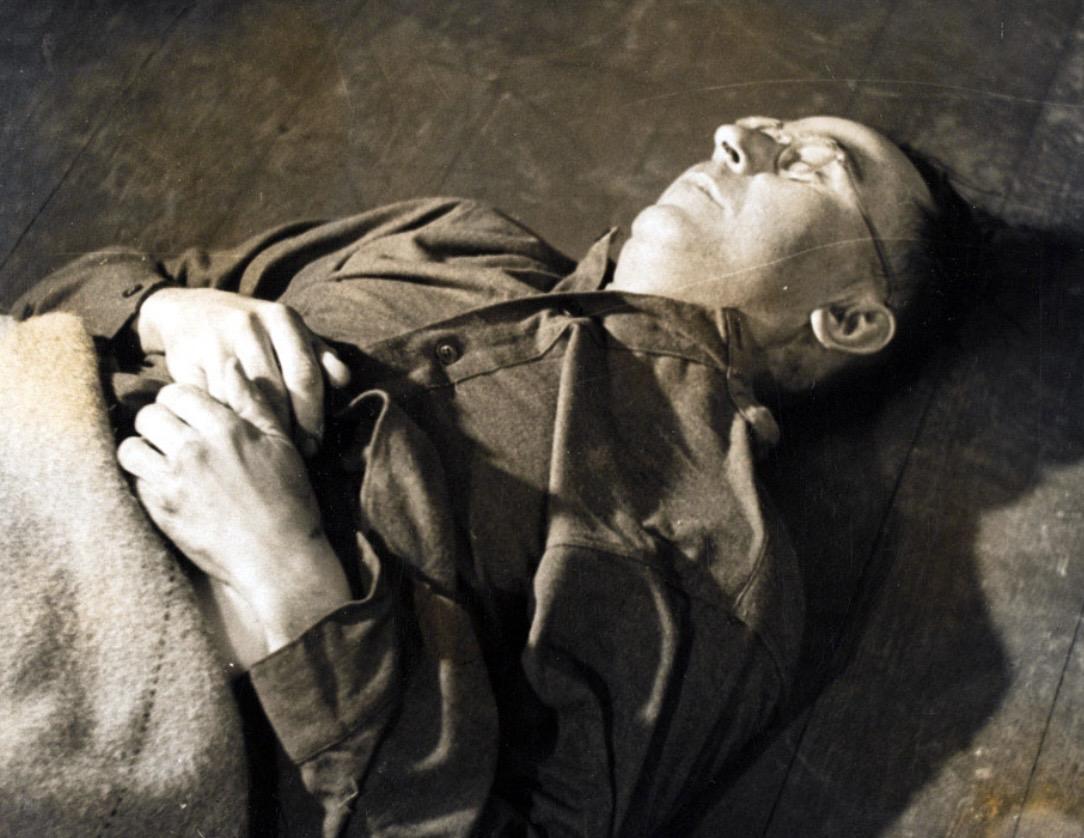
The poison was potassium cyanide. It worked extremely quickly. He collapsed almost at once, convulsed, and died within minutes. Attempts were made to save him, but there was little that could be done. His body was photographed and examined. The Allies had captured one of the chief organisers of Nazi terror, but they had lost the chance to put him on trial.
The scene was full of grim irony. A man who had commanded a vast system of torture, deportation, slave labour, and mass murder died not as a heroic soldier, as Nazi propaganda might have imagined, but as a frightened fugitive under a false name. He had tried to bargain with the enemies he had spent years denouncing. He had been rejected by Hitler, rejected by Dönitz, and finally trapped by the soldiers of the country he had once expected Germany to defeat.
His death also meant that he escaped public questioning at the Nuremberg Trials. Had he lived, he would almost certainly have been one of the central defendants. His testimony would have been of immense historical importance because he knew so much about the inner workings of the SS, the Holocaust, the concentration camps, forced labour, and Hitler’s leadership. Instead, historians have had to rely on documents, speeches, orders, witness statements, and surviving members of the Nazi administration to reconstruct the full scale of his role.
After his death, the British buried the body in secret. The exact location has never been publicly confirmed. This was done to prevent the grave from becoming a shrine for Nazi sympathisers or a place of political disturbance. The burial is generally understood to have taken place somewhere on Lüneburg Heath in northern Germany, but no marked grave exists. Like several other major Nazi figures, he was deliberately denied a public resting place.
There were rumours and conspiracy theories after the war, as often happened with senior Nazis. Some people claimed he had been murdered in British custody, while others questioned whether the body was really his. These theories have never displaced the accepted historical account: he was captured, identified, searched, and killed himself with cyanide on 23 May 1945. The circumstances were witnessed by British personnel, and his body was photographed after death.
His suicide did not lessen his responsibility. He had been one of the central architects of Nazi terror and genocide. He did not simply obey orders from above; he built the institutions that made mass murder possible. He recruited the men, shaped the ideology of the SS, expanded the camp system, oversaw police repression, exploited slave labour, and helped turn racial hatred into state policy.
In the end, his death was small compared with the scale of his crimes. Millions had died in systems he helped create and command. Yet when the time came to face judgement, he chose poison. The man who had demanded obedience, sacrifice, and fanaticism from others died trying to escape the consequences of his own actions.