M-1918 Trench Knife
The M1918 knuckle duster trench knife was one of the most distinctive and brutal close-combat weapons issued to American troops during the final year of the First World War. Officially known as the U.S. Mark I Trench Knife or simply the M1918 trench knife, it combined a stabbing blade with a cast metal knuckle guard and skull-crusher pommel, reflecting the savage realities of trench warfare. It was designed for silent, close-quarters fighting in narrow trenches where rifles with bayonets were cumbersome and firearms often impractical.
The weapon emerged from the experience of American forces observing European trench combat from 1917 onward. French and British soldiers already used a variety of improvised trench clubs, daggers, and knuckle-type knives, and American officers noted the need for a specialized hand-to-hand weapon. Earlier in 1917 the United States adopted the M1917 trench knife, a simpler triangular-bladed dagger without a knuckle guard. This model proved inadequate for the intense close combat anticipated in trench raids and patrols. The Ordnance Department therefore initiated development of a more effective weapon that could both stab and deliver crushing blows.
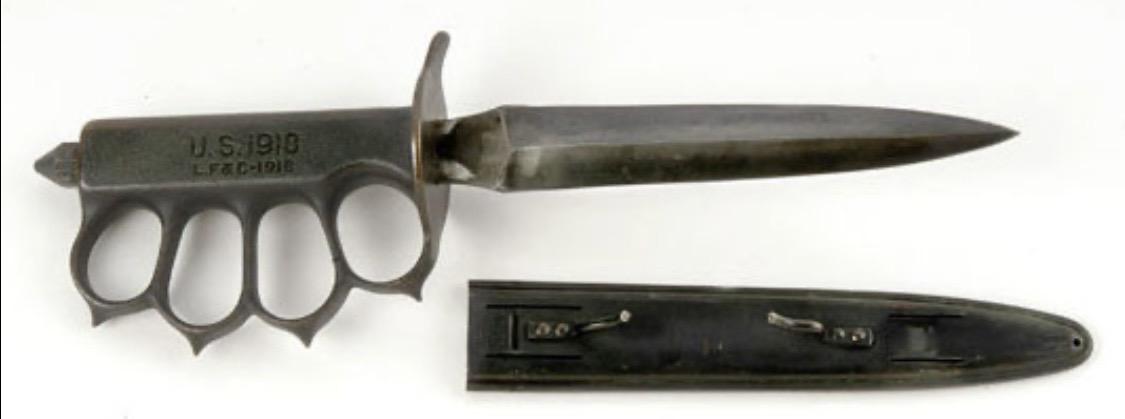
The M1918 design was developed under the authority of the United States Army Ordnance Department. Rather than a single named designer, it was the result of collaborative design work by ordnance engineers working with feedback from combat instructors and reports from European battlefields. The design integrated several elements already seen in French trench knives, particularly the use of a knuckle guard and heavy striking pommel. The final design featured a double-edged blade approximately 6.75 inches long, attached to a cast bronze or brass hilt with four finger holes forming a knuckle duster. Each knuckle position had a pyramid-shaped spike for punching. The pommel ended in a conical skull crusher intended for delivering stunning blows.
Manufacture began in 1918 but faced delays due to the complexity of the cast metal hilt and wartime production pressures. Several American companies were contracted to produce the knife. The principal manufacturers were Landers, Frary & Clark of New Britain, Connecticut; Henry Disston & Sons of Philadelphia, Pennsylvania; and the Oneida Community Limited of Oneida, New York. These companies were experienced in producing edged tools and cutlery, making them suitable for large-scale knife production. Landers, Frary & Clark and Henry Disston & Sons produced the majority, while Oneida Community’s involvement was smaller and later.
The total number of M1918 trench knives produced has been estimated by historians and collectors at roughly 119,000 to 125,000 units, though precise figures vary because wartime records are incomplete and some contracts were not fully delivered before the Armistice. Production began in mid-1918, but the war ended in November of that year, meaning relatively few knives actually reached front-line American troops before hostilities ceased. Many were still in production or awaiting shipment when the war ended. As a result, the knife saw limited combat use during the First World War compared to what had been anticipated.
Each knife was issued with a metal scabbard designed to be worn on the M1910 equipment belt. The scabbard featured a steel body with a leather and metal belt attachment system and was painted in olive drab. The blade itself was usually finished in blackened or blued steel to reduce reflections. The cast hilt was typically made of bronze, giving the knife considerable weight and durability. The triangular spikes on the knuckle guard were designed both to protect the user’s hand and to serve as offensive striking points.
The weapon was intended primarily for trench raiding parties, military police, and certain assault units. It was especially suited to silent killing and hand-to-hand fighting in confined spaces such as trenches, bunkers, and dugouts. Training manuals of the period emphasized aggressive use of the knife in stabbing and punching motions, reflecting the brutal nature of trench warfare. Soldiers were instructed to use the skull-crusher pommel and knuckle spikes as well as the blade itself.
After the First World War ended in November 1918, large stocks of M1918 trench knives remained in U.S. Army inventory. The knife was retained in service during the interwar period and issued in limited numbers to specialized units. When the United States entered the Second World War in 1941, many M1918 knives were taken out of storage and reissued, particularly early in the war when new combat knife production had not yet fully ramped up. Some were issued to U.S. Army Rangers, paratroopers, and Marine Raiders, though newer designs such as the M3 fighting knife and the Ka-Bar eventually replaced them for most front-line roles.
The knife began to be phased out of official service during the Second World War as more modern combat knives became available. By the mid-1940s it was largely obsolete as a standard issue weapon, though some examples remained in inventory and were used sporadically. By the end of the war it was effectively out of frontline service, though not formally declared obsolete immediately. Surplus knives continued to exist in storage and later entered civilian collections.
The M1918 trench knife gained a fearsome reputation due to its brutal appearance and intended purpose. Its combination of stabbing blade, spiked knuckle guard, and skull-crusher pommel made it one of the most aggressive military knives ever officially issued. Because of its design, similar knuckle-duster knives have been restricted or prohibited under various weapons laws in several countries in later decades, contributing to its notoriety among collectors.
Collectors today prize original examples of the M1918 trench knife, particularly those with clear manufacturer markings and original scabbards. Authentic pieces can command high prices due to their historical significance and relatively limited production. Reproductions have been made for decades, especially for military enthusiasts and reenactors, but original wartime knives are identifiable by specific markings, construction methods, and aging of materials.
An interesting feature of the knife is the casting of the hilt. Many examples display slight variations in casting quality and finish depending on the manufacturer and production batch. The knuckle guard often bears the inscription “U.S. 1918” and sometimes the maker’s name cast into the metal. The blade tang was secured within the hilt, creating a strong and durable construction. Despite its heavy and somewhat bulky form, the knife was extremely sturdy and capable of withstanding intense use.
Although it arrived too late to have a major impact on the First World War, the M1918 trench knife remains one of the most iconic American edged weapons ever produced. Its design vividly reflects the harsh conditions and close-quarters brutality of trench warfare. Today it stands as both a collector’s item and a symbol of the evolution of specialized combat knives in modern military history.