London Bombing
On 8 March 1973 a series of coordinated bomb attacks carried out by the Provisional Irish Republican Army struck central London, the most dramatic of which was the car bombing outside the Old Bailey, the Central Criminal Court of England and Wales. The operation formed part of the wider campaign of violence associated with The Troubles, during which the conflict in Northern Ireland spread to mainland Britain in an attempt to pressure the British government politically and psychologically.
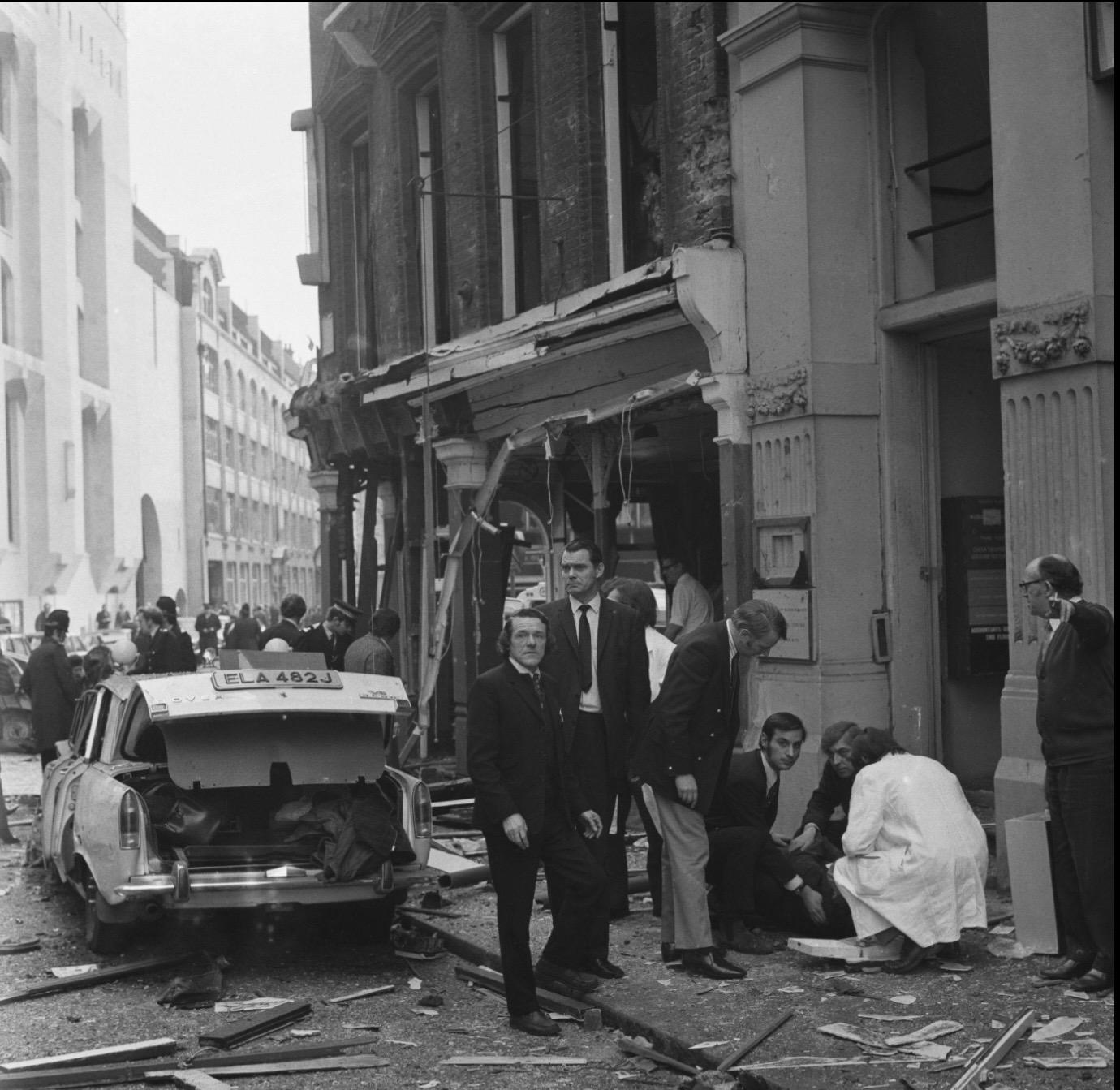
The main explosion occurred shortly before 2 pm outside the historic Old Bailey courthouse. A car packed with explosives had been parked near the building earlier in the day. Despite coded warnings telephoned in advance, the timing and scale of the blast caused widespread devastation in the surrounding streets. The explosion ripped through the front of the Old Bailey, shattering its windows and sending debris across the area. The famous dome of the building and interior courtrooms were damaged by blast pressure and flying fragments, while nearby buildings, including offices and shops, suffered heavy structural damage. Large sections of glass from surrounding properties were blown out across several streets, creating a wide debris field that extended for hundreds of metres.
On the same day, additional IRA bombs exploded at other London locations including Scotland Yard and the Ministry of Agriculture in Whitehall. These attacks were timed to cause disruption across central government and legal institutions, signalling the IRA’s intention to strike at what it considered symbols of British authority. The coordinated nature of the bombings demonstrated planning and logistical capability that alarmed the British public and security services.
More than 200 people were injured in the Old Bailey explosion and the related blasts across London. Most of the injuries were caused by flying glass and debris rather than the direct force of the explosion, as the advance warnings had allowed partial evacuations. However, many victims required hospital treatment for lacerations, fractures and shock. One man later died from a heart attack believed to have been triggered by the blast, though most casualty counts focus on the large number of injured rather than fatalities. Emergency services faced a chaotic scene, with streets covered in shattered glass and rubble and numerous injured civilians needing assistance simultaneously.
The physical damage to buildings was extensive and costly. The Old Bailey itself required significant repairs to its façade, windows and internal structure. Court proceedings were disrupted and some hearings had to be relocated temporarily. Surrounding buildings, including offices, government premises and commercial properties, sustained broken windows, structural cracking and interior destruction from the blast wave. Vehicles parked nearby were wrecked or set alight, and the financial cost of repairs across the affected areas ran into millions of pounds at 1973 values.
Police investigations quickly focused on a Provisional IRA unit that had travelled from Northern Ireland to carry out the operation. Among those arrested and later convicted were Marian Price and her sister Dolours Price, along with Gerry Kelly and Hugh Feeney. They were apprehended at Heathrow Airport while attempting to leave Britain shortly after the bombings. The group became some of the most high-profile IRA prisoners of the 1970s. Their arrests and subsequent trial revealed details of how the operation had been organised, including the transport of explosives into England and the placement of multiple devices across London.
The convicted individuals received lengthy prison sentences, and the case became politically controversial when the Price sisters undertook hunger strikes while imprisoned, drawing international attention to the treatment of republican prisoners. The bombings themselves marked a turning point in public awareness in Britain, bringing the violence of the Northern Ireland conflict directly to the capital and demonstrating that prominent civic and judicial institutions were vulnerable.
The 8 March 1973 Old Bailey bombing remains one of the most significant IRA attacks in London during the early 1970s.