On this day in military history…
On the night of 13 July 1942, one of the most daring and unusual attacks of the war took place in the shadow of Gibraltar. It was not carried out by battleships, aircraft or submarines, but by a small group of Italian naval commandos who slipped silently through the dark water with explosives strapped to them. These men belonged to the Decima Flottiglia MAS, Italy’s elite naval assault unit, and by the time the night was over several Allied merchant ships in Gibraltar harbour had been sunk or badly damaged.
Gibraltar was one of the most important British strongholds in the Mediterranean. Whoever controlled it could watch the narrow gateway between the Atlantic and the inland sea. Convoys, warships, supply ships and troop transports all passed through or sheltered beneath the great Rock. For Britain it was a lifeline to Malta, North Africa and the wider Mediterranean war. For Italy and Germany it was a tempting target that was difficult to reach by normal attack. The harbour was defended, watched and protected, but it had one weakness. Across the bay lay neutral Spain, and from the Spanish side the lights and outlines of Allied ships could be studied night after night.
The Italians had already shown that they were willing to use methods that seemed almost impossible. Their naval commandos trained with breathing equipment, limpet mines and manned torpedoes, learning how to approach ships underwater and attach explosives beneath the hull. It was dangerous, cold and exhausting work. A man had to swim in darkness, often through polluted harbour water, while carrying heavy gear and knowing that a single patrol boat, searchlight or depth charge could end the mission. If he was caught, he might not even be treated as a normal sailor, because these were secret raids carried out in the grey area between war, espionage and sabotage.
The Gibraltar attacks were made possible by the Italian presence at Algeciras, just across the bay. Italian agents and naval personnel had watched the harbour carefully, and in time a covert system was built up to support attacks against Allied shipping. One of the most famous parts of that story was the Italian tanker Olterra, which had been interned in Spanish waters and later secretly converted into a hidden base for underwater operations. But in the July 1942 raid the frogmen are most often linked with Villa Carmela, a house on the Spanish side used as a secret base by Italian personnel. From there the swimmers could begin their long approach across the bay towards the British anchorage.
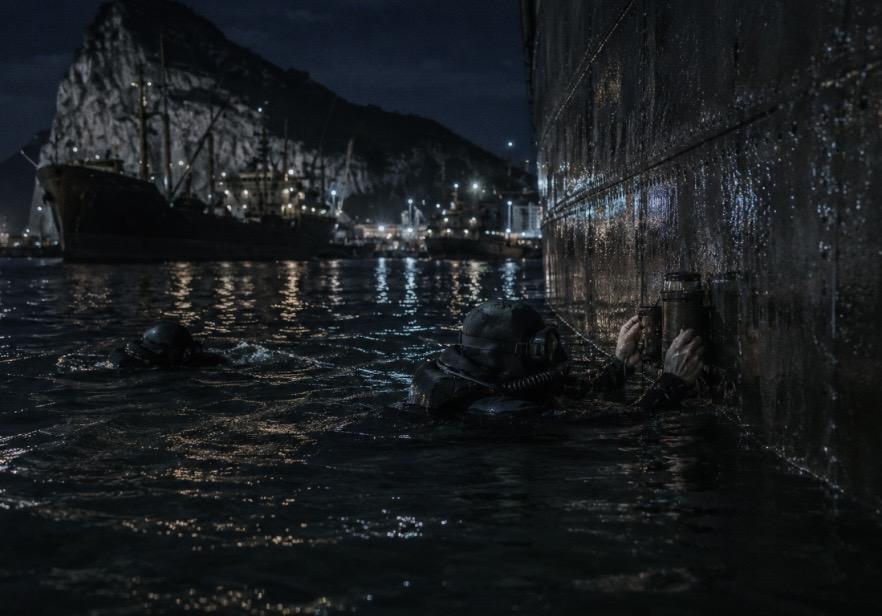
The men who set out that night knew they were entering one of the most closely watched naval areas in the world. They were not going in to fight a battle in the normal sense. Their task was to become almost invisible. Each man had to move slowly, breathe carefully and avoid any noise or disturbance that might reveal him. The explosives they carried were limpet mines, designed to be fixed to the steel hull of a ship below the waterline. Once attached, the mine could be set with a delay fuse, giving the swimmer time to escape before the explosion tore open the ship’s plates.
It was a simple idea in theory and a terrifying one in practice. The frogman had to find the right vessel in darkness, get underneath it, work by touch, secure the charge and then make his way back through the water without being seen. A ship at anchor might look still from above, but below the surface it was a mass of chains, shadows, currents and barnacled steel. There was always the danger of becoming trapped, disorientated or exhausted. There was also the risk that the explosive would fail, detonate early, or be discovered before it went off.
The Italian swimmers moved through the harbour and placed their charges on Allied merchant ships. These ships were vital to the war effort. They carried supplies, fuel, equipment and cargo needed to keep the British war machine moving. Merchant vessels did not have the glamour of battleships, but without them armies could not be fed, tanks could not move, aircraft could not fly and island garrisons could not survive. In the Mediterranean war, sinking a merchant ship could be just as important as damaging a warship.
After fixing the mines, the frogmen withdrew. The most remarkable part of the raid was that the swimmers were able to return safely. They had crossed into a major British naval base, attached explosives to ships, and escaped back towards the Spanish side before the full effect of the attack was understood. Then the delayed explosions came. The blasts ripped into the hulls of the targeted vessels, tearing open steel plates below the waterline and sending water flooding into the ships. The freighters Meta, Empire Snipe, Baron Douglas and Shuma are named among the vessels sunk in the attack, although some accounts differ slightly on whether three or four ships were sunk or how the losses were later recorded.
For the British, the attack was deeply worrying. It showed that even a powerful fortress harbour could be reached by men with courage, training and imagination. Gibraltar had guns, patrols, anti-aircraft defences and naval protection, yet a handful of swimmers had struck from beneath the surface where the normal defences were weakest. It forced the defenders to think differently. The enemy was not only in the air or on the sea. He could be below the water, moving slowly in the dark with a mine in his hands.
For the Italians, the raid was a major success and a boost to the reputation of the Decima MAS. Italy’s surface fleet had often struggled against British sea power and fuel shortages, but its special naval units became some of the most feared and inventive of the war. Their attacks at places such as Alexandria and Gibraltar proved that small teams could achieve results out of all proportion to their numbers. These were not mass operations involving thousands of men. They were attacks carried out by a few highly trained volunteers who accepted that their chances of survival were often poor.
The Gibraltar raid also belongs to the wider story of special operations during the Second World War. It came at a time when all sides were learning that unconventional warfare could change events in ways that traditional commanders had not always expected. Commandos, airborne troops, sabotage teams, raiders and underwater swimmers were beginning to show what determined small groups could do when they were given a clear target and the freedom to attack it in an unexpected way.
What makes the Italian frogman attack so striking is the contrast between the size of the force and the damage caused. A great harbour, watched by the British Empire, was attacked not by a fleet but by men slipping silently through the water from the far side of the bay. They had no armour, no heavy guns and no chance of fighting their way out if discovered. Their weapons were patience, nerve, darkness and limpet mines.