
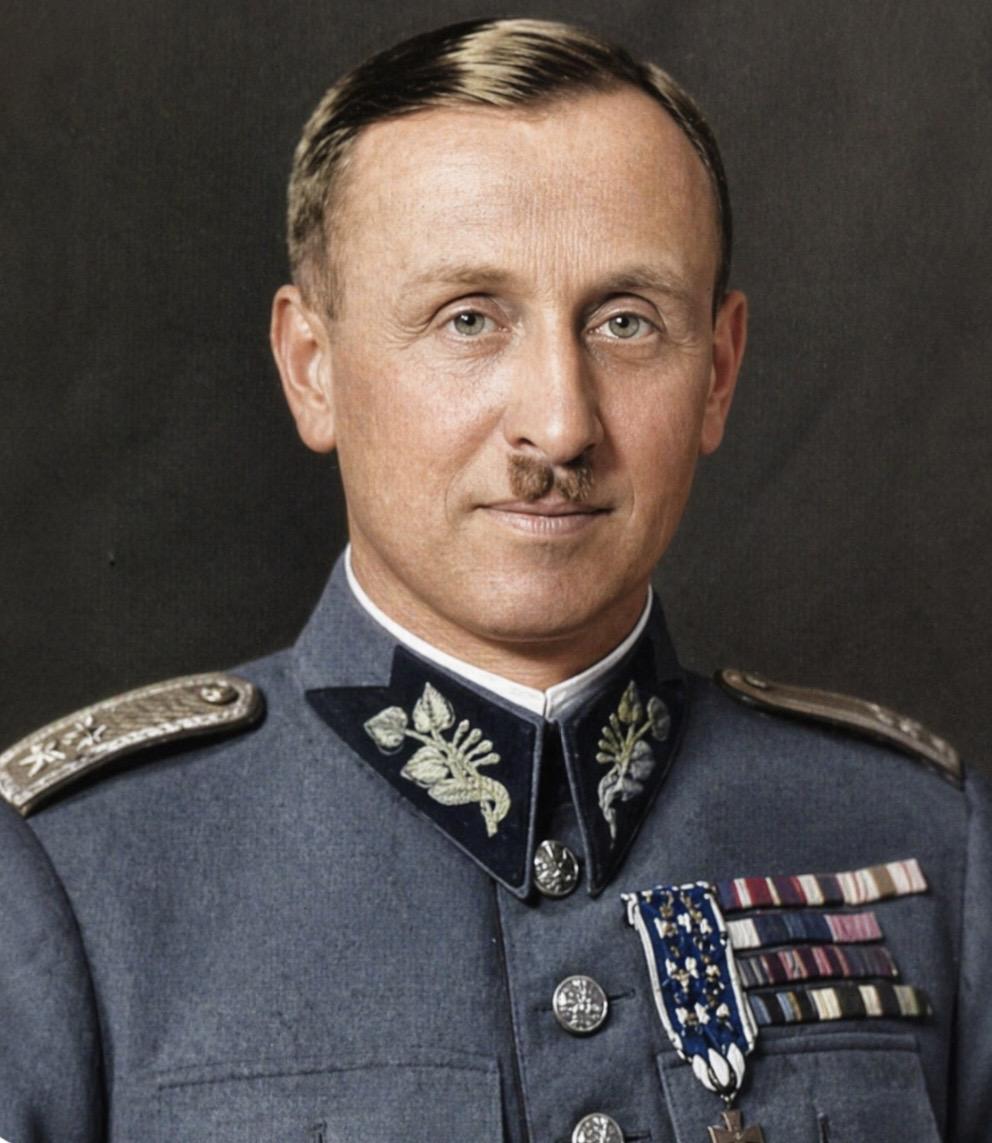
Karel Kutlvašr
Karel Kutlvašr was born on 27 January 1895 in Michalovice, then part of the Austro-Hungarian Empire. He grew up in a modest Czech family during a time when national identity was suppressed under imperial rule. Like many young men of his generation, he trained for a practical trade, but his life changed dramatically with the outbreak of the First World War. He was conscripted into the Austro-Hungarian Army and sent to fight on the Eastern Front, where he was eventually captured by Russian forces.
Rather than remaining a prisoner of war, Kutlvašr joined the Czechoslovak Legions, volunteer units made up of Czechs and Slovaks determined to win independence for their homeland. Fighting in Russia during the turmoil of the Russian Civil War, he proved himself a capable and disciplined officer. The experience was demanding and often chaotic, but it forged his leadership skills and strengthened his commitment to an independent Czechoslovakia. When the new state was created in 1918, he returned home as a respected officer ready to serve his country.
In the interwar years, Kutlvašr built a steady military career in the Czechoslovak Army, rising through the ranks to become a general. He was known more for professionalism than political ambition. This career was interrupted by the Munich Agreement and the subsequent Nazi occupation of Czechoslovakia in 1939, which dismantled the army and forced many officers, including him, out of active service.
His most significant role came in May 1945 during the Prague Uprising. As Nazi Germany collapsed, Prague’s citizens rose against the occupying forces. Kutlvašr emerged as the main military commander of the insurgents, coordinating a diverse and loosely organised force made up of resistance fighters, police, and ordinary civilians.
In extremely difficult conditions, he organised the defence of the city, overseeing the construction of barricades and attempting to maintain order across different resistance groups. One of his most important decisions was to negotiate directly with the German commander, Rudolf Toussaint. His aim was to secure a withdrawal rather than risk the destruction of Prague in a final battle. This approach helped spare the city from the widespread devastation seen elsewhere in Europe during the war’s closing days.
When Soviet forces under Ivan Konev entered Prague on 9 May 1945, the uprising came to an end. Kutlvašr was widely recognised at the time as one of the key figures who had helped bring about the city’s liberation.
In the immediate aftermath of the war, he continued serving in the army and was regarded as a national hero. However, the political situation in Czechoslovakia shifted sharply after the Communist takeover in 1948. Officers with independent reputations or ties to earlier traditions were increasingly viewed with suspicion, and Kutlvašr soon became a target.
In 1949 he was arrested and subjected to a show trial, accused of disloyalty and anti-state activity. The charges were politically motivated, and he was sentenced to life imprisonment. Stripped of his rank and reputation, he spent years in harsh prison conditions, becoming one of many wartime figures persecuted by the new regime.
He was eventually released in 1960 during a partial political thaw, but he was not fully rehabilitated at the time and lived the remainder of his life in relative obscurity. Karel Kutlvašr died on 2 October 1961, his contributions largely unrecognised by the state he had helped defend.
Only after the fall of communism in 1989 was his legacy properly restored. He was posthumously rehabilitated and honoured as a key military leader of the Prague Uprising. Today, he is remembered as a symbol of courage and integrity—an officer who helped free his country, only to suffer under the system that followed.