K-98 Bayonet
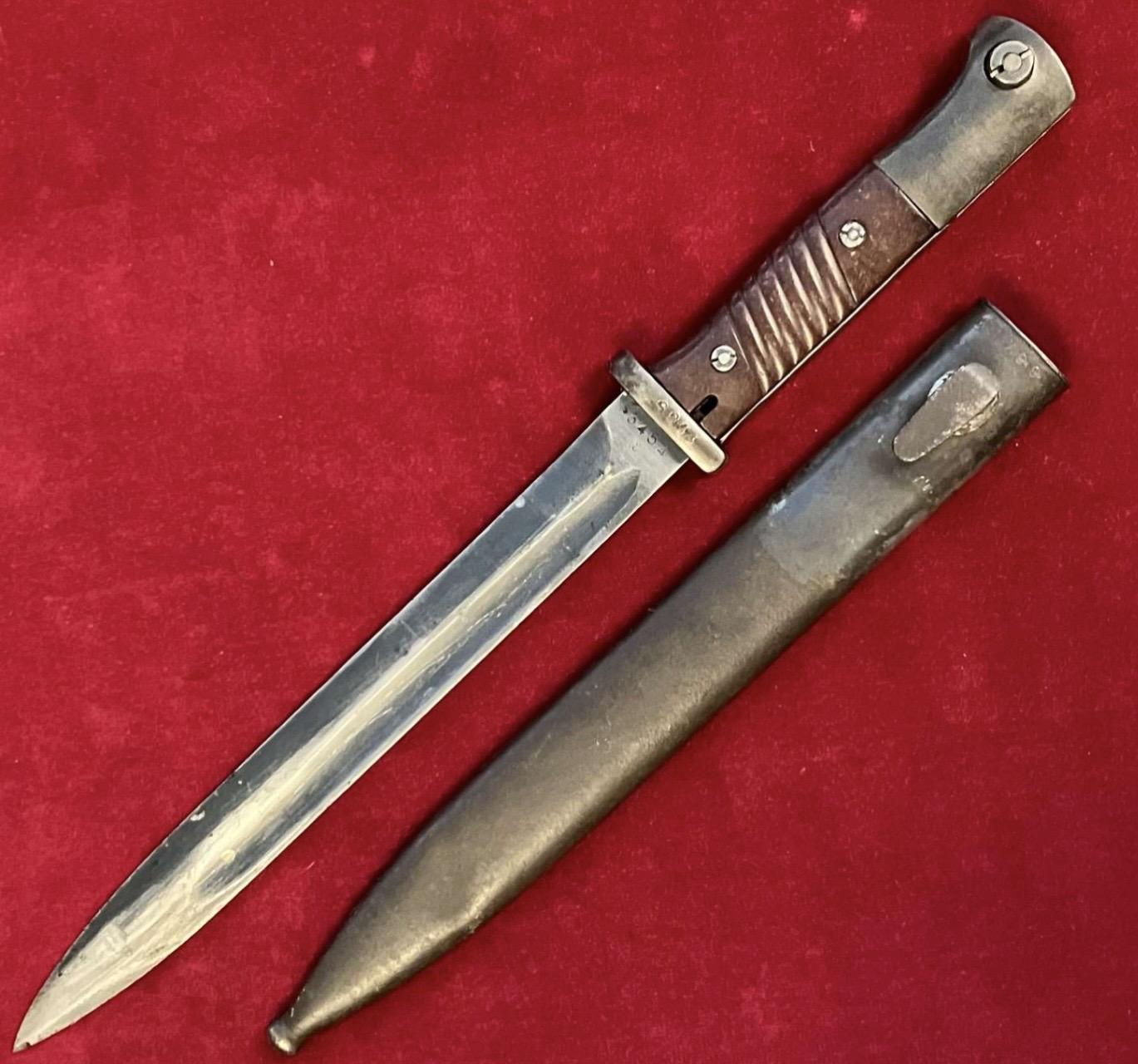
The German K98 bayonet most commonly associated with the Second World War was officially designated the Seitengewehr 84/98 III. Although often referred to simply as the “K98 bayonet,” this name reflects its standard issue with the Karabiner 98k service rifle rather than implying it was uniquely created as an entirely new bayonet design. The pattern itself was an updated development of the earlier Seitengewehr 84/98 bayonets introduced during the First World War for Mauser rifles, refined to suit the shorter dimensions and combat role of the Karabiner 98k adopted by the German Army in the 1930s.
There was no single named designer responsible for the K98 bayonet. German military edged weapons were developed through state ordnance offices, with patterns refined over time rather than attributed to individual inventors. The Heereswaffenamt, the Army Weapons Office, was responsible for approving and standardizing bayonet designs, specifications, and inspection procedures. The Seitengewehr 84/98 III was adopted to match the shorter Karabiner 98k, replacing the longer, heavier bayonets of earlier rifles that had become impractical for modern infantry tactics.
The bayonet featured a straight, single-edged blade approximately 25 centimeters long, with an overall length of roughly 38 to 39 centimeters. This compact size made it lighter and easier to carry than earlier German bayonets while still being effective as a close-combat weapon. The crossguard was minimal, with a muzzle ring sized specifically for the K98k barrel, and the pommel incorporated a push-button locking mechanism that engaged the rifle’s bayonet lug securely. Grips were initially made of walnut wood, later replaced by bakelite or other composite materials as wartime shortages increased.
Production of the Seitengewehr 84/98 III began around 1934–1935 as Germany rearmed and the Karabiner 98k entered full-scale production. Manufacturing continued throughout the war, with gradual simplification of finish and materials. Early bayonets were finely machined with blued blades and polished fittings, while late-war examples often show rougher machining, phosphate finishes, and reduced quality control as industrial conditions deteriorated.
Exact production numbers were never officially published and surviving records are incomplete, but it is widely accepted that several million examples were made. Estimates often place total production well into the tens of millions, roughly paralleling Karabiner 98k rifle production, which exceeded fourteen million units. Bayonets were not always issued one-to-one with rifles, but the scale of German mobilization required enormous quantities to equip frontline troops, reserves, and training units.
Manufacture was spread across numerous firms, many of them traditional blade and cutlery makers. Solingen, Germany’s historic sword- and knife-making center, produced a large share of bayonets through companies such as E. & F. Hörster, Carl Eickhorn, Weyersberg, Kirschbaum & Co., and others. Additional manufacturers operated throughout Germany and in occupied territories, including Austria and France. To obscure production locations, manufacturers were identified by letter codes rather than full company names, a system used widely on German wartime weapons.
The K98 bayonet was designed primarily for use with the Karabiner 98k rifle, but it could also fit other Mauser-pattern rifles equipped with compatible bayonet lugs. In practice, it was almost exclusively associated with the K98k in Wehrmacht service. It was carried in a metal scabbard, originally blued and later often finished in phosphate, and attached to the soldier’s belt using a leather or web frog.
Beyond its intended combat role, the bayonet served as a general utility knife in the field. Soldiers used it for cutting brush, opening crates, preparing food, and a variety of other everyday tasks. This practical use often resulted in worn blades and damaged grips, which today help distinguish heavily used frontline examples from those that remained in storage.
An interesting aspect of the K98 bayonet’s history is its long post-war life. Vast numbers were captured by Allied forces or transferred to other countries after 1945. Many were reused by foreign armies, modified for new rifles, or converted into ceremonial pieces. Others entered civilian markets, where they became popular collectibles. Because of the huge production runs and wide variety of markings, the K98 bayonet has become a specialized field of study among collectors, with variations in manufacturer codes, dates, finishes, and inspection marks providing insight into German wartime industry.
Today, the K98 German bayonet stands as one of the most recognizable military edged weapons of the twentieth century.