C-141 Starlifter
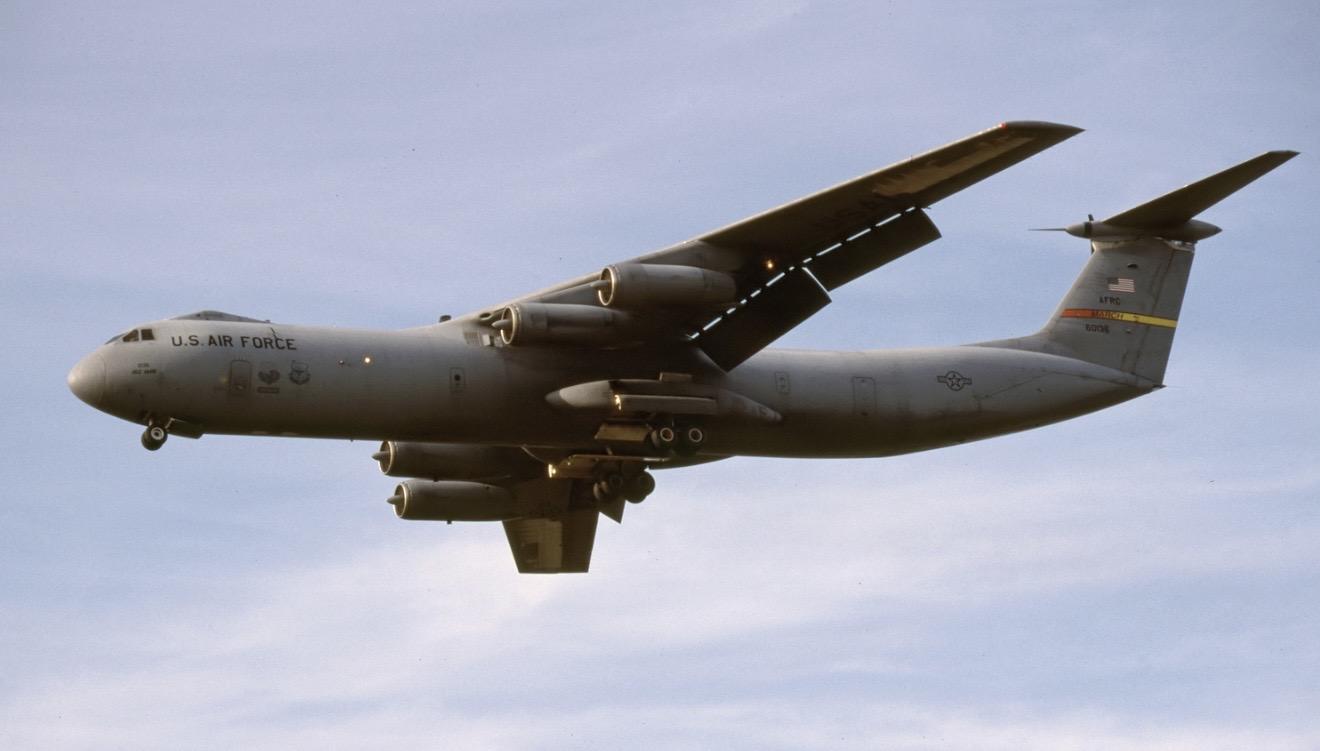
The C-141 Starlifter was the first jet-powered strategic airlifter designed specifically for the United States Air Force, and it fundamentally changed how the U.S. moved troops and equipment around the world. It entered service in the mid-1960s at the height of the Cold War, when the Air Force needed something much faster and longer-ranged than propeller-driven transports like the C-124 and C-133. The aircraft gave the United States the ability to respond quickly to crises anywhere on the globe, a capability that became central to modern air mobility doctrine.
The aircraft was designed by the Lockheed Aircraft Corporation, working closely with the United States Air Force. The design team operated within Lockheed’s famous Skunk Works culture of rapid, innovative engineering, although the program itself was more conventional than later black-project aircraft. Overall design leadership is often associated with Lockheed’s advanced engineering staff influenced by figures such as Kelly Johnson, whose emphasis on simplicity, performance, and reliability shaped Lockheed transports of the era. Manufacturing took place at Lockheed’s facilities in Marietta, Georgia, which became a major center for U.S. military transport aircraft production.
A total of 285 C-141s were built between 1963 and 1968, including prototypes and test aircraft. Of these, the vast majority were C-141A models, which were later extensively modified into the improved C-141B standard. Rather than building a new aircraft from scratch, the Air Force chose to upgrade existing airframes, extending their service life well into the late 1990s. This upgrade program proved to be one of the most cost-effective airlift improvements ever undertaken.
In terms of payload, the C-141 was designed to carry about 70,000 pounds of cargo. It could transport a wide range of loads, including vehicles, palletized freight, helicopters with partial disassembly, and large quantities of ammunition or supplies. In a troop-carrying role, it could carry roughly 150 fully equipped troops, or around 120 paratroopers. In medical evacuation configuration, the aircraft could carry over 100 litters along with medical staff, a role in which it proved invaluable during the Vietnam War and later conflicts.
The aircraft’s original unrefueled range was roughly 3,500 nautical miles with a moderate payload, but this figure depended heavily on cargo weight and flight profile. One of the biggest limitations of the original C-141A was that it lacked in-flight refueling capability, which restricted its true global reach. This was corrected with the C-141B upgrade, which added a refueling receptacle and also included a fuselage stretch of about 23 feet. This modification dramatically increased internal volume, allowing the aircraft to carry bulky cargo more efficiently and finally match its payload weight capacity with sufficient cargo space.
Powered by four Pratt & Whitney TF33 turbofan engines, the C-141 cruised at high subsonic speeds, allowing it to cross oceans much faster than earlier transports. This speed advantage was one of its greatest strengths and helped establish the expectation that strategic airlift should be fast as well as heavy-lifting. The aircraft was optimized for long, paved runways rather than rough forward airstrips, which later led to the development of complementary aircraft like the C-130 for tactical operations.
One of the most interesting aspects of the C-141’s service history is how heavily it was used. During the Vietnam War, it flew thousands of missions moving troops into Southeast Asia and bringing wounded personnel home. It became a familiar sight during Cold War crises, humanitarian relief operations, and large-scale exercises. In 1967, a C-141 named the “Hanoi Taxi” was famously used to bring American prisoners of war home from North Vietnam, becoming one of the most symbolic aircraft in Air Force history.
Despite its success, the C-141 was eventually limited by its cargo bay dimensions, which could not accommodate many of the oversized vehicles and equipment that emerged in later decades. This led to its gradual replacement by the larger C-5 Galaxy and the more versatile C-17 Globemaster III. The last C-141 was retired from U.S. Air Force service in 2006, after more than 40 years of continuous operation.
The legacy of the C-141 Starlifter lies in the way it reshaped strategic airlift. It proved that jet transports could reliably move large forces across intercontinental distances on short notice, and it set the template for every major U.S. airlifter that followed. Even long after its retirement, the doctrines, logistics systems, and expectations built around the C-141 continue to influence how the United States projects power and delivers aid around the world.