Joseph Beyrle
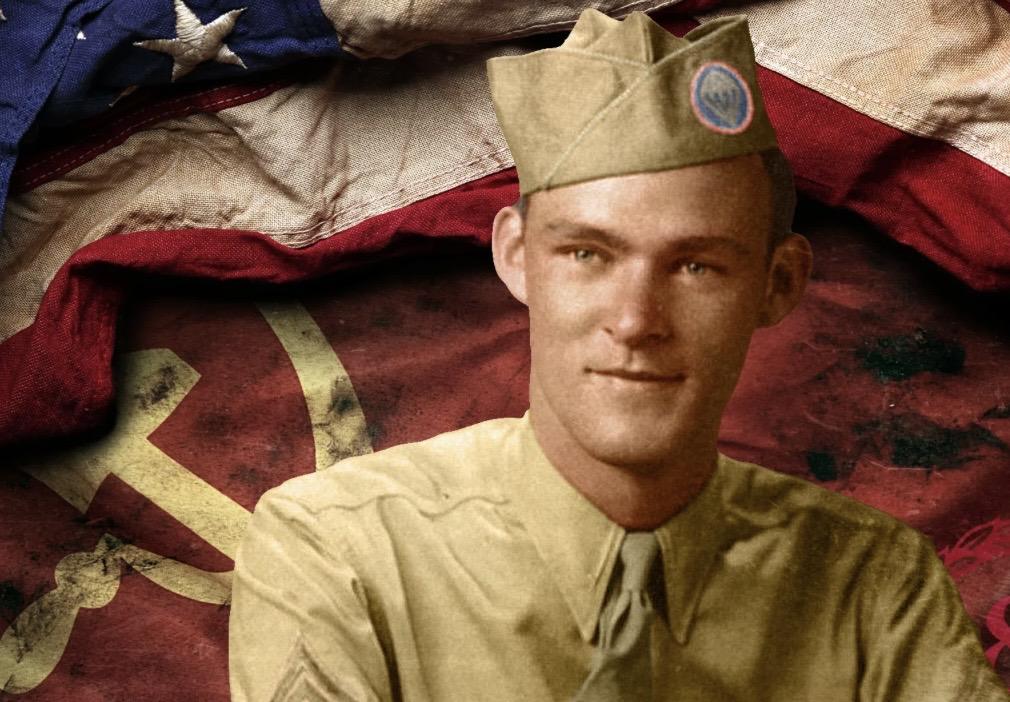
Joseph R. Beyrle holds a singular place in Second World War history as the only known American soldier to fight against Nazi Germany in both the United States Army and the Soviet Red Army. His story is one of persistence, endurance, and remarkable chance, stretching from a modest upbringing in Michigan to the battlefields of Western and Eastern Europe and finally to a rare meeting with one of the Soviet Union’s most powerful commanders.
Joseph Beyrle was born on August 25, 1923, in Muskegon, Michigan, to a family of German immigrants. His parents had come to the United States seeking a better life, and like many immigrant families of the time, they worked hard to establish themselves. Growing up during the Great Depression, Beyrle learned resilience early. He attended Muskegon Heights High School and was known as an energetic and determined young man. When the United States entered World War II after the attack on Pearl Harbor in December 1941, Beyrle was still in his teens but eager to serve. Like many young Americans inspired by patriotism and the scale of the global conflict, he volunteered for the U.S. Army in 1942 shortly after graduating from high school.
Beyrle volunteered for the paratroopers, one of the most elite and demanding branches of the Army at the time. Paratrooper training was notoriously tough, designed to produce soldiers capable of operating behind enemy lines, often isolated and under extreme pressure. He was assigned to the 506th Parachute Infantry Regiment of the 101st Airborne Division, a unit that would later become famous for its combat record in Europe. During training he earned the nickname “Jumpin’ Joe,” a reference to his enthusiasm for parachute jumping and his ability to adapt quickly to the intense physical demands of airborne service.
The 506th trained extensively in the United States and later in England in preparation for the Allied invasion of Nazi-occupied Europe. Their role would be critical in Operation Overlord, the massive amphibious and airborne assault on Normandy scheduled for June 1944. In the early hours of June 6, 1944, Beyrle boarded a C-47 transport aircraft and prepared to jump into occupied France as part of the D-Day airborne landings. His mission, like that of many paratroopers, was to disrupt German defenses, destroy communications and supply lines, and secure key routes for the advancing Allied forces landing on the beaches.
Beyrle parachuted into Normandy under heavy fire and chaotic conditions. The airborne drops were widely scattered due to anti-aircraft fire and navigational difficulties, leaving many paratroopers separated from their units. Despite the confusion, Beyrle quickly began carrying out sabotage operations behind German lines. His unit was tasked with destroying power stations and communications infrastructure to hinder German responses to the invasion. During these operations, he was captured by German forces.
What followed was a brutal period as a prisoner of war. Beyrle was interrogated by the Germans and eventually transported through a series of POW camps, including Stalag XII-A and later Stalag III-C near the Oder River. Conditions in these camps were harsh. Food was scarce, discipline severe, and escape attempts were met with severe punishment. Beyrle, however, repeatedly attempted to escape. He tried at least three times to break free, demonstrating a refusal to accept captivity. Each failed attempt resulted in recapture and further hardship, including beatings and confinement.
In January 1945, as Soviet forces advanced westward into German territory, Beyrle saw another opportunity. He managed to escape from a work detail and began moving eastward on foot through war-torn territory. After days of evading German patrols and enduring freezing conditions, he encountered a Soviet tank unit near the front lines in what is now Poland. Exhausted and starving, Beyrle approached the Soviet troops cautiously and attempted to communicate his identity as an American soldier. Despite language barriers and initial suspicion, he convinced them he was an escaped POW.
Rather than simply sending him to the rear, the Soviet tank brigade commander allowed him to join their unit. The commander, Captain Aleksandra Samusenko, was one of the few female tank officers in the Red Army and an experienced combat leader. Beyrle offered his skills as a demolitions expert, and the Soviets accepted him into their ranks. For several weeks, he fought alongside the Red Army, participating in attacks against German positions and helping destroy enemy supply lines and infrastructure. His knowledge of explosives and willingness to fight earned him respect among the Soviet soldiers.
During one of these operations, Beyrle was wounded by German artillery fire and evacuated to a Soviet field hospital. From there he was transported to Moscow for further treatment. While recovering, his case attracted attention because of its unusual nature. Eventually, he was introduced to Marshal Georgy Zhukov, one of the Soviet Union’s most senior and respected military commanders. Zhukov arranged for Beyrle to be returned to the United States through diplomatic channels. It was an extraordinary moment, symbolizing the rare personal connection between Allied forces on opposite sides of Europe.
When Beyrle arrived back in American hands, there was initial confusion. The U.S. Army had previously listed him as killed in action after he failed to return from the D-Day mission. His family had even received a notice of his death. His reappearance therefore came as a shock and relief to his relatives and to military authorities. He was honorably discharged later in 1945 after recovering from his injuries.
For his service and bravery, Beyrle received numerous decorations from both the United States and the Soviet Union. From the United States he received the Purple Heart and the Bronze Star, among other honors. The Soviet Union awarded him the Order of the Patriotic War and the Medal for Battle Merit, reflecting the high regard in which he was held by his Soviet comrades. After the war, Beyrle returned to civilian life in Michigan, where he married, raised a family, and worked in a variety of jobs including as a shipping clerk and in local government, remaining a modest man despite his extraordinary wartime experiences and gaining wider recognition only later in life as historians and the public came to appreciate the uniqueness of his story.
Joseph Beyrle died on December 12, 2004, leaving behind a remarkable legacy as a determined and resilient soldier whose journey from a small American town to the battlefields of Normandy, through German prison camps and into the ranks of a Soviet tank brigade made him the only known American to officially fight for both the United States and the Soviet Union during the Second World War and one of the most extraordinary personal stories to emerge from that global conflict.