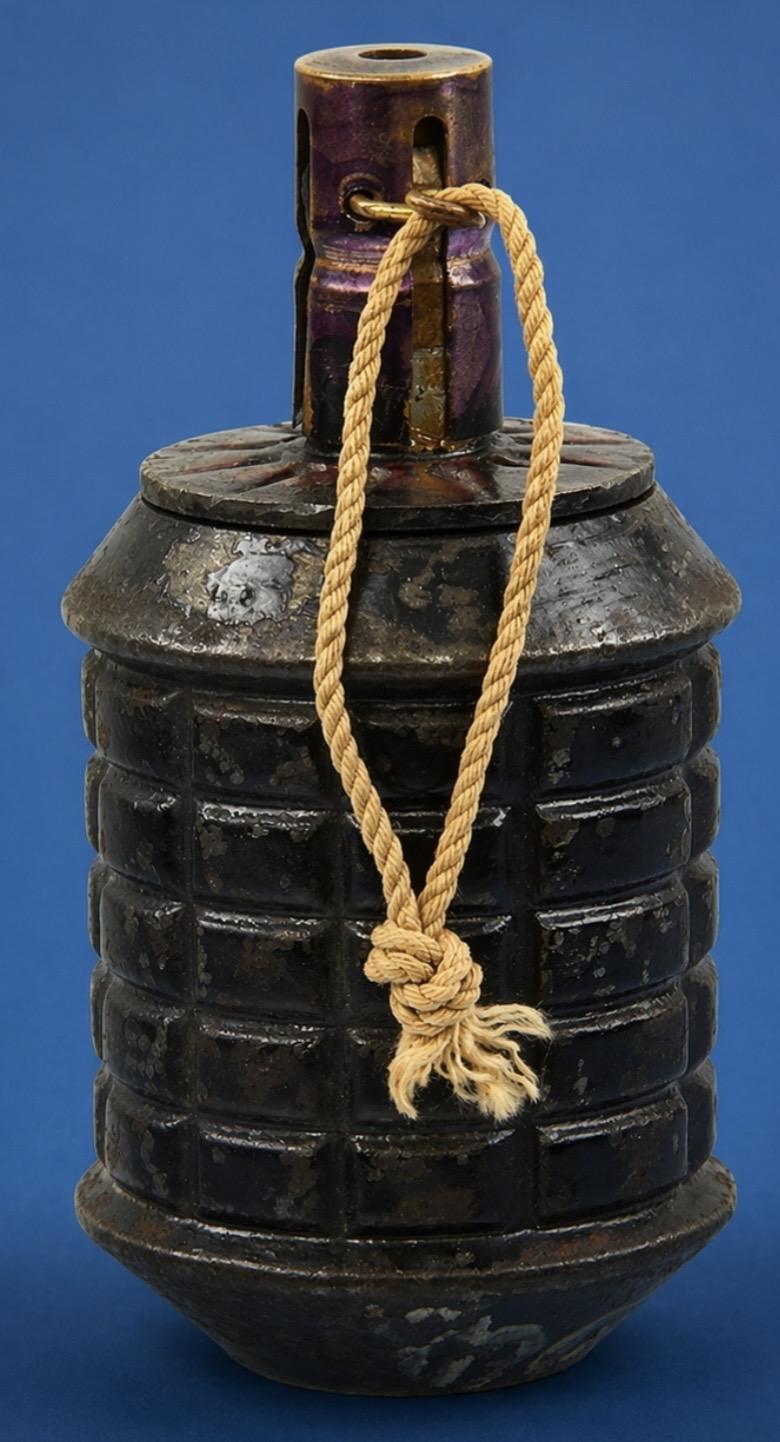
Japanese type 97 grenade
The Japanese Type 97 hand grenade was the standard fragmentation grenade of the Imperial Japanese Army during the late 1930s and throughout the Second World War. It was developed as a dedicated hand-thrown explosive after shortcomings were identified in the earlier Type 91, which had been intended as a multi-purpose grenade for both throwing and use with grenade dischargers.
The design work was carried out by the Japanese Army Technical Bureau in 1936, and it was officially adopted in 1937, with the designation coming from the Japanese imperial year 2597. Manufacturing was handled by state-run army arsenals, with production centred at major facilities such as Kokura, Osaka, and Nagoya, all of which produced large quantities of wartime ordnance.
It featured a classic segmented “pineapple” style casing, designed to break into fragments upon detonation. The grenade weighed approximately 450 grams and contained around 65 grams of TNT. Compared to Allied designs, this was a relatively small explosive charge, which limited its overall effectiveness.
One of its most distinctive aspects was the ignition system. Rather than a simple pull-pin mechanism, the user had to remove safety components and strike the top against a hard surface to activate a delay fuse of roughly four to five seconds. This method made it slower and more hazardous to use, particularly under combat conditions.
In terms of performance, it had a relatively small lethal radius, generally estimated at about 10 to 12 meters, although fragments could travel beyond that depending on terrain and conditions. The fragmentation effect was often less consistent and less powerful than that of comparable British or American grenades.
It developed a mixed reputation during the war. While simple and suitable for mass production, it was frequently criticised for its limited blast power and inconsistent fuse reliability. The delay could vary, and the striking method increased the risk to the user if not carried out correctly.
Despite these drawbacks, it saw widespread use across all theatres where Japanese forces operated, including China, Southeast Asia, and the Pacific islands, remaining in service largely due to production needs and lack of an early superior replacement.
Experience with this weapon led to further development, resulting in the Type 99 grenade, which incorporated improvements to the ignition system and overall reliability. It therefore represents an important step in the evolution of Japanese grenade design, reflecting both the industrial capabilities and tactical doctrine of the Imperial Japanese Army during the Second World War.