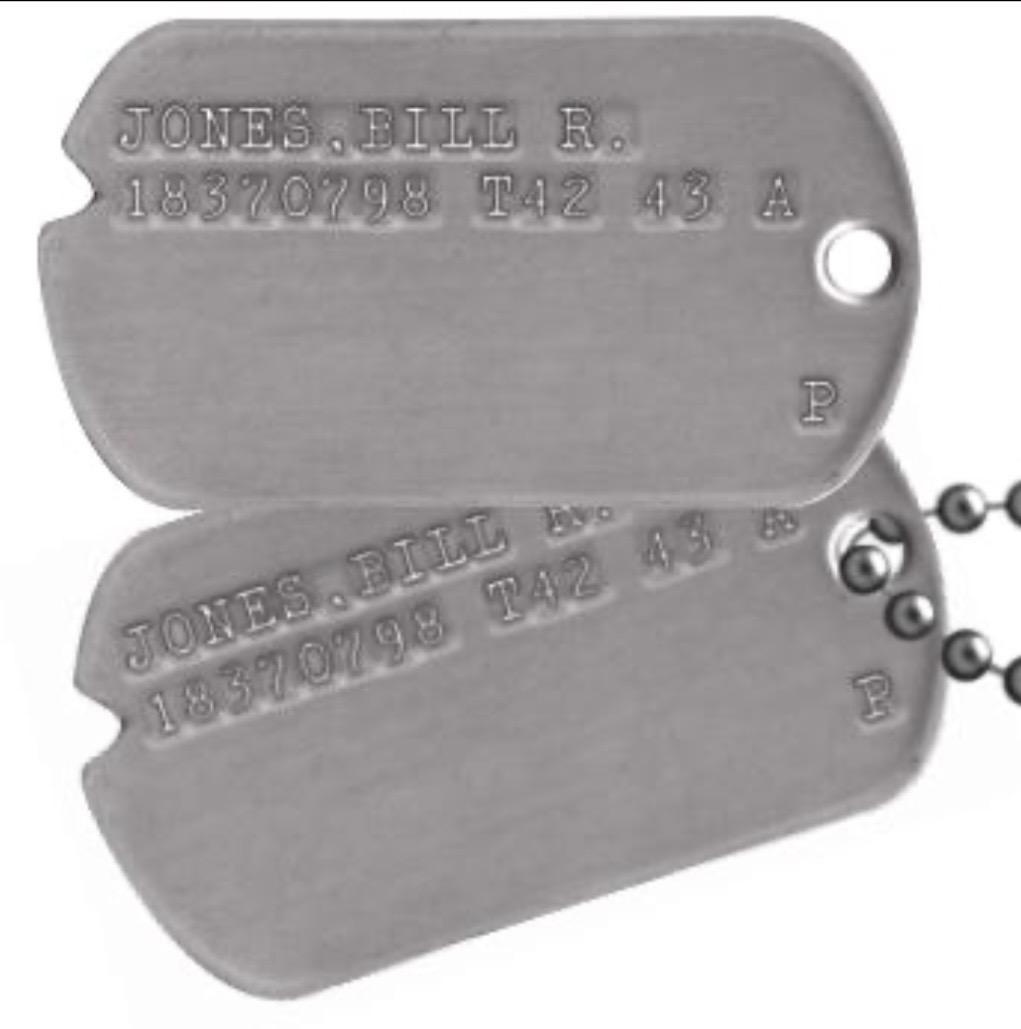
U.S Dog Tags
American World War II dog tags were not produced by a single well-known company in the way weapons or vehicles often were. Instead, they were manufactured through a decentralised system overseen by the U.S. Army Quartermaster Corps. Multiple contracted metalworking firms produced the blank tags in bulk, while the personal details were added later at induction centres and military facilities. This system allowed for rapid production and flexibility rather than relying on a single manufacturer.
The tags used during World War II were part of a design introduced just before the war, commonly referred to as the M1940 identification tag. These tags were rectangular with rounded corners and featured a small notch on one side. The design became standard and remained largely unchanged for many years after the war.
The blank tags were produced by industrial companies capable of stamping large quantities of metal items. Early in the war, materials such as monel, a nickel alloy, and brass were used. As the war progressed and material demands increased, stainless steel became the preferred material because it was durable, resistant to corrosion, and easier to mass-produce consistently. The tags were cut to a standard size and prepared in large batches before being distributed to military centres.
The personalisation of the tags did not take place in factories. Instead, machines such as the Addressograph and similar imprinting devices were used at recruitment and processing centres. These machines functioned somewhat like typewriters, pressing letters and numbers into the metal. Clerks would input a soldier’s details and stamp the tags on site. This method allowed for immediate issue and made it easy to replace lost or damaged tags quickly.
The notch on the side of the tag is one of its most recognisable features and is often misunderstood. It was not intended for use on the battlefield, but rather to hold the tag steady in the stamping machine during the imprinting process. Over time, myths developed about its purpose, but its origin is purely mechanical.
Dog tags had already been in official use by the U.S. military since 1906, meaning that by the time of World War II they had been in service for several decades. The practice of issuing two identical tags to each soldier had been established earlier, ensuring that one tag could be removed for records while the other remained with the body if necessary.
The scale of production during World War II was enormous. With millions of personnel serving in the U.S. armed forces, and each individual issued two tags, the number produced reached into the tens of millions. This total would have included replacements and tags for all branches of the military, not just the Army.
The cost of producing dog tags was kept extremely low. They were simple stamped metal items designed for mass production, and once manufacturing was fully scaled, each tag likely cost only a few cents to make. Their low cost and ease of production made them ideal for rapid distribution across a large military force.
Each tag typically included essential identification information such as the soldier’s name, service number, blood type, tetanus immunisation status, and religious preference. Religion was often indicated by a single letter, reflecting the importance placed on proper burial practices according to faith.
Another practical advantage of the system was how quickly replacements could be issued. Because tags were stamped locally rather than centrally engraved, a soldier who lost his tags could receive a new set in a very short time. This efficiency was vital during a global conflict where personnel were constantly moving between locations.
Material shortages during the war also led to some variation in the tags. Depending on when and where they were produced, differences in metal composition and finish can be seen in surviving examples. This reflects the broader industrial pressures of wartime production.