
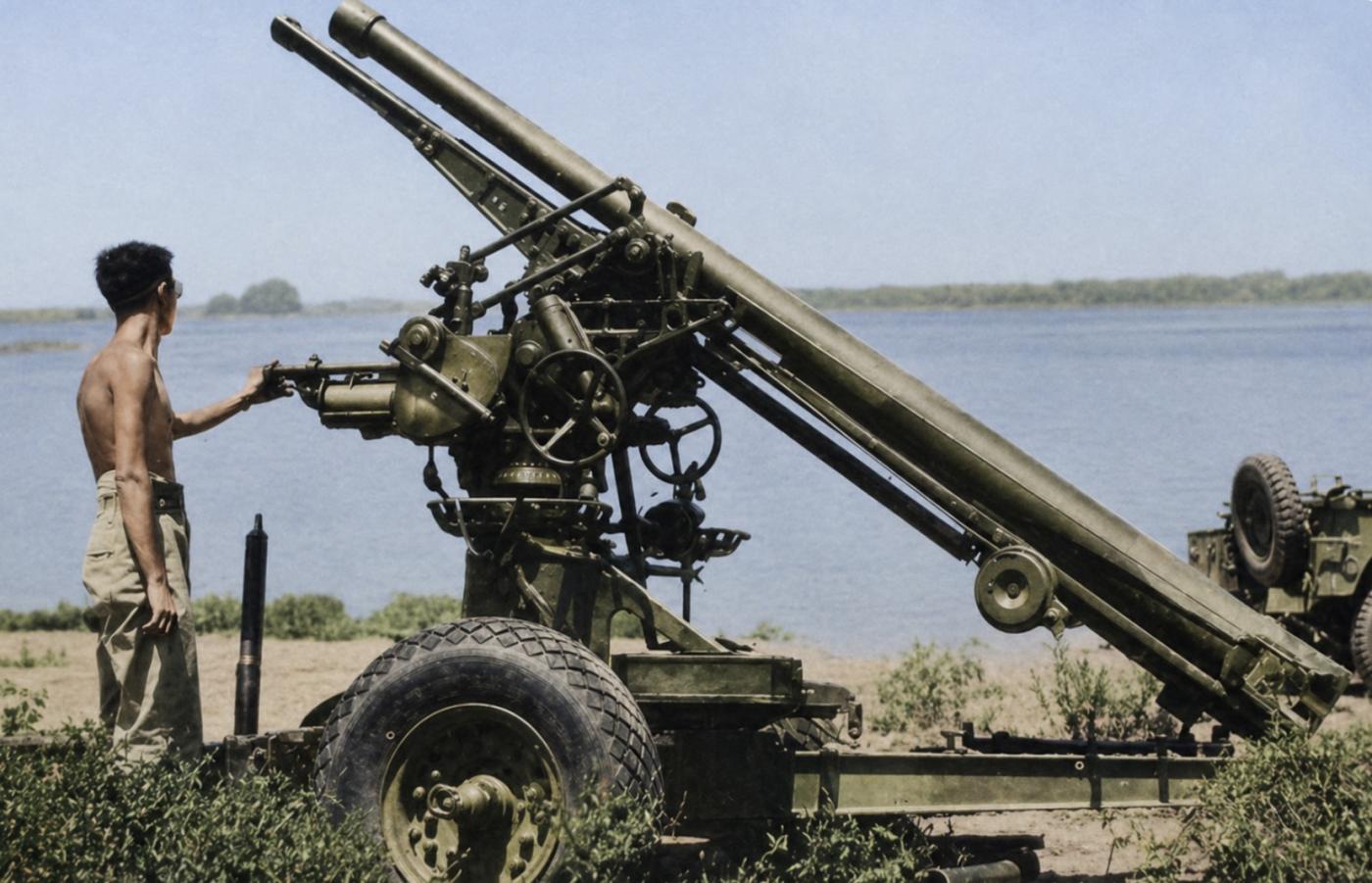
Japanese type 88 Anti Aircraft Gun
The Type 88 75 mm anti-aircraft gun was a key heavy air defense weapon used by the Imperial Japanese Army from the late 1930s through the Second World War. Introduced in 1928, its name came from the imperial year 2588. It marked Japan’s move toward more modern anti-aircraft artillery as aircraft became an increasingly serious threat.
Its design drew heavily on European ideas of the interwar period. Japanese engineers studied French and German guns and adopted features such as a high-angle mounting, long barrel, and a cruciform carriage for stability. Development and production were handled by army arsenals, notably the Osaka Army Arsenal, which manufactured large numbers of artillery pieces for the military.
The gun had a 75 mm barrel and a muzzle velocity of about 720 meters per second, allowing it to engage aircraft at altitudes of up to roughly 9,000–10,000 meters. Around 2,000 units were produced, forming the backbone of Japan’s air defense, though never in sufficient numbers to fully protect all strategic targets as Allied air power expanded.
Its carriage used multiple outriggers to stabilize the weapon during high-angle firing, but this also made it slow to deploy and difficult to move quickly. Once in position, however, it provided a steady and accurate firing platform.
Ammunition was varied and gave the gun flexibility. High-explosive shells with time or altitude fuzes were the main anti-aircraft rounds, designed to burst near aircraft and scatter fragments. Shrapnel shells increased hit probability by spreading projectiles, while armor-piercing rounds allowed use against ground targets such as vehicles or fortifications. Incendiary shells were also used later in the war to ignite aircraft components.
The weapon was deployed widely across China, Southeast Asia, Pacific islands, and the Japanese home islands. It played a major role in defending cities during bombing campaigns, including attacks by aircraft like the B-29 Superfortress. However, limited radar and fire-control technology reduced its effectiveness against fast, high-altitude bombers.
As the war progressed, advances in aircraft performance made it increasingly outdated. Despite this, it remained in service until the end of the conflict due to limited industrial capacity for newer systems. It stands as a representative example of Japan’s interwar artillery development and its attempt to keep pace with rapidly changing aerial warfare.