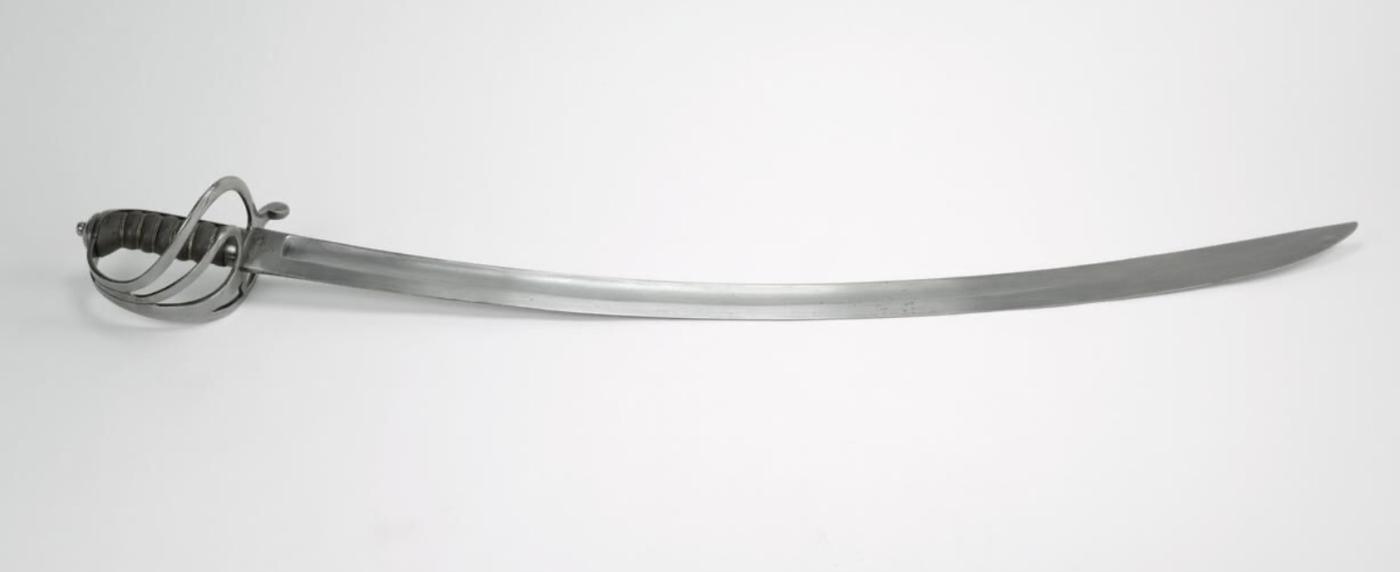
Indian Army Cavalry Troopers Sword
The Indian Army pattern cavalry trooper’s sword is closely associated with the British Indian Army and later with the armed forces of independent India and Pakistan. It developed from British cavalry sword patterns of the nineteenth century and reflects the period when mounted troops were still an important part of imperial military forces. Designed for use by ordinary cavalry troopers rather than officers, it combined practical battlefield function with strong, standardised construction suitable for large-scale military issue.
Its origins lie in the mid-nineteenth century when British cavalry doctrine and equipment were applied across India. After the reorganisation of the Indian Army following the 1857 uprising, equipment began to be standardised, and cavalry swords issued to Indian regiments were largely based on contemporary British patterns. Early examples resembled the British light cavalry sabres of the 1820s and 1850s, but by the late nineteenth century more defined Indian Army patterns appeared. These were influenced by later British designs such as the Pattern 1899 trooper’s sword, which favoured a straight, thrust-oriented blade reflecting changing cavalry tactics.
The sword typically featured a straight, single-edged steel blade with a spear point, designed for both cutting and thrusting from horseback. The hilt usually had a solid steel bowl guard offering good hand protection in combat. Grips were made from wood, covered in leather and bound with twisted steel wire for a secure hold. The pommel and guard were constructed from steel to create a strong, durable hilt capable of heavy use. Scabbards were generally made from sheet steel with suspension rings so they could be worn from a cavalry belt or attached to a saddle.
Blades were forged from high-carbon steel, chosen for strength, flexibility and edge retention. Steel hilts and scabbards were often polished or nickel-plated to resist corrosion, particularly important in varied climates across the Indian subcontinent. Production methods evolved from largely hand forging to increasingly mechanised processes by the late nineteenth century, using rolling mills, drop forges and precision grinding. Each sword underwent inspection and testing to ensure it met military standards for durability and flexibility.
Manufacture took place both in Britain and in India. British firms such as Wilkinson Sword, Mole of Birmingham, and Enfield produced large numbers for Indian cavalry units, especially in the late nineteenth and early twentieth centuries. At the same time, Indian government arsenals including Kirkee and Rawalpindi manufactured many swords locally. These facilities operated under military oversight and produced weapons to the same general specifications as British-made examples, ensuring consistency across the army.
Most Indian Army cavalry trooper’s swords carry markings identifying their origin and acceptance into service. These are usually found on the blade near the guard and may include the maker’s name, date, inspection stamps and government ownership marks. British-made swords often show the name of firms such as Wilkinson or Mole along with crown inspection marks and the broad arrow symbol. Indian arsenal examples typically bear stamps like “Kirkee” or “R.P.” for Rawalpindi with dates and inspection marks. Some also include regimental issue numbers on the guard or scabbard, indicating the unit and weapon number. These markings help identify where and when a sword was made and confirm it met official military standards.
Indian Army pattern cavalry trooper’s swords saw widespread use from the late nineteenth century through the First World War and into the interwar period. Indian cavalry armed with these swords served in frontier campaigns, the Middle East and Europe. Although the importance of cavalry declined with mechanisation and modern firearms, swords remained part of cavalry equipment into the early twentieth century and continued in ceremonial use after mounted combat roles faded.
Following the independence and partition of India in 1947, both India and Pakistan retained many of these swords. While no longer used in combat, they remained part of ceremonial military tradition. Today they can still be seen carried by mounted ceremonial units such as presidential bodyguards and parade cavalry, where they serve as symbols of historical continuity rather than battlefield weapons.
Surviving examples are found in museums, private collections and military stores, often still bearing clear maker’s marks and inspection stamps. These swords represent a blend of British military design and Indian production, illustrating the scale and organisation of the former British Indian Army and the lasting ceremonial traditions that continue in South Asian armed forces today.