On this day in military history…
On 2 April 1982 Argentine forces carried out the invasion of the Falkland Islands, a British overseas territory in the South Atlantic that Argentina calls the Islas Malvinas. The operation had been planned by the ruling Argentine military junta, which was led by Lieutenant General Leopoldo Galtieri. The regime believed that taking the islands would strengthen national pride and support for the government, which at the time faced severe economic problems and public unrest inside Argentina.
The operation to seize the islands was known as Operation Rosario. The overall commander of the invasion force was Vice Admiral Carlos Büsser of the Argentine Marine Corps. The assault force consisted primarily of elite Argentine naval infantry and special forces supported by naval vessels, amphibious ships, and aircraft. The aim of the operation was to take control of the islands quickly while avoiding heavy casualties and preventing damage to the small British garrison and the local population.
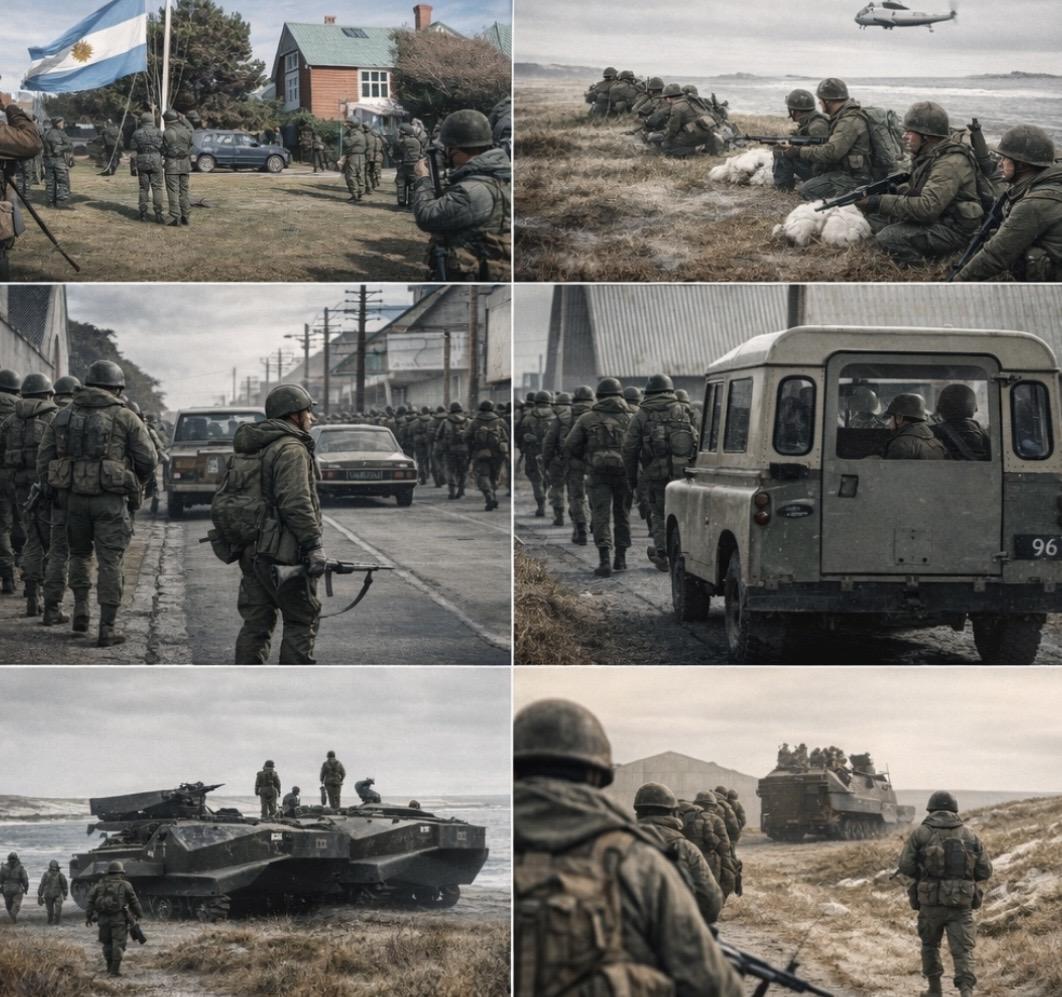
In the early hours of 2 April 1982 Argentine forces began landing on the Falkland Islands. The initial assault involved around 600 to 800 Argentine troops, mainly from the 2nd Marine Infantry Battalion, supported by naval commandos and amphibious commandos. These troops had sailed from Argentina aboard several naval vessels including the amphibious landing ship ARA Cabo San Antonio and the transport ARA Isla de los Estados. The invasion force was escorted by major warships such as the aircraft carrier ARA Veinticinco de Mayo, the cruiser ARA General Belgrano, destroyers, and submarines.
Before the main landing began, Argentine special forces were inserted by submarine and small boats to secure key locations. Naval commandos from the submarine ARA Santa Fe and other vessels were sent to reconnoitre the beaches and to mark landing points near the capital, Port Stanley. Amphibious commandos landed near Mullet Creek, south of Stanley, with the task of advancing toward Government House and neutralising British resistance.
The main amphibious landing followed shortly afterwards. Argentine marines landed from amphibious vehicles launched from ARA Cabo San Antonio. These included LVTP-7 amphibious assault vehicles capable of carrying troops directly from ship to shore. The landing occurred at Yorke Bay, just outside Port Stanley. The marines moved quickly toward the town while additional troops secured the airport and other strategic positions.
At the time of the invasion the British garrison on the islands was very small. The defence of the Falklands was the responsibility of Naval Party 8901, a Royal Marines unit consisting of about 68 to 80 men. The detachment was commanded by Major Mike Norman of the Royal Marines. Also present were a small number of local Falkland Islands Defence Force volunteers and a few British officials including Governor Sir Rex Hunt.
The Royal Marines had limited equipment. They possessed small arms such as L1A1 Self-Loading Rifles, general purpose machine guns, and a few anti-tank weapons. They had no heavy artillery, armoured vehicles, or air support. Despite being heavily outnumbered, the Royal Marines prepared defensive positions around Government House and key locations in Stanley.
The first clashes occurred when Argentine amphibious commandos advanced toward Stanley before dawn. The British defenders engaged them with small arms fire as the Argentine troops attempted to approach Government House. A firefight broke out that lasted for several hours in different parts of the town. Argentine marines supported by armoured amphibious vehicles attempted to push into Stanley while British marines conducted delaying actions.
One of the most intense moments occurred around Government House where Governor Hunt and several Royal Marines had taken defensive positions. Argentine troops surrounded the building and used armoured vehicles and machine guns to apply pressure. The Royal Marines managed to hold off the attackers for some time despite their numerical disadvantage.
During the fighting a small number of casualties occurred. One Argentine marine, Lieutenant Commander Pedro Giachino, who was leading a group attempting to storm Government House, was mortally wounded. He later became one of Argentina’s most famous casualties of the conflict and was honoured by the Argentine government.
As Argentine forces continued to land and surround Stanley it became clear that the British defenders were vastly outnumbered. Argentine troop numbers on the islands increased rapidly to more than 1,000 soldiers within hours, and further reinforcements were on the way. Major Mike Norman and Governor Rex Hunt realised that continued resistance would lead to unnecessary casualties without any chance of stopping the invasion.
Governor Hunt therefore ordered the Royal Marines to cease resistance and surrender in order to avoid bloodshed among the civilian population. The surrender occurred later on the morning of 2 April 1982. The Royal Marines were taken prisoner but were treated relatively well and later repatriated to Britain.
Argentina quickly consolidated control over the islands. Additional units were flown in by transport aircraft including C-130 Hercules transports landing at Stanley airport. Within days the Argentine garrison grew to several thousand troops including army units, marines, air force personnel, artillery, and anti-aircraft systems.
The invasion caused immediate shock and anger in Britain. The British government was led at the time by Prime Minister Margaret Thatcher. News of the invasion reached London early on 2 April and emergency meetings were held by the British cabinet and military leaders. The government condemned Argentina’s actions and demanded immediate withdrawal.
The same day Britain began preparing a major naval task force to sail to the South Atlantic to retake the islands. Warships, aircraft carriers, submarines, and thousands of troops were assembled in what became one of the largest British naval deployments since the Second World War.
One interesting aspect of the invasion was that the Argentine planners originally hoped the operation could be completed with minimal violence and that Britain might negotiate afterwards rather than attempt a military response. The Argentine junta underestimated Britain’s willingness and ability to send a task force nearly 8,000 miles to recover the islands.
Another notable detail is that the Argentine invasion was partly accelerated by an earlier incident on the island of South Georgia in March 1982. Argentine scrap metal workers had landed there and raised the Argentine flag, leading to rising tensions between the two countries. This crisis contributed to the junta’s decision to launch the full invasion earlier than originally planned.
Although the invasion itself was successful and quickly overwhelmed the small British garrison, it triggered the Falklands War. Britain’s naval task force sailed within days, and after ten weeks of intense fighting on land, at sea, and in the air, British forces recaptured the Falkland Islands on 14 June 1982. The conflict ultimately led to the collapse of Argentina’s military dictatorship the following year.