Hungarian Zrinyi
The Hungarian Zrínyi tank, more accurately described as an assault gun, was one of the most successful armored fighting vehicles produced by Hungary during the Second World War. It was designed to provide heavy fire support for infantry and armored units and was influenced by German assault gun concepts. Hungarian forces realized during the early fighting on the Eastern Front that their existing tanks were not well suited to destroying fortified positions or supporting infantry assaults. In response, engineers began work in 1942 on a new vehicle capable of carrying a powerful gun while using an existing tank chassis to simplify production.
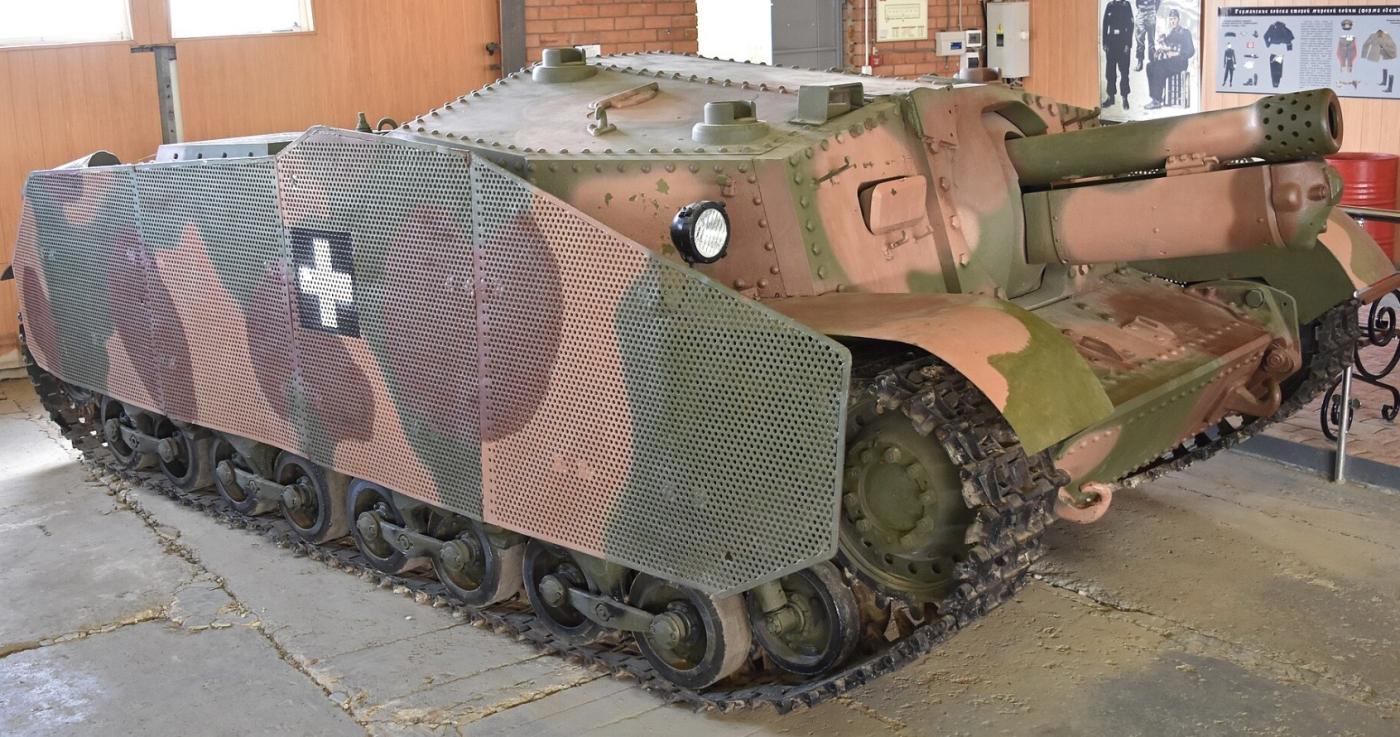
The vehicle was designed by engineers working for the Manfréd Weiss industrial company, one of the largest armaments manufacturers in Hungary. Development took place mainly at the company’s facilities in Budapest, especially at the large industrial complex on Csepel Island. Instead of creating a completely new design, the engineers based it on the chassis of the Hungarian Turán medium tank. The Turán itself had earlier been developed from the Czechoslovak Škoda T-21 design. To convert the chassis into an assault gun, the turret was removed and replaced with a large armored superstructure that housed the main weapon. The hull was widened by about 40 centimetres to allow enough room for the large gun and its crew.
The machine was named after Miklós Zrínyi, a famous Hungarian and Croatian military leader and national hero from the sixteenth century who fought against the Ottoman Empire. Hungarian military vehicles were often named after historic national figures, and this name was chosen to symbolize resistance and military strength.
Two main versions were planned. The first was the 43M Zrínyi II, which became the main production model. The second was the 44M Zrínyi I, intended to serve as a tank destroyer with a more powerful anti-tank gun. Only the Zrínyi II entered large scale production because Hungarian industry and resources were already under severe pressure by the later stages of the war.
Production of the assault gun began in 1943. The main manufacturer was the Manfréd Weiss factory in Budapest, while the Ganz works also assisted with parts and assembly. Manufacturing continued through 1943 and into 1944. Allied bombing raids against Hungarian industry caused major damage to the factories involved in building the vehicle. A large air raid in July 1944 badly damaged the Manfréd Weiss plant and significantly disrupted production. Because of this destruction and the worsening military situation, manufacturing stopped before large numbers could be completed.
Around seventy-two examples of the Zrínyi II were built in total, although some estimates suggest slightly higher numbers when incomplete or prototype vehicles are counted. These vehicles were issued mainly to Hungarian assault gun and armored units and saw service on the Eastern Front against Soviet forces, especially during the fighting in Hungary during 1944 and early 1945.
The armor protection was respectable for an assault gun of its role. The frontal armor of the superstructure was about 75 millimetres thick and sloped, improving its ability to deflect enemy shells. The sides of the hull and superstructure were thinner, around 25 to 30 millimetres, while the rear armor was about 25 millimetres. Roof and bottom armor were thinner, as was common for armored vehicles of the period. The strong frontal protection allowed it to resist many medium caliber anti-tank guns when facing the enemy directly.
The main weapon of the production model was a 105 millimetre howitzer known as the 40/43M 105 mm gun. This weapon was derived from a Hungarian field artillery piece and was designed mainly for firing high explosive shells. It was highly effective against bunkers, anti-tank positions, and infantry concentrations. The gun could also fire smoke shells and occasionally armor-piercing rounds, though the vehicle was not intended primarily for anti-tank combat. About 52 rounds of ammunition were carried inside the vehicle. A secondary weapon was a 7.92 millimetre machine gun used for defence against infantry.
The planned Zrínyi I variant was designed to mount a long 75 millimetre anti-tank gun similar in power to the German Pak 40. This version would have been much more effective against enemy tanks such as the Soviet T-34. However only a prototype or a very small number of experimental vehicles were built before the project was cancelled due to wartime pressures.
The crew consisted of four men: commander, gunner, loader, and driver. Most of the crew worked inside the armored superstructure, while the driver sat slightly forward in the hull. The commander observed the battlefield and directed the gunner. Because the vehicle lacked a rotating turret, the driver often had to help align the hull toward the target so the gun could engage it.
Power came from a Manfréd Weiss Z-TURAN gasoline engine producing about 260 horsepower. This allowed a maximum road speed of around 40 kilometres per hour, though operational speeds were usually lower in combat conditions. The vehicle weighed approximately 21 to 22 tons depending on equipment and ammunition. Its operational range was roughly 200 kilometres on roads.
In combat the assault gun proved to be one of the most effective armored vehicles used by Hungary during the war. Hungarian crews generally considered it reliable and well suited to infantry support. The powerful 105 millimetre gun was particularly feared by enemy infantry and could easily destroy field fortifications. Although it was not designed to fight tanks, skilled crews sometimes used it successfully against enemy armor by firing high explosive shells at close range.
Several Hungarian assault gun battalions were equipped with these vehicles, including units that fought during the defense of Hungary in 1944 and during the battles around Budapest in 1944–1945. By the final months of the war many had been destroyed in combat or abandoned because of mechanical failure or lack of fuel. Very few survived the war intact.