How V-2 Rocket worked
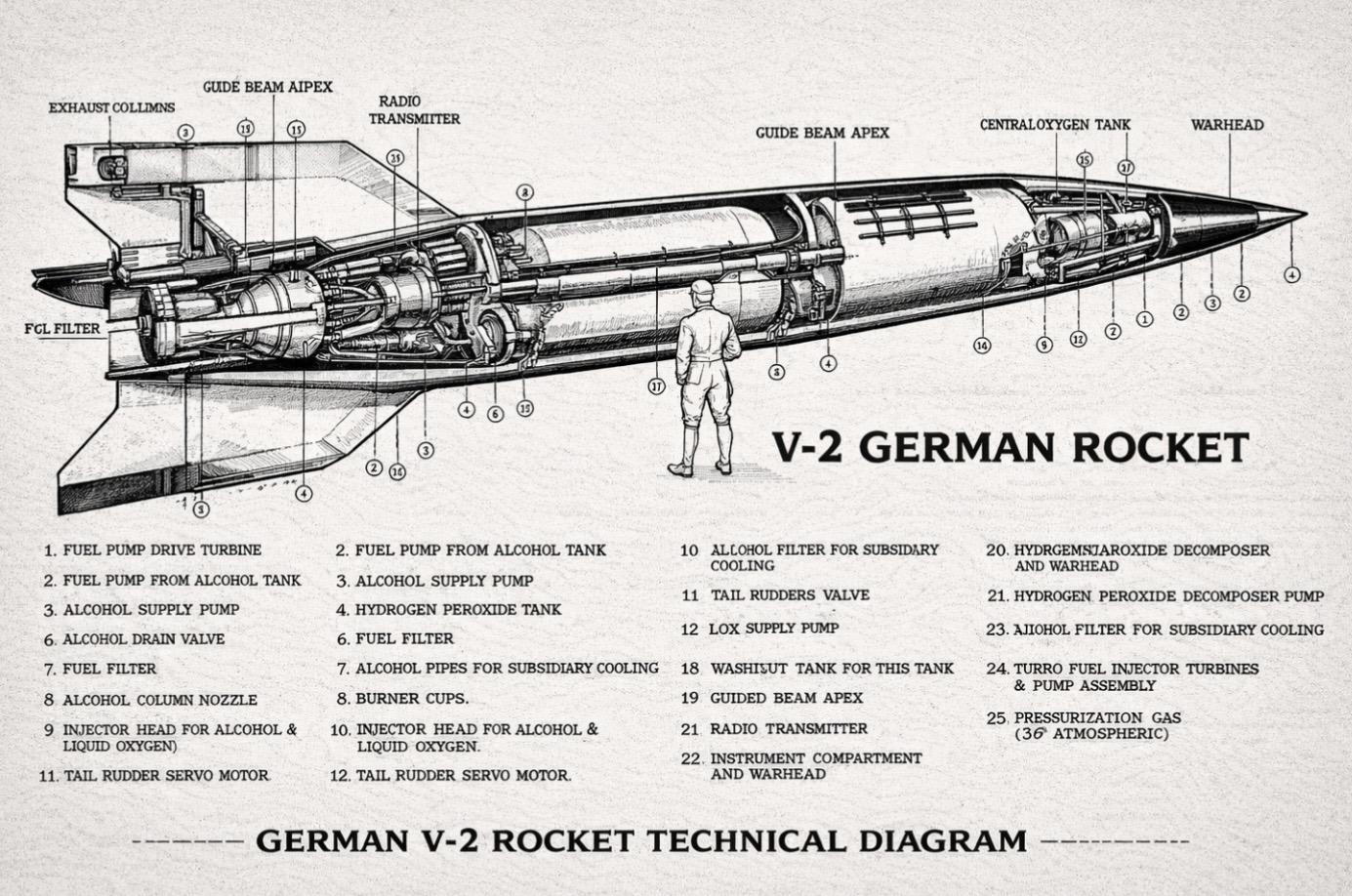
The V-2 rocket, known in Germany as the A-4, was the world’s first operational long-range ballistic missile and one of the most technologically advanced weapons developed during the Second World War. It was designed to deliver a large explosive warhead over distances of several hundred kilometres using a liquid-fuel rocket engine. The internal arrangement of the rocket, shown in the cutaway reference drawing used for this article, reveals how a series of complex systems worked together to launch the missile, guide it during flight, and carry it to its target at supersonic speed.
At the very top of the rocket was the warhead contained within a streamlined nose cone. The warhead held approximately 910 kilograms of high explosive, usually amatol, packed within a strong steel casing. It was fitted with an impact fuze designed to detonate the charge when the missile struck the ground. Because the rocket travelled extremely fast and re-entered the atmosphere after reaching high altitude, the explosive was surrounded by insulating material such as glass wool to protect it from vibration and heat during flight. The shape of the nose cone helped reduce aerodynamic drag and allowed the missile to travel efficiently through the air.
Directly beneath the warhead was the guidance and control compartment. The V-2 did not rely on radio control once launched. Instead it used an automatic inertial guidance system. Two gyroscopes measured the rocket’s orientation in space and ensured that it maintained the correct attitude during flight. An accelerometer measured the rocket’s velocity, and these instruments fed information into an analogue control system that continuously adjusted the rocket’s steering. If the rocket began to deviate from its programmed course, electrical signals were sent to steering mechanisms in the tail to correct the direction. The rocket’s range was controlled by measuring its velocity. When the missile reached the correct speed for the intended distance, the guidance system shut off the engine, allowing the rocket to continue along a ballistic trajectory toward its target.
Below the guidance compartment were the large propellant tanks that occupied most of the rocket’s central structure. Because a rocket must carry both fuel and oxidiser, the V-2 stored two separate propellants. One tank contained liquid oxygen, which served as the oxidiser necessary for combustion. The other tank held the fuel, a mixture of approximately seventy-five percent ethanol and twenty-five percent water. The water was added to moderate combustion temperature and reduce the risk of overheating the engine. Together these tanks held several tonnes of propellant, which made up the majority of the rocket’s launch weight. As the rocket ascended, the propellants were drawn from the tanks and fed to the engine at very high flow rates.
Delivering the propellants to the engine required a powerful pumping system. Instead of relying on pressurised tanks, which would have been extremely heavy, the V-2 used a turbopump driven by steam. Concentrated hydrogen peroxide was passed over a catalyst that rapidly decomposed it into steam and oxygen. This high-pressure steam drove a turbine connected to two centrifugal pumps. One pump forced the alcohol fuel toward the combustion chamber, while the other pumped liquid oxygen. The turbopump allowed large quantities of propellant to be delivered to the engine each second, which made it possible for the rocket to generate the thrust necessary to lift itself off the ground.
At the base of the rocket was the engine itself. Inside the combustion chamber the alcohol and liquid oxygen were injected through a complex injector system that ensured the propellants mixed efficiently. An ignition system started the reaction, and once combustion began the propellants burned rapidly, producing extremely hot gases. These gases expanded and rushed out through the rocket nozzle at very high speed. According to Newton’s third law, the reaction force from the escaping exhaust pushed the rocket upward. The engine produced roughly twenty-five tons of thrust, enough to accelerate the heavy missile away from the launch platform and continue propelling it upward for just over a minute.
During the powered portion of the flight the rocket needed to be steered carefully to ensure it followed the correct path. The V-2 used two different steering systems. Inside the exhaust stream were four graphite vanes mounted just below the engine nozzle. These vanes could be moved slightly into the exhaust flow to deflect the direction of the escaping gases. By altering the thrust direction in this way, the rocket could be turned during the early phase of flight when the missile was moving too slowly for aerodynamic control surfaces to be effective. As the rocket accelerated and the airflow over the vehicle increased, aerodynamic fins at the base of the missile began to assist with steering. Each of the four external fins contained a movable rudder surface that responded to signals from the guidance system, allowing more precise control once the rocket had reached high speed.
When the engine ignited on the launch platform, the rocket accelerated vertically before gradually tilting toward its programmed trajectory. The engine continued burning for about sixty to sixty-five seconds, during which time the rocket accelerated to several times the speed of sound. Once the rocket reached the velocity required for its target distance, the guidance system shut off the engine. By this point the missile was already travelling extremely fast and climbing steeply. Even without further thrust, its momentum carried it upward to altitudes approaching ninety kilometres, near the edge of space.
After reaching the peak of its trajectory, the rocket began to descend toward its target along a ballistic path similar to that of an artillery shell, though on a much larger scale. During this phase there was no further propulsion. Gravity pulled the missile back toward Earth, and it accelerated again as it fell through the atmosphere. Because the rocket travelled faster than the speed of sound, it struck its target before the sound of its approach could be heard. The impact triggered the fuze in the warhead, detonating the explosive charge.
The internal arrangement shown in the cutaway reference drawing illustrates how carefully balanced the rocket’s design had to be. The heavy warhead was placed at the front, the guidance instruments just behind it, the large propellant tanks in the central structure, and the engine and steering systems at the rear. Each component depended on the others. The pumps supplied propellant to the engine, the engine produced the thrust required for flight, the guidance system maintained the rocket’s direction, and the warhead provided the destructive payload.
Although it was developed as a weapon, the V-2 represented a major technological step in rocketry. Many of its features—liquid propellants, turbopumps, gyroscopic guidance and high-altitude ballistic flight—later became fundamental elements of space launch vehicles and modern missiles. The engineering principles demonstrated by the rocket would influence rocket development long after the war had ended.