Guadalcanal final Offensive
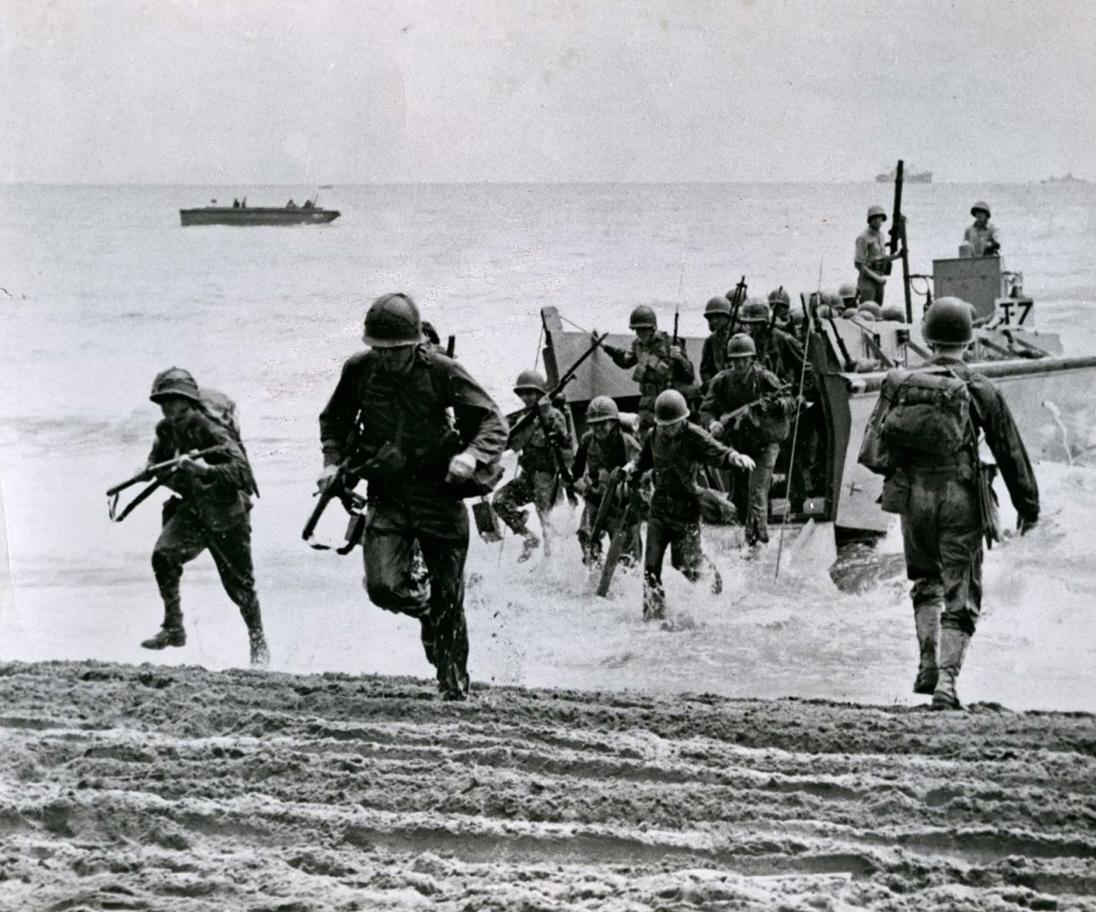
The final American offensive on Guadalcanal in early 1943 marked the decisive conclusion of one of the most brutal and strategically important campaigns of the Second World War in the Pacific. Guadalcanal, part of the Solomon Islands chain, had been the scene of relentless fighting since August 1942, when U.S. Marines first landed to prevent Japan from completing an airfield that could threaten Allied supply routes to Australia. By January 1943 the initiative had shifted firmly to the United States, and the Japanese position on the island had become desperate.
Overall Allied command in the South Pacific was held by Admiral William F. Halsey Jr., an aggressive and outspoken U.S. Navy officer who replaced Admiral Robert Ghormley in October 1942 after the campaign had begun to stagnate. Halsey immediately injected energy into Allied operations, pushing for more decisive action and reinforcing Guadalcanal with additional troops, ships, and aircraft. On the ground, American forces were under the command of Major General Alexander M. Patch of the U.S. Army, who took over from Marine General Alexander Vandegrift in December 1942. By this time, the original Marine divisions had been badly worn down by months of jungle fighting, disease, and supply shortages, so the U.S. Army’s Americal Division and the 25th Infantry Division were brought in to finish the job.
Opposing them was Japan’s 17th Army, commanded by Lieutenant General Harukichi Hyakutake. By early 1943, Hyakutake’s forces were in catastrophic condition. Most of his troops were malnourished, weakened by tropical disease, and short of ammunition, food, and medical supplies. Repeated attempts by the Japanese Navy to resupply or reinforce Guadalcanal had failed due to American air and naval dominance, especially after the Allies secured Henderson Field, the key airstrip on the island. The nightly Japanese destroyer runs, nicknamed the “Tokyo Express” by the Americans, could bring in some men but not enough heavy supplies to sustain a large army.
The American final offensive began in January 1943 and was designed to eliminate the remaining Japanese strongholds on the western side of the island. General Patch planned a methodical advance rather than the risky, headlong assaults that had characterized earlier phases of the campaign. U.S. forces pushed westward from their established perimeter around Henderson Field toward a series of heavily defended ridges, rivers, and jungle positions. The Japanese had built strong defensive lines, using the dense terrain to their advantage, digging bunkers and foxholes into hillsides and positioning machine guns to cover narrow trails.
One of the most significant objectives was a powerful Japanese defensive area near Mount Austen, a rugged, jungle-covered massif that dominated key routes. American troops had already fought hard battles there in late 1942, but in January 1943 they renewed the attack with greater strength and coordination. Artillery, mortars, and air strikes from Marine and Army aircraft were used to soften Japanese positions before infantry advanced. U.S. soldiers learned from earlier mistakes and avoided massed charges, instead using flanking movements and small-unit tactics to root the defenders out of their bunkers.
As the Americans advanced, Japanese resistance steadily weakened. Many Japanese soldiers were too sick or hungry to fight effectively, and some units simply melted away into the jungle. Despite this, pockets of fierce resistance still occurred, and American troops had to clear caves, ravines, and fortified hilltops one by one. The terrain and weather remained brutal, with thick mud, heavy rain, and swarms of insects making every movement exhausting and dangerous.
By this point, the Japanese high command in Tokyo had already accepted that Guadalcanal was lost. In a remarkable decision, they chose not to continue sacrificing troops in a hopeless fight but instead planned a secret evacuation, known as Operation Ke. Under this plan, Japanese naval forces would extract as many surviving soldiers as possible using fast destroyers under cover of darkness. Admiral Isoroku Yamamoto, the architect of the attack on Pearl Harbor, was involved in coordinating the naval side of this evacuation, even as American forces believed they were facing preparations for a final Japanese counterattack.
Throughout late January and early February 1943, while U.S. troops were still pushing westward, Japanese destroyers slipped in at night and took off thousands of soldiers from remote beaches. American intelligence misread these movements, thinking they were reinforcement runs rather than evacuations, which allowed the Japanese to pull off one of the most successful withdrawals in their military history. By the time the Americans realized what was happening, most of Hyakutake’s remaining troops were already gone.
On 7 February 1943, U.S. patrols reached the western end of Guadalcanal and found it largely empty of enemy forces. Organized Japanese resistance had ceased, and the island was declared secure. Although many Japanese soldiers had escaped, they left behind enormous quantities of equipment, artillery, and supplies, and more than 20,000 Japanese troops had died during the campaign, compared to about 7,000 Allied dead from combat and disease.
The final American offensive on Guadalcanal was therefore a success, even though it ended with an enemy evacuation rather than a total annihilation. Strategically, it was a decisive victory. It marked the first major land defeat of the Imperial Japanese Army and ended Japan’s attempt to expand toward Australia. Control of Guadalcanal gave the Allies a vital base from which to launch further offensives up the Solomon Islands and toward New Guinea, beginning the long advance that would eventually lead to Japan’s defeat. The campaign also proved that American forces, under leaders like Halsey and Patch, had learned how to fight effectively in the Pacific, combining land, sea, and air power in a way that Japan could no longer match.