
Germanys WW1 Borrowing
Germany entered the First World War with a financial system that was confident, centralized, and deeply shaped by nineteenth-century assumptions about how wars should be paid for. The leadership expected a short conflict and believed that victory would allow the defeated enemies to cover Germany’s costs. This belief fundamentally shaped how the war was financed and ultimately proved disastrous.
At the outbreak of war in 1914, the German government deliberately avoided heavy wartime taxation. Instead, it suspended the gold standard and relied on borrowing and money creation. The central institution in this process was the Reichsbank, which expanded the money supply and supported government borrowing. Gold coins disappeared from circulation almost immediately and were replaced with paper money, while citizens were encouraged to hand over gold jewelry and coins “for the fatherland.”
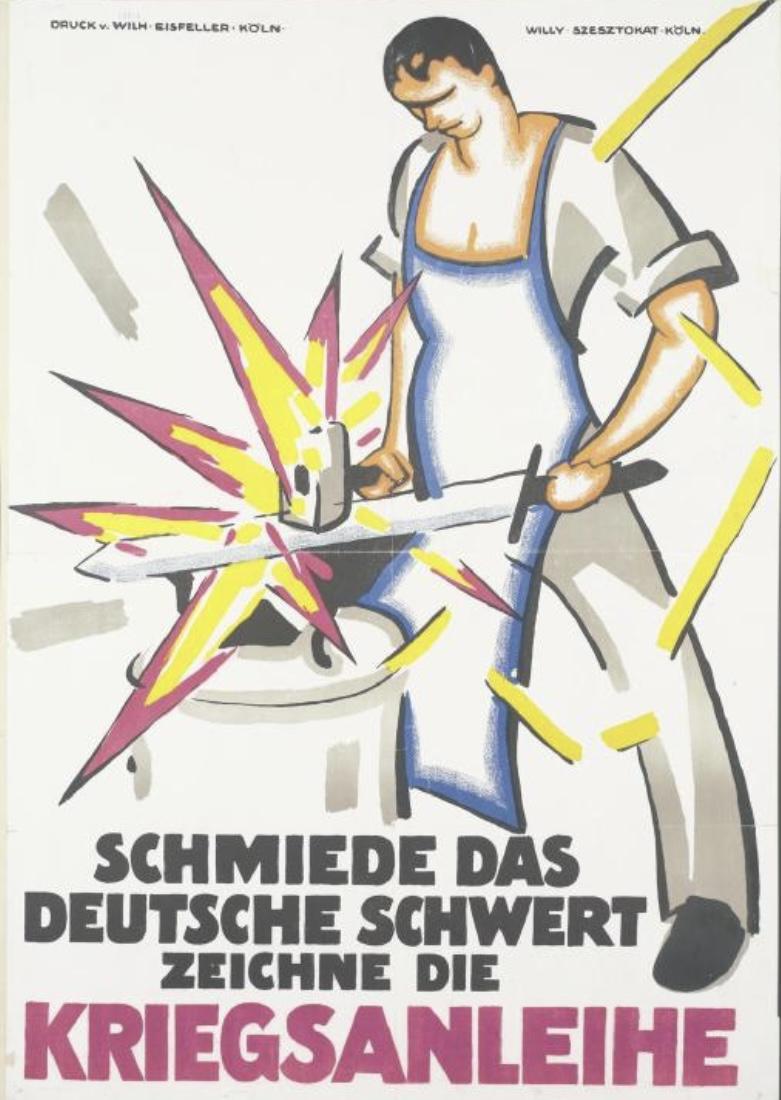
The core of Germany’s wartime finance was a series of eight major war loans issued between 1914 and 1918. These loans were marketed aggressively to the public as patriotic investments. Middle-class households, industrialists, banks, and even schoolchildren were encouraged to participate. The state presented the loans not as a burden, but as a moral duty and a symbol of national unity. One striking propaganda theme showed a medieval-style swordsmith hammering a glowing blade on an anvil, sparks flying, embodying strength, sacrifice, and endurance. The message was clear: the money raised would be forged directly into weapons for victory, and the act of subscribing to a loan was portrayed as equivalent to striking the hammer yourself.
The propaganda campaign was extensive and emotionally sophisticated. Posters, pamphlets, newspaper ads, and public rallies emphasized honor, protection of the homeland, and faith in inevitable triumph. Subscriptions were often accompanied by ceremonies, bands, and speeches. Banks displayed lists of subscribers in their windows, turning participation into a public measure of loyalty. Social pressure played a powerful role, especially in urban middle-class communities.
In total, Germany raised roughly 98 billion marks through war loans over the course of the conflict. This was an enormous sum by prewar standards, but it still covered only part of the total cost. Overall wartime expenditure reached approximately 150 billion marks. Taxes contributed less than 10 percent of total war spending, an exceptionally low figure compared with Britain or France. The remainder was financed through borrowing and the expansion of credit, much of it indirectly monetized by the Reichsbank.
As the war dragged on, this system became increasingly fragile. Each successive loan was harder to sell. Early optimism faded as casualties mounted, food shortages worsened, and victory looked less certain. Later loans relied more heavily on institutional investors and banks, while ordinary citizens were stretched thin. At the same time, prices steadily rose. Although inflation during the war was significant, it was partially masked by price controls and rationing.
Defeat in 1918 transformed a risky financial strategy into a full-blown economic crisis. The new Weimar Republicinherited massive internal debt, a weakened tax base, and an economy disrupted by demobilization and social unrest. Unlike the original plan, Germany could not shift its wartime costs onto defeated enemies. Instead, the burden remained domestic, compounded by reparation obligations imposed by the Treaty of Versailles.
To meet its obligations and stabilize society, the postwar government continued to rely on borrowing and money creation. Confidence in the mark eroded, and inflation accelerated dramatically. By 1923, this process culminated in hyperinflation, during which savings accumulated through years of war loan subscriptions were effectively wiped out. Middle-class families who had believed they were investing safely and patriotically found their bonds nearly worthless. The social consequences were severe, breeding resentment, distrust in democratic institutions, and a lasting sense of betrayal.