French Commemorative Medal
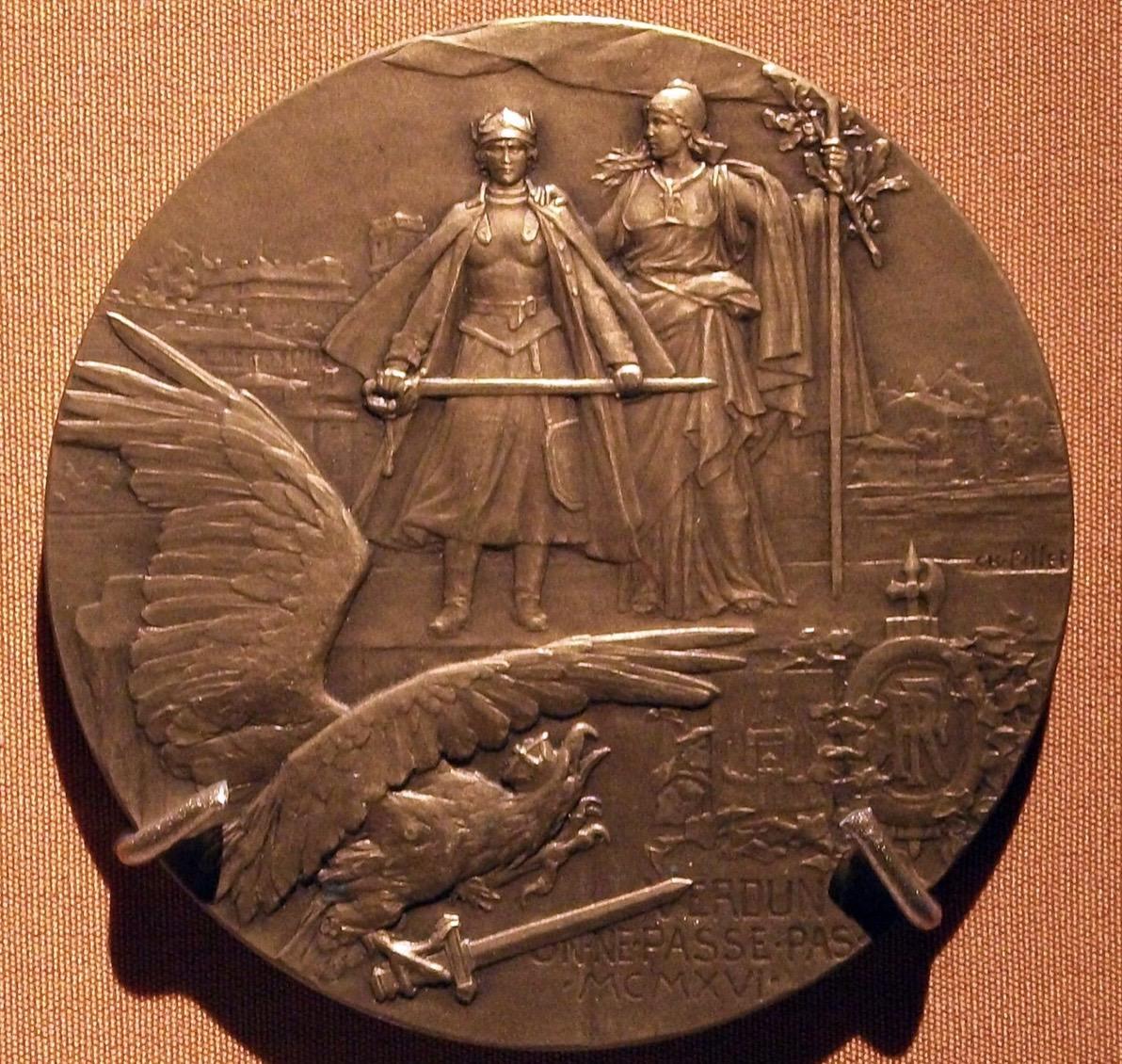
The commemorative medal known as the “Héros de Verdun” created by the French medallist Charles Pillet is one of the most evocative unofficial decorations connected with the First World War, particularly the titanic struggle around Verdun in 1916. Although often mistaken for an official state decoration, it was in fact a privately commissioned and distributed commemorative piece intended to honour those who had taken part in one of the most famous defensive battles in French history. Its production, distribution, artistic symbolism and later collecting history all contribute to its enduring interest among historians and numismatists.
Charles Pillet, a respected French medallist and sculptor active in the late nineteenth and early twentieth centuries, designed the medal in the years following the war. Pillet had a long association with patriotic and commemorative medallic art, and his work frequently combined classical allegory with realistic portraiture. His Verdun medal fits squarely into this tradition, portraying the battle not simply as a military event but as a national ordeal and triumph. The medal is typically referred to as the “Médaille Commémorative des Héros de Verdun” and sometimes simply as the “Verdun Medal” or “Pillet Verdun Medal.”
The medal was not issued by the French government but by a veterans’ and patriotic initiative connected to committees formed to commemorate the defenders of Verdun. It appears to have been struck in the early 1920s, when many French towns and organisations were creating memorials and issuing commemorative items to honour veterans. Production was undertaken by French private mints and medal workshops rather than the Monnaie de Paris in an official capacity, although the Paris Mint did carry out some contract striking work for private commissions at the time. Evidence suggests that the medal was manufactured by a Parisian medallic firm under Pillet’s artistic supervision, using traditional striking methods rather than casting, giving the pieces a sharp, sculpted relief characteristic of high-quality French medallic art of the period.
The precise number produced has never been definitively recorded, as surviving documentation is incomplete and production likely occurred in several batches. Estimates from numismatic research and surviving specimens suggest that several tens of thousands were made, most commonly cited between roughly 20,000 and 50,000 pieces. The number may have varied because additional strikings were produced to meet demand from veterans and families. Unlike strictly limited official decorations, the Verdun medal could be requested or purchased by eligible veterans or their relatives, which explains why production was demand-driven rather than fixed. Some later restrikes may also exist, adding complexity to attempts to determine an exact total.
The medal was generally struck in bronze, which was the standard material for many French commemorative medals of the era. Bronze provided durability, affordability and a suitably dignified appearance. Some examples exist in silvered bronze or gilt bronze, and a smaller number were produced in solid silver, usually intended for presentation purposes or for officers and dignitaries. These precious metal versions are considerably rarer. The typical bronze version has a warm brown or chocolate patina, often applied at the time of manufacture. The medals were struck rather than cast, meaning that blanks were prepared and then stamped under pressure between engraved dies, resulting in crisp detail.
The obverse design created by Pillet is particularly striking. It usually depicts a symbolic representation of France, often as Marianne or a helmeted female allegory, sometimes shown standing resolute or in mourning yet defiant, accompanied by imagery of the fortress of Verdun or battlefield motifs. The reverse typically bears inscriptions honouring the defenders of Verdun, with wording such as “Aux Héros de Verdun” and dates referencing the 1916 battle. Some versions include additional inscriptions naming Verdun itself or commemorating the endurance of French forces. The medal’s iconography emphasises sacrifice, national unity and the defensive heroism associated with Verdun’s prolonged resistance against German assault.
Distribution of the medal was directed primarily toward French veterans who had served in the Verdun sector during the battle and subsequent operations in the region. Eligibility was broad, reflecting the battle’s prolonged duration and the large number of units rotated through the front. Soldiers of all ranks who could demonstrate service at Verdun were entitled to receive or purchase the medal. It was also given in some cases to the families of those killed in action there, and occasionally to nurses, support personnel and others whose wartime service was directly connected to Verdun. Because it was not an official state decoration, it did not carry the strict award criteria or formal citation process of decorations such as the Croix de Guerre. Instead, it functioned as a commemorative honour acknowledging participation and sacrifice.
Veterans’ associations and commemorative committees played a major role in distribution. Many medals were presented during post-war reunions, remembrance ceremonies and unveiling events for war memorials. In some cases, local committees arranged group presentations to veterans in their communities. Others were acquired individually by veterans through application or purchase, often accompanied by certificates attesting to their Verdun service. This hybrid system of presentation and purchase was common for privately issued commemorative medals in post-war France.
The medal was typically worn suspended from a ribbon, though ribbon colours and patterns varied slightly depending on the issuing body or production batch. Most commonly, the ribbon incorporated colours associated with Verdun or French national symbolism, often including red, white and blue or combinations suggestive of sacrifice and victory. Some recipients wore the medal alongside official decorations on ceremonial occasions, though it held no official precedence in the French honours system.
An interesting aspect of the Pillet Verdun medal is the emotional and symbolic significance it held for veterans. Verdun had become the central symbol of French endurance during the war, and those who served there were often regarded with particular reverence. The medal served not only as a personal memento but also as a visible sign of participation in what many contemporaries saw as the defining struggle of the French army in 1916. Its popularity among veterans explains why production numbers were relatively high and why it remained in demand for years after the war.
Collecting interest in the medal began relatively early, particularly among French and European numismatists specialising in First World War memorabilia. Because it was produced in multiple metals and sometimes in slightly different die varieties, collectors today often seek to identify variations in inscription, patina and ribbon. The rarer silver and gilt versions command higher interest and value. Provenanced examples with named certificates or known veteran ownership are particularly prized, as they link the object directly to individual participants in the battle.
The medal also forms part of a broader tradition of unofficial commemorative awards created after the First World War. Many French battles and campaigns inspired similar pieces, but the Verdun medal designed by Charles Pillet stands out for its artistic quality and widespread recognition. It encapsulates both the trauma and the pride associated with Verdun and reflects the desire of veterans and society to memorialise a shared ordeal.