Free French Forces
The combined Free French units in North Africa emerged between 1940 and 1943 as a fragile but increasingly effective military force built from fragments of the defeated French Army, colonial troops, and volunteers who rejected the authority of Vichy France. After the French armistice with Germany in June 1940, most French forces in North Africa initially remained loyal to the Vichy regime, leaving the Free French movement with almost no formal military presence in the region. What eventually became the Free French forces in North Africa was the result of political realignment, battlefield success, and careful consolidation rather than a single planned creation.
Overall leadership of the Free French was held by Charles de Gaulle, who operated first from London and later from Algiers. In the field, however, command was fragmented until late 1942. One of the most important operational commanders was Philippe Leclerc, whose desert column became a symbol of Free French resistance. Other senior figures included General Marie-Pierre Kœnig, who commanded Free French forces during critical desert engagements, and General Georges Catroux, who played a key role in rallying colonial territories to the Free French cause. After the Allied landings in North Africa in November 1942, de Gaulle was forced into an uneasy power-sharing arrangement with General Henri Giraud, a rival French commander supported by the Americans, until de Gaulle gradually consolidated authority in 1943.
In terms of manpower, Free French forces in North Africa were initially very small. In 1941, the Free French presence in the region amounted to only a few thousand men, mostly based in Chad and other central African territories rather than the Mediterranean coast. By mid-1942, Free French units operating in the Libyan desert numbered roughly 5,000 to 6,000 troops. These included the 1st Free French Brigade, composed of infantry, artillery, engineers, and support units. After Operation Torch and the subsequent defection of most Vichy forces in North Africa, the situation changed dramatically. By mid-1943, the combined Free French and rallied former Vichy units in North Africa amounted to approximately 300,000 men, although only a portion of these were initially combat-ready.
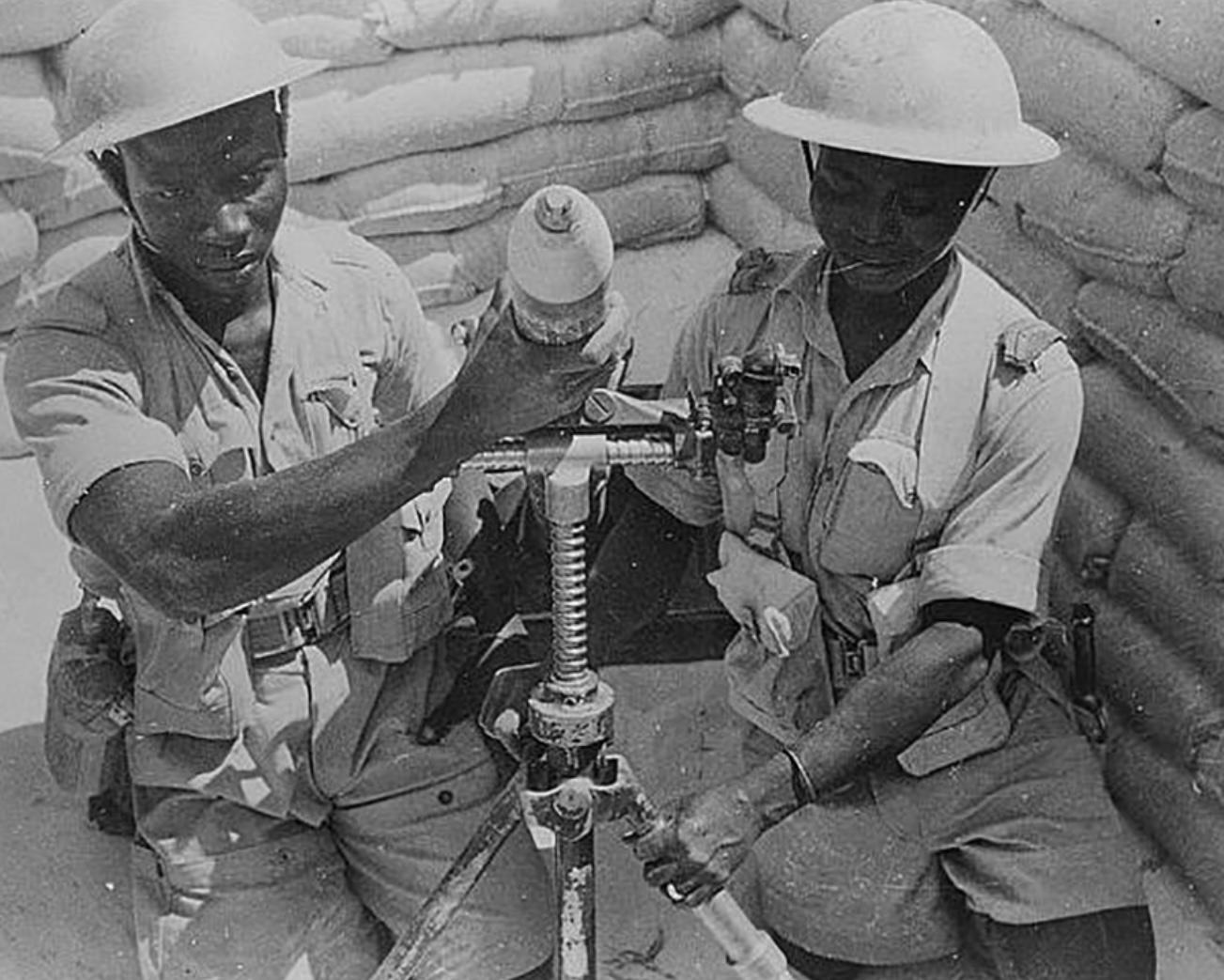
The origins of these troops were remarkably diverse. Many came from France itself, having escaped via Spain, the Mediterranean, or the Middle East. Large numbers were colonial soldiers drawn from French territories in Africa, including troops from Chad, Cameroon, Congo, Morocco, Algeria, and Tunisia. North African Muslims formed a significant portion of the rank and file, especially after 1942, serving alongside European settlers and metropolitan French volunteers. There were also foreign volunteers, including Spaniards who had fled Franco’s regime and Jews from North Africa who joined after anti-Jewish Vichy laws were overturned.
One of the most famous actions involving Free French units in North Africa was the defense of Bir Hakeim in Libya in 1942. For over two weeks, Free French forces held off Axis attacks by German and Italian troops, disrupting Axis plans and earning international recognition for the Free French as a credible fighting force. This battle had enormous symbolic value, proving that French troops were still willing and able to fight the Axis independently.
An interesting feature of the Free French forces in North Africa was the severe shortage of equipment. Early units relied on a mix of obsolete French weapons, captured Italian equipment, and British-supplied arms. Uniforms were equally inconsistent, with British battledress worn alongside French kepis and colonial headgear. This logistical chaos reinforced the perception of the Free French as improvised and under-resourced, yet it also fostered a strong esprit de corps among the troops.
Politically, North Africa became crucial to the future of Free France. After the Allied landings and the collapse of Vichy authority in the region, Algiers became the de facto capital of Free France. From there, de Gaulle reorganized the French armed forces into what would later become the French Army of Liberation. Many of the units formed or reconstituted in North Africa went on to fight in Italy, southern France, and Germany itself.
Another notable aspect was the tension between ideology and pragmatism. While the Free French portrayed themselves as champions of republican values, colonial hierarchies largely remained intact, and non-European soldiers were often denied promotion or equal treatment. Despite this, many colonial troops remained loyal and fought with distinction, forming the backbone of several frontline units.
By the end of the North African campaign in 1943, the Free French forces had transformed from a symbolic resistance movement into a mass army capable of sustained conventional warfare. North Africa served as the bridge between defeat in 1940 and liberation in 1944, and the combined Free French units there laid the institutional, military, and political foundations for France’s return as a major Allied power.