On this day in military history…
The formation of Australia’s national military on 1 March 1901 marked a pivotal moment in the nation’s history, coinciding with the federation of the colonies into the Commonwealth of Australia on 1 January 1901. Before federation, each colony maintained its own forces, including volunteer militias, local defense units, and small permanent contingents. These units varied in size, organization, and equipment, and their operations were largely focused on local defense rather than a coordinated national strategy. With federation, the Commonwealth sought to unify these disparate colonial forces into a single, cohesive organization capable of defending the young nation.
On 1 March 1901, the Commonwealth Government formally established the national military as a unified entity. The formation involved consolidating existing colonial units under the Department of Defence, which was headquartered in Melbourne, Victoria, initially at 1 Treasury Place. At the time of formation, the service enrolled approximately 28,000 personnel. This number included members of the permanent forces, numbering around 1,500, and the larger citizen militia and volunteer contingents drawn from all six former colonies. These personnel were distributed across various regiments, batteries, and infantry units, which had previously served independently within their respective colonies.
The first commander of the newly formed force was Colonel William Bridges, an experienced officer with a career in the British Army before serving in Australia. Bridges played a crucial role in organizing the troops, establishing training standards, and creating administrative structures that allowed for centralized command and coordination among the previously separate colonial units. His leadership was instrumental in setting the foundation for the modern national defense organization and in guiding its early development.
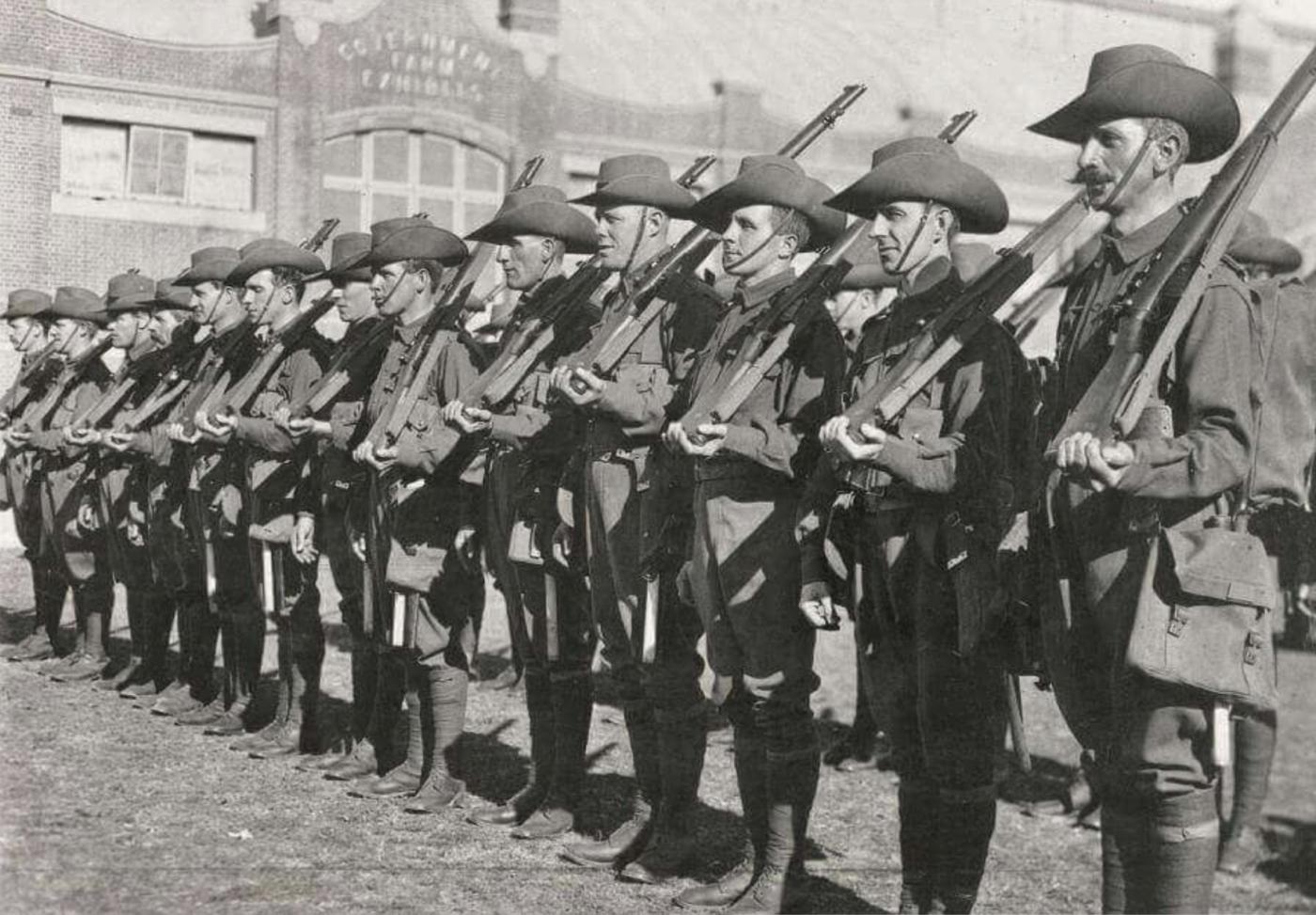
At the time of federation, the troops were equipped with a range of weapons inherited from the colonial forces. Rifles such as the British-designed Martini-Henry and Snider-Enfield were widely used, while sidearms included revolvers like the Beaumont-Adams. Most of this equipment had been supplied by British manufacturers under contracts with the individual colonies prior to 1901. Cavalry and mounted troops were provided with hardy Waler horses suited to Australia’s terrain. Because each colony had purchased weapons independently, there was considerable variation in calibres and types of equipment across units, and the standardization of arms became a key focus of the new administration in the years following federation.
Training and administration initially took place in Melbourne, with additional drill grounds and depots across New South Wales, Queensland, South Australia, Tasmania, and Western Australia to facilitate the transition of colonial units into the national force. Units were encouraged to maintain local recruiting while adhering to standardized training, discipline, and operational procedures. This centralization helped ensure that the military could function as a unified body rather than as a collection of independent militias.
The early defense force was relatively small compared to other nations’ armies, but it reflected the country’s strategic priorities at the time, emphasizing coastal defense and the capacity to support the British Empire if needed. Its formation also represented a broader effort to create a national identity and sense of unity among Australians in the years following federation. This step toward centralization allowed Australia to develop its own military traditions while maintaining strong links with Britain and laid the groundwork for participation in later conflicts, including the First World War.
Overall, the establishment of the national forces on 1 March 1901 was a carefully organized process involving the unification of colonial contingents, the enrollment of tens of thousands of personnel, and the appointment of Colonel William Bridges as its first commander. The creation of this centralized military institution reflected both practical defense needs and the symbolic importance of nation-building, forming a framework that would evolve into one of the most respected armed forces in the region.