First use of GEE Navigation
The Royal Air Force first began operational use of the Gee radio navigation system in March 1942 as part of its effort to improve the accuracy of night bombing over German-occupied Europe and Germany itself. By early 1942 RAF Bomber Command had suffered from severe navigational problems. Night bombing reduced losses to German fighters but greatly reduced accuracy. Many bombers were missing their targets by miles, and reports suggested that only a small proportion of bombs fell within five miles of the intended aiming point. The British Air Ministry and scientific advisers had therefore accelerated the development of electronic navigation aids, and Gee became the first of these to reach operational status.
The Gee system entered combat service on the night of 8 March 1942. This date marked the first major RAF bombing raid in which Gee was used operationally to guide aircraft to their target. The chosen target for this first Gee-assisted operation was the German industrial city of Essen in the Ruhr, a heavily defended area that included the Krupp armaments works, one of the most important industrial facilities in Nazi Germany. Bomber Command had attacked Essen many times before, but with limited accuracy and inconsistent results. The introduction of Gee was intended to improve navigation over long distances and through heavy cloud and darkness.
On the night of 8/9 March 1942, approximately 211 RAF bombers took part in the attack on Essen. Of these, a selected number of aircraft were equipped with the new Gee navigation receivers. Early operational squadrons fitted with Gee included Stirling, Wellington, and Halifax bombers. Roughly 60 to 80 aircraft on the raid are generally estimated to have carried operational Gee sets, though exact numbers varied as equipment installation was still underway and some aircraft carried experimental or partially calibrated sets. The Gee-equipped aircraft were usually assigned to experienced crews and often placed in leading positions within the bomber stream, since their improved navigation was expected to help guide other aircraft toward the target area.
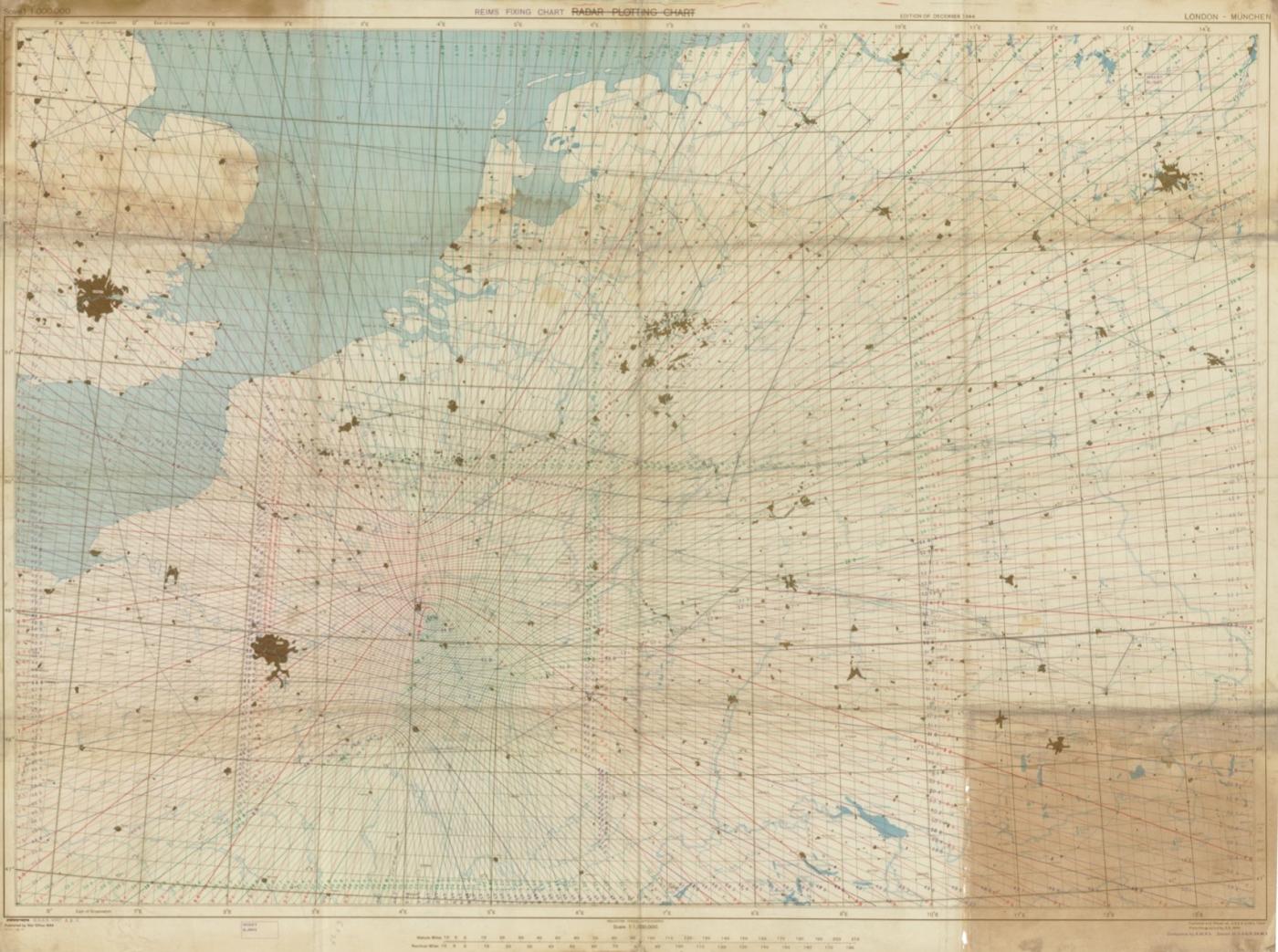
The Gee system itself was a hyperbolic radio navigation system based on precise timing of radio pulses transmitted from ground stations in Britain. Chains of synchronized transmitters sent out radio signals at carefully controlled intervals. Each Gee receiver in a bomber measured the time difference between signals arriving from different transmitting stations. Because radio waves travel at the speed of light, the time difference corresponded to a difference in distance from each station. By using these time differences, navigators could determine that they lay somewhere along a hyperbolic line on the map. With signals from multiple stations, the intersection of these hyperbolic lines gave a fairly precise position fix. The navigator used a special Gee chart marked with hyperbolic curves and a cathode-ray tube display in the aircraft to interpret the signals and determine the aircraft’s position.
Under ideal conditions Gee could provide positional accuracy of roughly one mile or better at ranges up to about 350 to 400 miles from the transmitters in Britain. Accuracy decreased with distance, but for targets in western Germany such as Essen the system was extremely valuable. Navigators could obtain fixes every few minutes, even in total darkness or cloud cover, and could therefore guide the aircraft much more reliably than by dead reckoning or celestial navigation. The equipment consisted of a receiver unit, a display tube, and associated aerials. It added weight and required electrical power but was considered a major technological advance.
The Essen raid of 8/9 March 1942 demonstrated the promise of Gee but did not immediately produce dramatic bombing accuracy. Weather conditions over the target included haze and industrial smoke, and although Gee improved navigation to the target area, the RAF still relied on visual identification or flares to mark aiming points. Reports after the raid indicated that bombing was somewhat more concentrated than in previous attacks but still scattered across the city. Some damage was inflicted on Essen and its industrial districts, but the Krupp works were not heavily damaged in this particular raid. In that sense the operation was only partially successful. However, Bomber Command considered the introduction of Gee a significant step forward. It allowed a much higher proportion of aircraft to reach the target area and reduced the number of crews becoming lost or bombing alternate targets.
The system was initially kept highly secret. Crews were instructed to destroy Gee equipment if forced down, and the RAF feared that if a receiver fell into German hands the enemy might develop countermeasures. By spring 1942 more and more bomber squadrons were being equipped with Gee, and production of the receivers was accelerated. Within a few months hundreds of RAF bombers carried Gee sets. It became standard equipment in many aircraft used for operations over western Europe. Gee was also used by Pathfinder aircraft once the Pathfinder Force was formed later in 1942, helping elite crews mark targets more accurately for the main bomber force.
German forces eventually detected the signals and began jamming Gee transmissions in the summer of 1942. By August of that year effective jamming over Germany reduced its usefulness for deep penetration raids, although it remained valuable for navigation over the North Sea and occupied France. Despite this, Gee represented the first operational electronic navigation aid used by the RAF on a large scale. It paved the way for more advanced systems such as Oboe and H2S radar. The initial use of Gee in March 1942 marked a turning point in RAF bombing operations, demonstrating how radio navigation could significantly improve the ability of bomber crews to find and attack targets at night.