
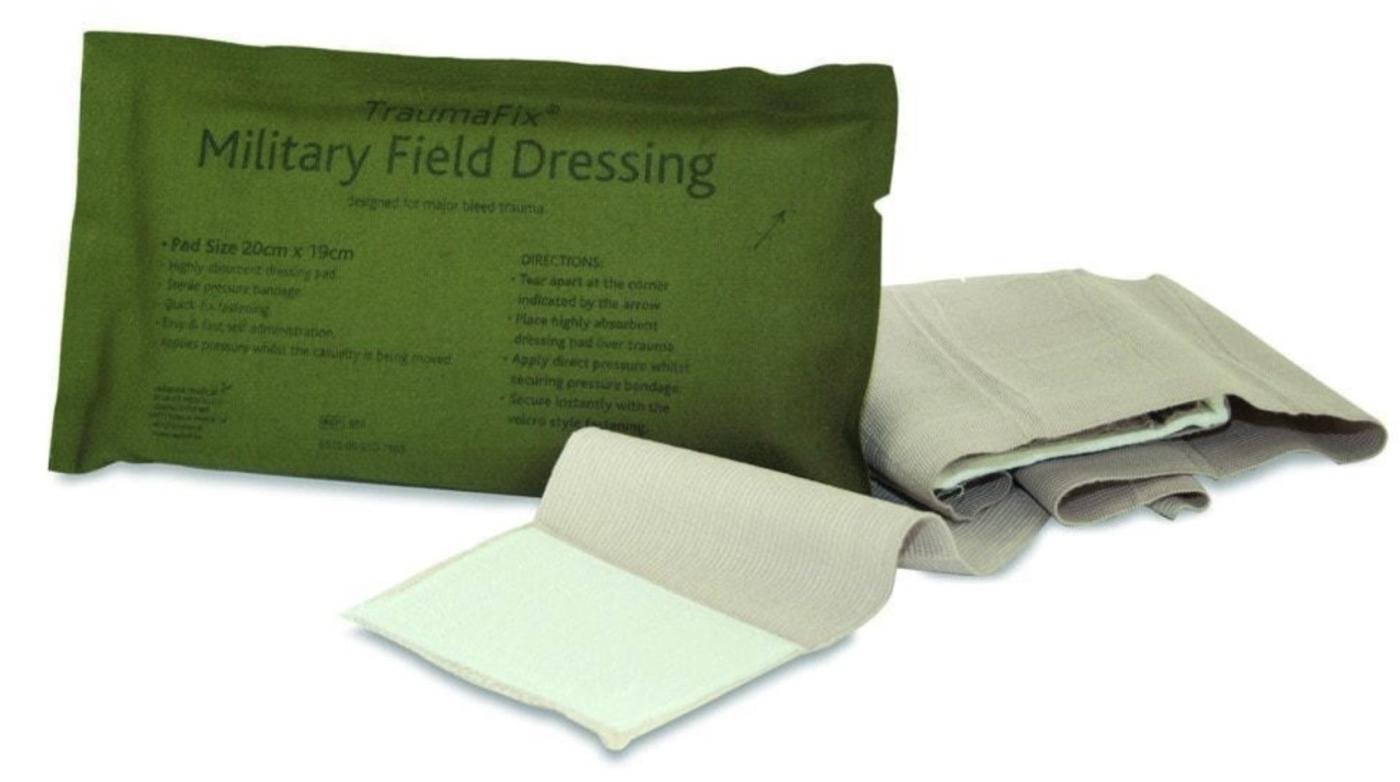
Field Dressings
On the battlefield throughout history, the greatest threat to a wounded soldier has rarely been the initial injury itself but the loss of blood that follows it. For centuries, soldiers who might have survived a gunshot wound, shrapnel injury, or blast trauma instead died from hemorrhage before they could receive proper medical treatment. One of the most significant developments in saving lives in combat has therefore been the simple but remarkably effective military field dressing. Over time this piece of equipment has evolved from basic cloth bandages carried by individual soldiers into highly engineered trauma dressings capable of absorbing large volumes of blood while simultaneously applying pressure to control bleeding.
In earlier centuries, battlefield care was extremely limited. Soldiers often relied on improvised bandages made from torn cloth, shirts, or linen strips. Medical attention usually came too late because wounded men had to be transported away from the fighting before surgeons could treat them. Even when care arrived quickly, there was little that could be done to stop heavy bleeding beyond tying cloth around wounds or applying crude tourniquets. Many soldiers died within minutes or hours from blood loss rather than from the injury itself.
During the nineteenth century, armies began to recognize the importance of immediate wound care. Military planners realized that if every soldier carried a basic dressing, bleeding could be controlled immediately after injury rather than waiting for a medic. By the late 1800s and early 1900s many armies issued a “first field dressing,” a small sealed package containing sterile gauze and bandage material. These early dressings were influenced by advances in medical science, especially the understanding of infection and the importance of sterile materials.
The two world wars accelerated the development of battlefield medical equipment. Massive numbers of wounded soldiers forced militaries to improve both the speed and effectiveness of treatment in the field. Individual field dressings became standard issue, and training taught soldiers to apply them quickly to themselves or to wounded comrades. Even a simple dressing could slow bleeding enough to keep a soldier alive until stretcher bearers or medics arrived.
As warfare evolved, so did the nature of injuries. High-velocity rifle rounds, artillery fragments, and later explosive devices produced more severe trauma. Medical researchers therefore focused on improving dressings that could control bleeding from large wounds. Materials were redesigned to be more absorbent, sterile, and durable. Packaging allowed soldiers to open and apply the dressing even with one hand.
The principle behind a modern trauma dressing is straightforward but powerful. Severe bleeding from a wound occurs when damaged blood vessels allow blood to escape faster than the body can clot. By placing a thick absorbent pad directly on the wound and applying firm pressure, the dressing compresses the damaged vessels. This pressure slows or stops the bleeding and gives the body time to form natural clots. At the same time, the absorbent pad collects the blood so it does not simply flow away, which helps maintain pressure at the injury site.
Modern military trauma dressings are far more advanced than earlier gauze pads. They are designed to combine several life-saving functions into one compact package. The central pad is made of highly absorbent material capable of soaking up large quantities of blood without falling apart. The attached bandage is long and elastic so it can be wrapped tightly around a limb, torso, or head to maintain pressure. Some designs include built-in pressure bars or compression devices that allow the user to tighten the bandage directly over the wound.
An example of a modern battlefield dressing is the type sometimes referred to as trauma-fix or similar high-capacity trauma bandages used by military medics and combat soldiers. These dressings are engineered to absorb several pints of blood while maintaining structural integrity. This capacity is important because severe wounds can produce extremely heavy bleeding in a short period of time. By absorbing and containing the blood while continuing to press against the wound, the dressing prevents blood from escaping freely and helps preserve what circulation remains in the body.
The materials used in these dressings are carefully chosen. Advanced cotton blends, synthetic fibers, and layered absorbent cores allow the dressing to draw fluid away from the wound while still maintaining pressure. Some designs use non-adherent surfaces that prevent the pad from sticking to the wound itself, reducing additional injury when the dressing is later removed by medical professionals. Others incorporate vacuum-packed packaging that keeps the dressing sterile and compact until the moment it is needed.
Ease of use is critical on the battlefield. A wounded soldier may be in shock, under fire, or suffering from severe pain. Modern trauma dressings are therefore designed to be applied quickly and often with one hand. The bandage can be wrapped around the wound, threaded through a pressure device, and tightened with minimal movement. In many cases a soldier can apply the dressing to himself even if one arm is injured.
Another important aspect is durability. Battlefield conditions are harsh, with dirt, mud, and debris everywhere. Dressings must remain sterile until opened and must function effectively even in extreme environments such as desert heat or freezing temperatures. Packaging is usually waterproof and vacuum sealed to protect the contents.
The effectiveness of these dressings is supported by extensive military medical research. Studies of battlefield casualties have repeatedly shown that uncontrolled bleeding is one of the leading causes of preventable death in combat. Because of this, modern combat medical doctrine focuses heavily on rapid hemorrhage control. The combination of tourniquets for limb injuries and trauma dressings for other wounds has dramatically improved survival rates.
Medical training for soldiers now emphasizes immediate self-aid and buddy-aid. Every soldier carries a personal first aid kit containing trauma dressings, tourniquets, and other lifesaving equipment. When a soldier is wounded, the first response is often from nearby comrades rather than medics. By quickly applying a pressure dressing, they can stabilize the casualty long enough for evacuation to more advanced medical care.
The development of modern field dressings has also influenced civilian emergency medicine. Many of the same trauma bandages designed for military use are now carried by police officers, paramedics, and emergency responders. In situations such as car accidents, industrial injuries, or natural disasters, these dressings can control life-threatening bleeding in exactly the same way they do on the battlefield.
One of the remarkable aspects of the field dressing is that it represents a relatively simple solution to a deadly problem. Despite the complexity of modern medicine, a carefully designed bandage that applies pressure and absorbs blood remains one of the most effective life-saving tools available. In many cases it can mean the difference between life and death during the critical minutes after a severe injury.
Over more than a century of warfare, countless lives have been saved by this small piece of equipment carried in a soldier’s kit. From the early cloth bandages of the nineteenth century to today’s highly engineered trauma dressings capable of absorbing multiple pints of blood, the evolution of the military field dressing stands as one of the most important advances in battlefield medicine. Its effectiveness lies not in technological complexity but in its ability to stop the most immediate threat faced by the wounded soldier: the rapid and deadly loss of blood.