F-117 Night Hawk
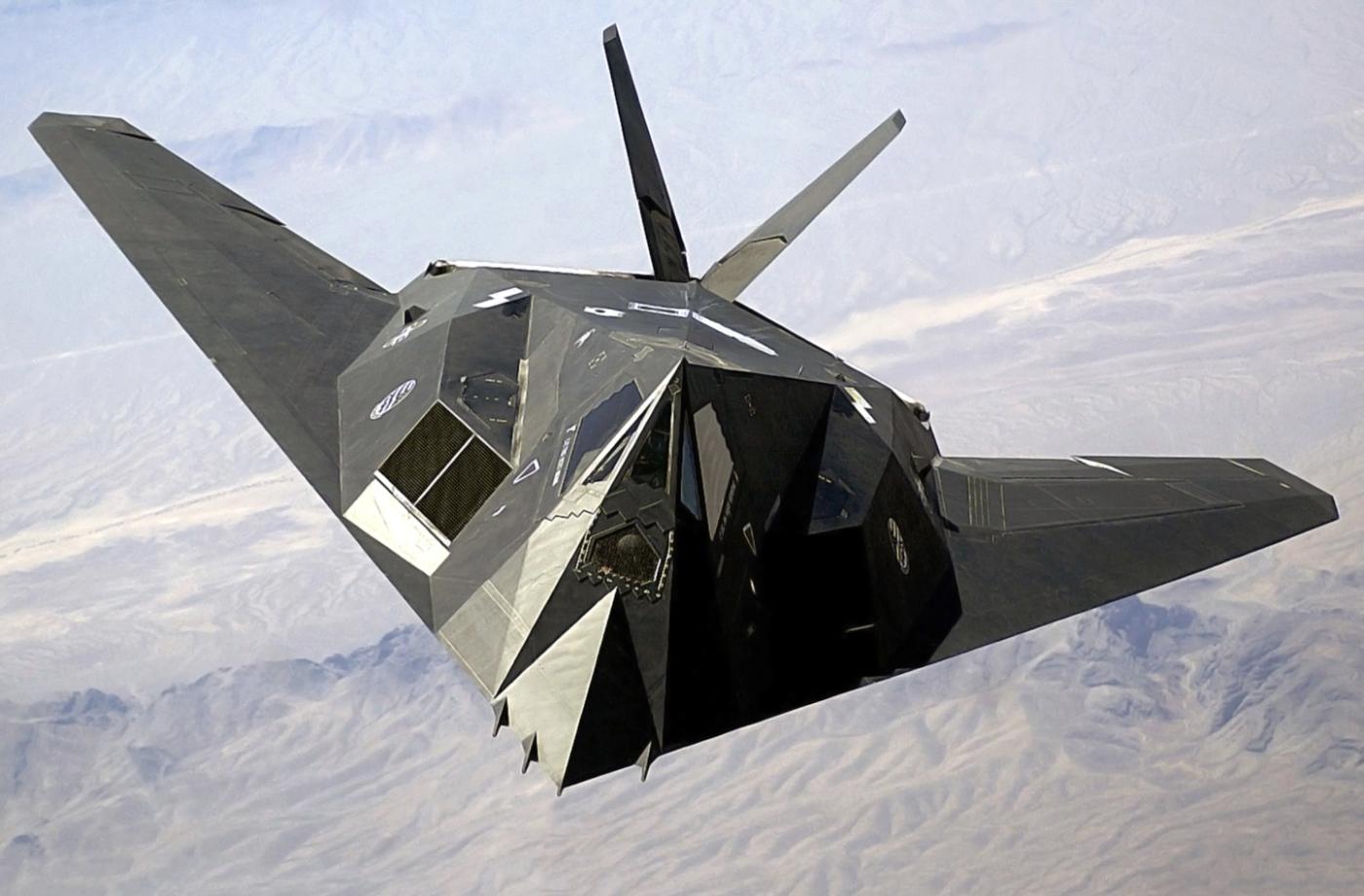
The F-117 Nighthawk was one of the most secretive and revolutionary military aircraft ever built, created during the height of the Cold War to solve a specific and dangerous problem: how to strike heavily defended targets without being detected. Although commonly referred to as a fighter, the aircraft was actually a precision attack platform designed to operate at night, relying on stealth rather than speed, maneuverability, or air-to-air combat ability. Its unusual faceted shape was not aesthetic but mathematical, carefully calculated to deflect radar signals away from enemy receivers and drastically reduce detection.
The aircraft was designed by Lockheed’s advanced development division, better known as Skunk Works, under the direction of engineer Ben Rich. Development began in the mid-1970s following research that demonstrated radar visibility could be reduced through angular design rather than relying solely on radar-absorbing materials. Manufacturing was carried out by Lockheed at highly secured facilities, with final testing conducted in Nevada under extreme secrecy. Between prototypes and production aircraft, a total of 64 F-117s were built, of which 59 were operational models. Each aircraft cost approximately 42 million US dollars at the time of production, a figure that would be far higher when adjusted for inflation, reflecting both the advanced technology involved and the classified nature of the program.
The F-117 carried all of its weapons internally to maintain its stealth profile. Its maximum payload was about 5,000 pounds, usually consisting of two precision-guided bombs. The aircraft was best known for delivering laser-guided bunker-buster munitions designed to destroy hardened targets such as command centers and reinforced shelters. Later upgrades allowed it to deploy GPS-guided bombs, improving accuracy in poor weather conditions. It had a combat range of roughly 930 miles, which could be extended significantly through aerial refueling. The aircraft flew at subsonic speeds, with a maximum of around 617 miles per hour, as speed was deliberately sacrificed to maintain low observability. It was operated by a single pilot, supported by highly advanced flight control, navigation, and targeting systems that were years ahead of their time.
It first saw combat during the 1991 Gulf War, where it became famous for striking critical targets deep inside Baghdad while avoiding detection. Although it flew a small percentage of total coalition missions, it was responsible for destroying a large share of high-value targets with remarkable accuracy. Its reputation for near invisibility was challenged in 1999 when one aircraft was shot down over Serbia by a modified surface-to-air missile system, proving that stealth reduced risk rather than eliminating it completely. Despite this loss, the pilot survived, and the aircraft’s overall combat record remained exceptional.
It was officially retired from frontline service in 2008, replaced by newer multirole stealth aircraft. However, it has never fully disappeared. A limited number remain in flyable condition and are occasionally used for testing, training, and evaluation missions. More than anything else, the Nighthawk’s significance lies in its legacy. It was the world’s first operational stealth combat aircraft, and its success permanently reshaped military aviation, influencing the design of every modern low-observable aircraft that followed.