Entrenching Tool
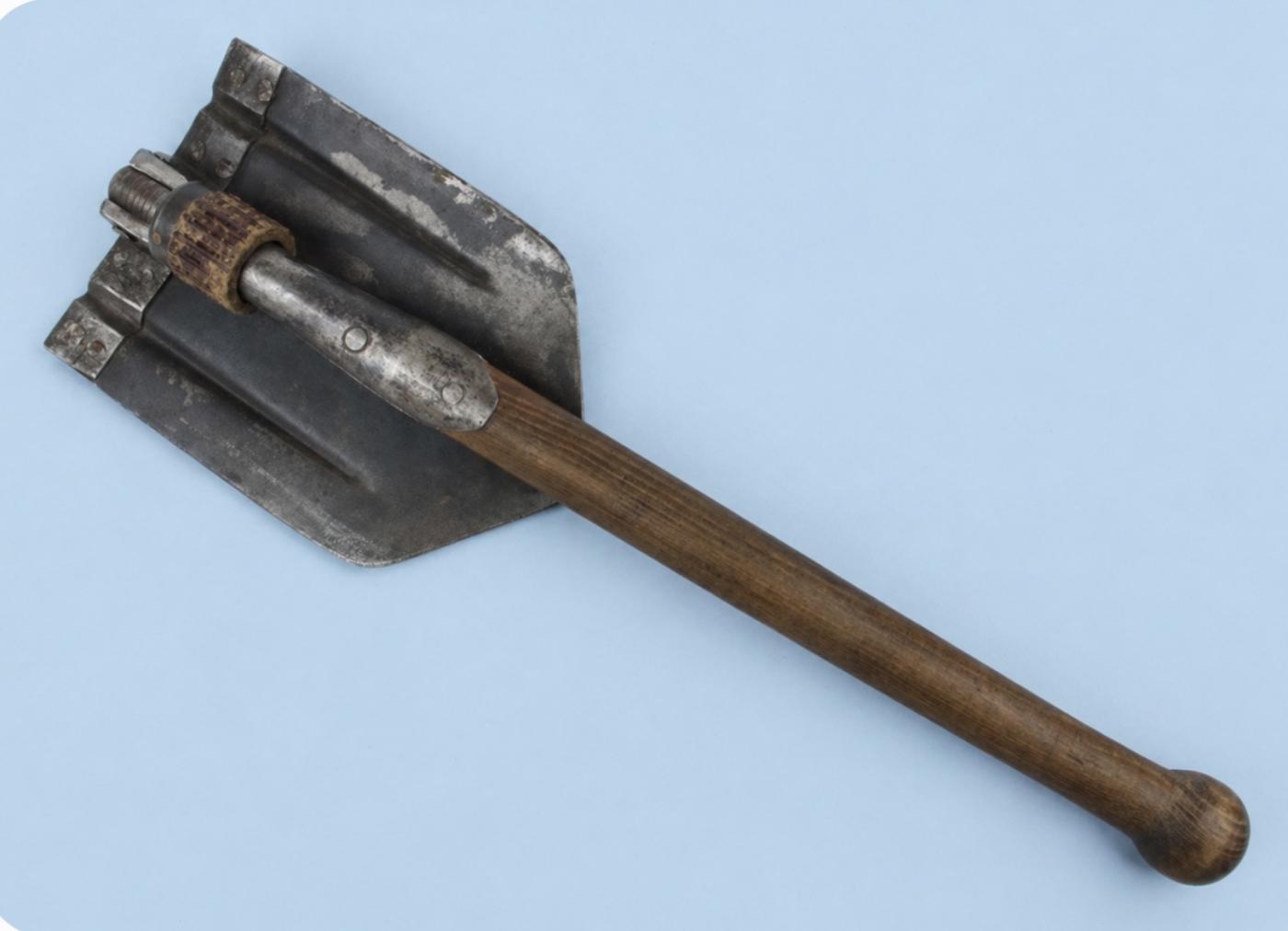
The German Klappspaten, or folding spade, became one of the most recognizable and practical pieces of individual equipment carried by soldiers of the Wehrmacht during the Second World War. At first glance it appears to be a simple tool, but its thoughtful design and battlefield versatility made it stand out among all the entrenching tools of the era. While many armies issued shovels, this folding spade was something closer to a compact engineering instrument, equally useful for digging, chopping, prying, and even fighting.
The origins of the design go back to the interwar period, when the German military, constrained by the Treaty of Versailles, focused heavily on efficiency and innovation in equipment. Rather than inventing the folding shovel entirely from scratch, German designers refined earlier concepts from the late nineteenth and early twentieth centuries. One important influence was a folding spade patented in 1869 by the Danish officer Mads Johan Buch Linnemann, whose work introduced the idea of a portable, collapsible digging tool for infantry. German engineers developed this concept into a far more robust and adaptable form suited to modern mechanized warfare.
By the late 1930s, as Germany rearmed, the folding entrenching tool was standardized and issued widely. It was already in service during the invasions of Poland in 1939 and France in 1940. The design was not credited to a single individual; instead, it emerged from collaboration between military engineering departments and German industry, reflecting a broader emphasis on practicality and durability.
Production was handled by numerous companies rather than one central manufacturer. Firms such as E. & F. Hörster and Paul Weyersberg & Co., along with many smaller subcontractors, produced large quantities. Because manufacturing was decentralized, surviving examples today often display different maker’s marks, dates, and minor variations, making them especially interesting to collectors.
Its defining feature was the hinged blade, which could be locked straight for digging or angled to act as a pick or *blocked text*. This adaptability allowed soldiers to work effectively in a wide range of soil conditions, from soft earth to root-filled or frozen ground. The handle, usually made of wood, provided a good balance of strength and weight, while the hinge mechanism was designed to be both sturdy and simple to maintain in the field.
The blade was typically forged from steel and often sharpened by the soldiers themselves, turning it into a tool capable of cutting through roots or even light wood. When folded, it became compact enough to carry in a cover attached to a belt or pack, an advantage over longer, fixed tools used by other armies.
On the battlefield, it proved invaluable. German infantry doctrine emphasized speed and the ability to quickly establish defensive positions. Soldiers could dig foxholes or shallow trenches rapidly, often under fire. The angled blade made breaking ground easier, which could mean the difference between exposure and protection, especially in harsh environments like the Eastern Front.
It also gained a reputation as an improvised weapon. In close combat, particularly in confined spaces such as trenches or urban ruins, soldiers sometimes used the sharpened edge as a striking tool. While not its intended purpose, this use reflected both its durability and the realities of hand-to-hand fighting.
The tool illustrates the German preference for multipurpose equipment. Instead of issuing separate tools for different tasks, they favored designs that could handle multiple roles, reducing the load on individual soldiers while increasing effectiveness. This philosophy has influenced military equipment design ever since.
As the war continued, production methods were sometimes simplified due to shortages, resulting in rougher finishes on later examples. Even so, the essential design remained unchanged and continued to perform reliably under difficult conditions.
After the war, the influence of this folding spade spread widely. Many modern military entrenching tools, including those used by the United States and other countries, follow the same basic folding, multi-position concept. Today, similar tools are also used by campers, survivalists, and emergency services.
Collectors value original examples for their craftsmanship and historical significance. Each piece, marked with its maker and date, offers insight into wartime production and the daily life of soldiers.