Douaumont Ossuary
The Douaumont Ossuary stands on a ridge above the former battlefield of Verdun in northeastern France and is one of the most powerful memorials to the First World War anywhere in Europe. It was built to hold and commemorate the unidentified dead from the 1916 Battle of Verdun, one of the longest and most destructive battles in modern history. For ten months French and German armies fought almost continuously over a landscape of forts, trenches and shell holes, and by the end of the fighting the ground was saturated with human remains. Vast numbers of soldiers were never identified or recovered in any formal burial, and the ossuary was created as a permanent resting place for these unknown dead and as a national symbol of remembrance.
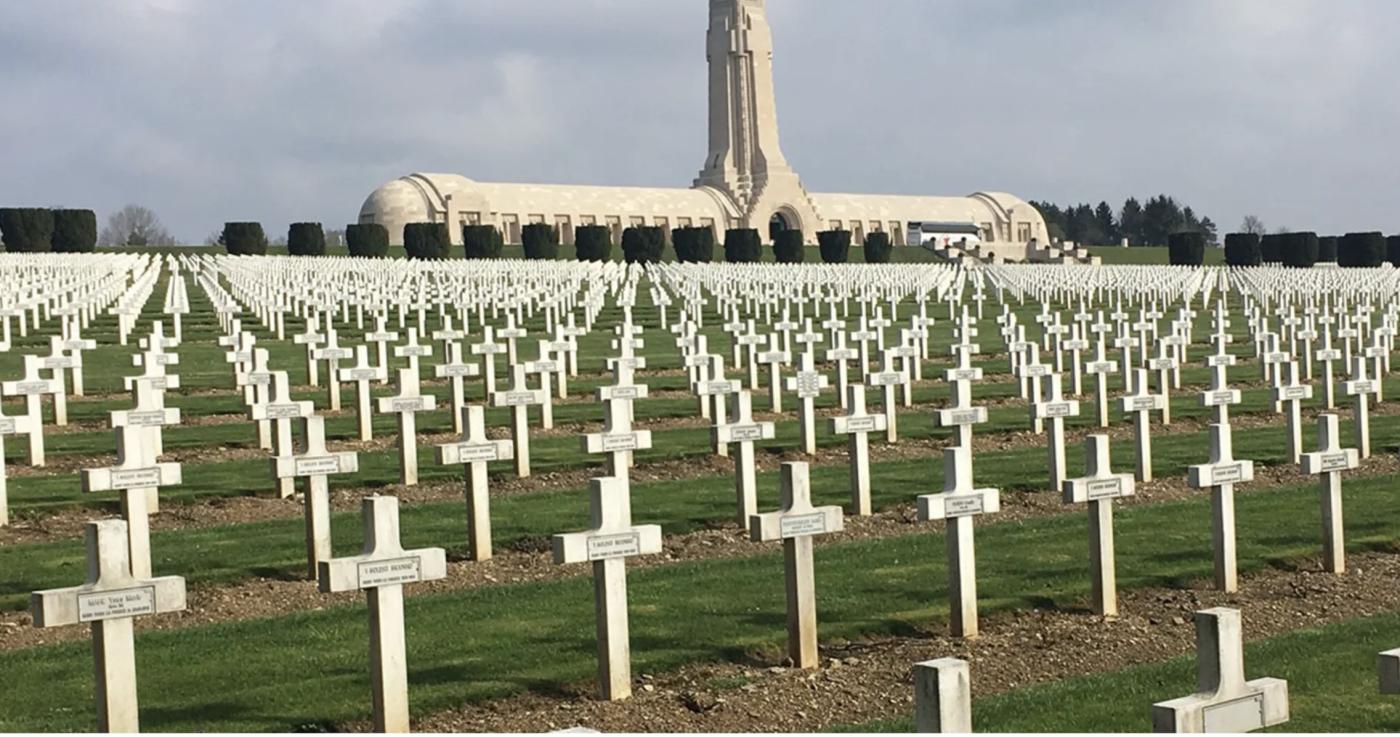
Construction of the ossuary began in the early 1920s and it was officially inaugurated in 1932. The long stone building, more than 130 metres in length, resembles a cloister and is dominated by a central tower that rises above the surrounding countryside. The tower is often interpreted as a symbolic sword plunged into the earth, with the hilt forming the observation point at the top. From there visitors can look out across the former battlefield and the immense cemetery that surrounds the ossuary.
Inside the building are the remains of approximately 130,000 unidentified French and German soldiers. These bones were collected from the battlefield over many years after the war. The fighting at Verdun was so intense that bodies were frequently destroyed by artillery fire or buried where they fell, and many could not be identified when recovered. The ossuary contains these remains in a series of vaults, each filled with bones gathered from specific sectors of the battlefield. Through small windows along the exterior walls visitors can see piles of skulls and long bones stacked within these chambers, a stark and direct reminder of the human cost of the battle.
In front of the ossuary lies the Douaumont National Cemetery, the largest French military cemetery of the First World War. It contains more than 16,000 individually marked graves, almost all of them French soldiers. The graves are arranged in long, perfectly aligned rows stretching across the slope below the ossuary. Each grave is marked by a simple white stone cross bearing the name of the soldier, his rank, and the year of death if known. For soldiers of other faiths there are alternative markers; Jewish soldiers have a stone bearing the Star of David, and Muslim soldiers are commemorated by stelae with Islamic inscriptions and a shape distinct from the Christian crosses. These markers reflect the diversity of the French army at Verdun and the effort made to honour each individual according to his beliefs.
Despite the thousands of marked graves, many of those who died at Verdun have no individual burial at all. The ossuary itself is essentially a mass grave for the unidentified. The bones contained within are not separated or individually marked, and it is impossible to know which remains belong to which soldier. In addition to the ossuary, there are areas of the former battlefield where bodies were never recovered and remain buried beneath the soil. Over the decades occasional remains have been discovered during forestry work or by farmers, and when this happens they are usually interred within the ossuary or in the cemetery. The ossuary therefore continues to serve as a collective burial place for the unknown dead of Verdun.
The site is carefully maintained and protected. Responsibility for the ossuary and cemetery lies primarily with a French veterans’ organisation known as the National Federation of Combatants and Victims of War, working in cooperation with the French government and the Ministry of the Armed Forces. The Commonwealth War Graves Commission does not manage this particular cemetery because it is a French national site, though similar care is taken in its upkeep. The grounds are meticulously maintained, with the white crosses kept clean and aligned and the surrounding lawns and trees carefully tended. Restoration work has been carried out periodically on the ossuary building itself to preserve the stonework and the tower, ensuring that the memorial will endure for future generations.
The Douaumont Ossuary remains one of the most visited First World War memorials in France. Thousands of visitors come each year, including tourists, historians, school groups and descendants of those who fought at Verdun. French national commemorations are regularly held at the site, particularly on anniversaries connected with the battle and on Armistice Day. German visitors also come in significant numbers, reflecting the shared memory of the battle and the reconciliation that developed between France and Germany after the war. One of the most symbolic moments in the site’s modern history occurred in 1984 when French President François Mitterrand and German Chancellor Helmut Kohl stood hand in hand before the ossuary during a ceremony of remembrance, an image that became a powerful symbol of European reconciliation.
For many visitors the experience of walking through the cemetery and entering the ossuary is deeply moving. The sheer number of graves, the knowledge that tens of thousands more lie unidentified within the building, and the quiet of the surrounding landscape combine to create a strong sense of reflection. The site is not only a burial place but also a reminder of the scale of industrialised warfare and the human cost of the First World War. More than a century after the Battle of Verdun, the Douaumont Ossuary continues to fulfil its original purpose as a place of mourning, memory and historical awareness, visited by people from across the world who come to pay their respects to the known and unknown dead who rest there.