On this day in military history…
The Battle of Verdun began on 21st February 1916 and became one of the most costly and emotionally charged battles of the First World War. It lasted until December 1916 and developed into a struggle that symbolised French determination to defend their homeland at any cost. Verdun was not simply another battlefield; for the French it represented national pride, honour, and the memory of past invasions. The German High Command, led by General Erich von Falkenhayn, selected Verdun deliberately, believing that its loss would shatter French morale and force France out of the war.
Verdun held deep historical and strategic importance to France. It was a fortified region on the Meuse River, surrounded by a ring of powerful forts and defensive works built after the Franco-Prussian War of 1870–1871. The area had long been considered a gateway into the heart of France. If the Germans captured Verdun, they would threaten the French interior and deliver a devastating psychological blow. Falkenhayn’s strategy was not necessarily to capture Verdun quickly but to “bleed France white” by forcing the French army to defend the position at all costs. He expected that the French would commit vast numbers of troops to the defence and suffer unsustainable losses.
When the German attack began on 21st February 1916, it opened with one of the most intense artillery bombardments yet seen in the war. Over one million shells fell on French positions in the opening hours. German forces advanced behind the barrage and quickly captured several forward positions, including Fort Douaumont, one of Verdun’s strongest forts, which fell with surprising ease on 25th February. The early German successes caused alarm in France, and it became clear that Verdun must be held regardless of the cost.
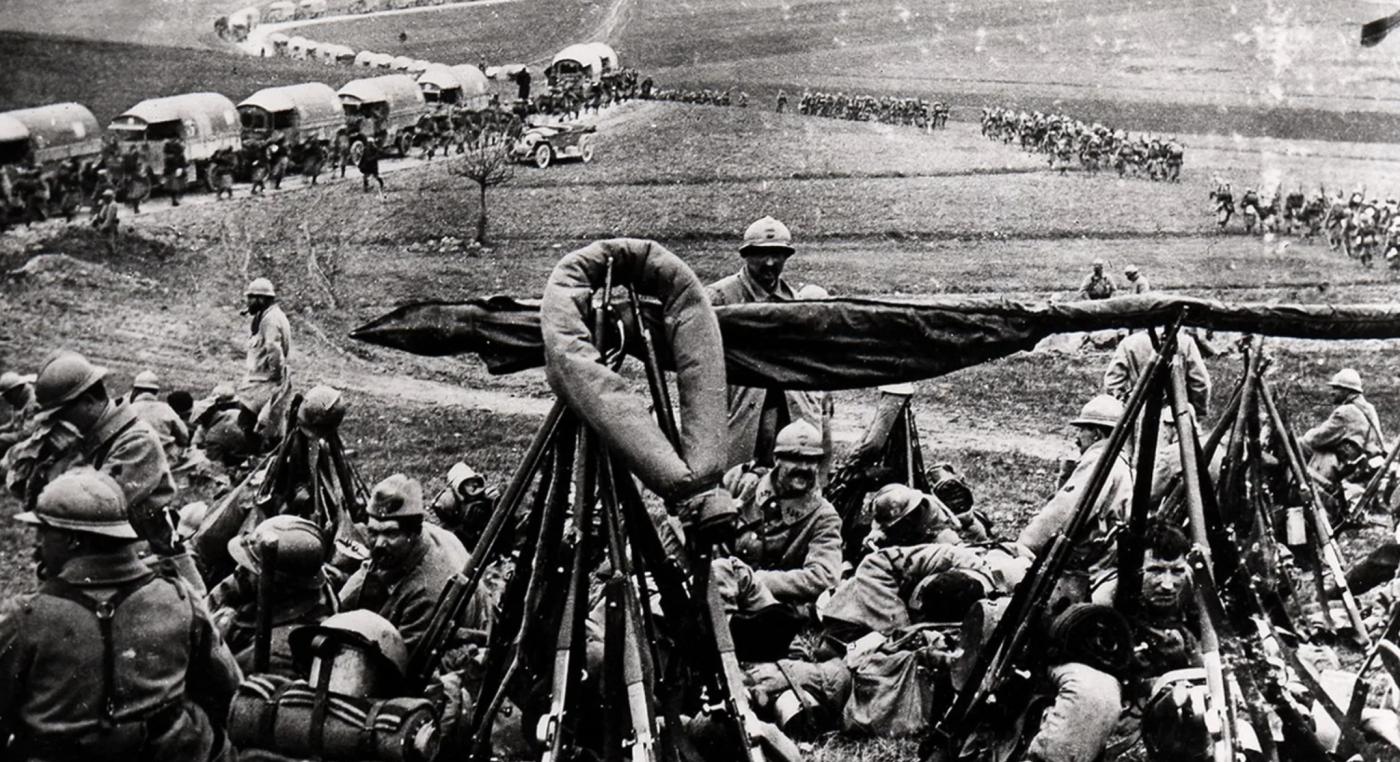
The defence of Verdun was placed under the command of General Philippe Pétain, who quickly became the central figure in organising the French resistance. Pétain recognised that the battle would be decided not only by firepower but by logistics and morale. To sustain the defence, he relied heavily on a supply route known as the Voie Sacrée, or Sacred Way, the road connecting Verdun to the French rear areas. Along this road, a constant stream of trucks carried ammunition, food, and reinforcements to the front. Without this lifeline, the defence of Verdun would have collapsed.
One of the most important systems introduced during the battle was the French troop rotation system often described as a “waterwheel.” This system ensured that divisions were continuously rotated in and out of the front line rather than being left there until exhausted or destroyed. Fresh units replaced those who had suffered heavy casualties or severe fatigue. The idea was to spread the burden of the battle across the entire French army and prevent any single unit from being completely annihilated. As a result, nearly 70 percent of the French army served at Verdun at some point during the battle. The constant movement of troops resembled the turning of a wheel, with units flowing into the line, fighting, and then being withdrawn to recover before returning again.
The conditions at Verdun were horrific. Soldiers on both sides endured relentless artillery fire, mud, shattered landscapes, and constant fear. Trenches were often obliterated, forcing men to fight in shell holes and ruined fortifications. The noise of shelling was continuous, and the dead and wounded often lay where they fell because retrieval was too dangerous. Gas attacks, machine-gun fire, and hand-to-hand combat added to the terror. The psychological strain was immense, and many soldiers suffered what was then called shell shock.
German forces were commanded initially by Crown Prince Wilhelm, with operational control exercised by experienced generals such as Falkenhayn and later General Paul von Hindenburg and General Erich Ludendorff when Falkenhayn fell from favour. On the French side, Pétain’s leadership was crucial in stabilising the defence. Later in the battle, General Robert Nivelle took over from Pétain and launched counterattacks to regain lost ground.
The numbers involved were staggering. By the end of the battle, around 2.3 million French and German soldiers had taken part in the fighting at Verdun. The human cost was enormous. French casualties are estimated at approximately 377,000, including around 162,000 dead. German casualties were similarly severe, with roughly 337,000 casualties, including around 143,000 killed. These figures made Verdun one of the bloodiest battles in human history. The landscape was so devastated by shelling that forests, villages, and fields were reduced to a wasteland of craters and shattered earth.
As the months dragged on, the Germans found themselves unable to achieve a decisive breakthrough. French resistance stiffened, and the rotation system ensured a steady flow of fresh troops. Meanwhile, the Allied offensive on the Somme, launched by Britain and France in July 1916, forced the Germans to divert resources away from Verdun. This reduced the pressure on French defenders and allowed them to begin counterattacks. By October and December 1916, French forces had recaptured key positions, including Fort Douaumont and Fort Vaux.
By the end of 1916, the battle effectively ended with the front lines near where they had been at the start. The Germans had failed to break French resistance or force France out of the war. For the French, Verdun became a symbol of national endurance and sacrifice. The phrase “Ils ne passeront pas” meaning “They shall not pass” became associated with the defence of Verdun and reflected the determination to hold the line no matter the cost.
The Battle of Verdun demonstrated the brutal nature of industrialised warfare and the immense human cost of attrition. It showed how modern weapons and tactics could produce vast casualties without significant territorial gains. For France, Verdun became a powerful symbol of unity and resilience. For both sides, it was a grim reminder of the price of total war, measured in hundreds of thousands of lives and months of relentless fighting that left an indelible mark on history.