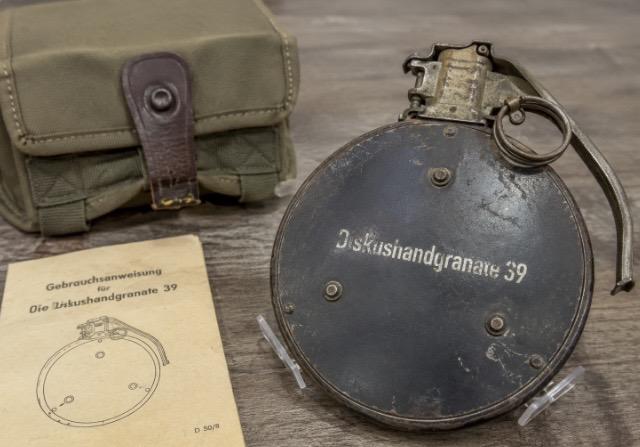
Diskushandgranate grenade
Among the many unusual weapons created during the First World War, few looked as strange as the German Diskushandgranate, better known to Allied soldiers as the “turtle grenade.” It was also described in some British collecting and battlefield accounts as the tortoise grenade or oyster grenade, names that came not from any official German title but from its flattened, shell-like appearance. To German troops it was a Diskushandgranate, literally a discus hand grenade, although in practice it was less a sporting discus and more a clever but troublesome attempt to solve one of the oldest dangers of grenade fighting: the enemy throwing it back.
The weapon appeared from a pre-war idea that gained new importance once the Western Front had settled into trenches, dugouts, shell holes and wire. Germany had entered the war with grenades such as the heavy Kugelhandgranate, but trench warfare demanded weapons that could be carried in quantity and used quickly in close fighting. Time-fused grenades had an obvious weakness. If the delay was too long, a brave or desperate defender could pick them up and throw them back. The discus grenade tried to remove that possibility by detonating on impact rather than after a slow-burning fuse. The result was one of the most unusual German grenades of the war, a flat, lenticular bomb with an internal percussion system arranged like a small star.
The design is generally linked to Dynamit AG, the German explosives company associated with the Nobel industrial group, which is credited in several accounts with patenting the concept before the war, around 1911. A limited pre-war model was produced by 1913, known as the Diskushandgranate 13 alter Art, but the German Army showed only limited interest before the enormous demand for trench weapons changed priorities. By 1915, the idea returned in improved form as the Diskushandgranate Model 1915, produced for the Imperial German military through state arsenals and wartime contractors. Exact production figures are difficult to confirm from surviving open sources, and reliable totals do not appear to have been recorded in the same way as better-known weapons such as the Stielhandgranate. What can be said with confidence is that it was produced and issued in meaningful numbers during 1915, but its front-line life was short because it was soon overtaken by simpler and more reliable grenade designs.
The grenade came in more than one form. The offensive version was the larger and more powerful of the common hand-thrown types. It was made from two thin steel shells crimped together and carried about 130 grams of explosive in a total weight of roughly 420 grams. Its purpose was blast and shock rather than a heavy fragmentation pattern, making it more suitable for attacking troops who hoped to throw it and then move forward without being cut down by their own fragments. The defensive version was smaller, around 360 grams, and carried a much smaller explosive filling of about 20 grams, but its cast-iron body was internally grooved or pre-fragmented so that it could throw dangerous fragments across a wider area. This made it more suitable for troops fighting from cover, where the thrower was protected but the enemy was exposed.
Its famous shape was not a gimmick. The flat body was part of the arming and impact system. Inside the grenade was a cross-like or star-like arrangement of tubes. Several of these held small moving inertia blocks and percussion elements, while another held the detonator. When the grenade was thrown correctly with a spinning motion, centrifugal force moved internal parts into position. On impact, one of the moving elements was meant to strike the central percussion arrangement and fire the detonator. In theory this meant the grenade exploded as soon as it struck hard ground, trench timber, masonry or another solid surface. In practice, it demanded more skill than ordinary grenades and was far less forgiving in mud, snow, water or soft earth.
This was the great problem with the turtle grenade. It was ingenious, but the Western Front was not a laboratory. Trenches were wet, shell holes were deep, and the ground was often soft enough to swallow a man’s boot. If the grenade landed in mud or failed to strike correctly on one of its impact points, it could fail to explode. Moisture also affected reliability, and contemporary-style descriptions of the weapon repeatedly note its weakness in damp conditions. A grenade designed to remove the uncertainty of a time fuse therefore created a new uncertainty of its own: it might explode instantly, or it might do nothing at all.
The killing or danger zone depended on the version and the way it landed. One modern ordnance reference gives the 1913 disk grenade a burst radius of about 8 metres, while the 1915 defensive version was specifically intended to kill or wound through fragments over a wider area. The offensive model, by contrast, relied more on blast, shock and close-range effect, making it dangerous in trenches, dugouts and enclosed positions but less dependent on heavy fragmentation. As with all grenades, “killing zone” is not a clean circle on a battlefield. Fragments could be stopped by earth, sandbags or timber, or they could travel unpredictably if the grenade burst on hard ground. In the open, anyone within several metres was in extreme danger; beyond that, wounds were still possible depending on the grenade type, angle of burst and surrounding cover.
The grenade’s method of use also made it unusual. Despite the name “discus,” some specialist descriptions argue that it was not meant simply to be thrown like a sports discus through the air, because the impact system needed the correct part of the grenade to strike the ground. It was often described as being bowled or thrown with a spinning motion so that its internal safety and percussion parts could operate. This required training and confidence, and it was not ideal for frightened men working in cramped trenches under shellfire. A simple stick grenade, with its handle giving extra throwing distance and its conventional fuse being easier to understand, was often more practical even if it lacked the instant impact idea.
The Diskushandgranate also reflected the experimental spirit of the early war. Before the great standardisation of later years, all armies tried strange solutions to trench problems. Grenades were made from jam tins, pipes, cast iron, sheet metal, rifle-launched rods and improvised explosive charges. Germany’s turtle grenade belonged to that inventive but transitional period, when engineers and soldiers were still discovering what modern industrial trench warfare truly required. The concept was bold: a compact impact grenade that could not be thrown back. The execution was clever. The battlefield verdict was harsher.
By the end of 1915 and into 1916, the German stick grenade became the more familiar and successful weapon. The Stielhandgranate, later nicknamed the “potato masher” by Allied soldiers, was easier to throw, easier to manufacture in huge numbers, and better suited to rough trench conditions. The turtle grenade did not disappear instantly, and surviving examples show that both offensive and defensive versions were used, carried and collected from battlefields, but it never achieved the lasting reputation of the German stick grenade.
Today the Diskushandgranate remains one of the most distinctive grenades of the First World War. Its flat shell, strange inner star mechanism and Allied nicknames make it stand out among the brutal inventions of trench warfare. It was a weapon born from a very real battlefield problem, designed to deny the enemy the few seconds needed to throw a grenade back. Yet its own complexity, its sensitivity to wet ground and its dependence on correct impact made it less reliable than its designers hoped.