On this day in military history…
Operation Chestnut was one of the lesser-known but most revealing SAS operations of the Sicily campaign, a small airborne mission launched in the shadow of Operation Husky, the great Allied invasion of Sicily in July 1943. It did not have the spectacular success of some earlier desert raids, and it did not become famous like the battle for Primosole Bridge, but it remains a fascinating episode because it shows the SAS at a turning point. The regiment had come out of the North African desert with a fearsome reputation for raiding, sabotage and deep penetration work, but Sicily presented a very different battlefield. The wide open spaces of Libya and Tunisia were gone. In their place were mountains, villages, roads, enemy patrols, Italian garrisons, German reaction forces and a civilian population that could expose a small raiding party within minutes.
The mission was part of the wider Allied plan for Operation Husky, the invasion of Sicily, which began on the night of 9/10 July 1943. Husky was intended to open the road into Europe through the Mediterranean, knock Italy out of the war, force Germany to divert troops from other fronts, and give the Allies control of the central Mediterranean. British, Canadian and American forces landed across the south and south-east of the island, while airborne troops were used to seize or disrupt key points ahead of the seaborne advance. The British airborne effort in Sicily was badly affected by weather, navigation errors, scattered drops and friendly fire, and this formed the dangerous background against which the SAS mission was launched.
By 1943 the SAS had already changed greatly from the small band created by David Stirling in the desert. Stirling had been captured in Tunisia in January 1943, and command of the original 1 SAS had passed to Robert Blair “Paddy” Mayne, while David’s brother, Lieutenant Colonel William “Bill” Stirling, established 2 SAS in Algeria. In Sicily, Mayne’s Special Raiding Squadron fought more in the style of commandos, storming coastal positions and helping to clear the way for the landings, but 2 SAS was given a task closer to the old SAS idea: small parties inserted behind enemy lines to create confusion, cut communications and attack movement routes.
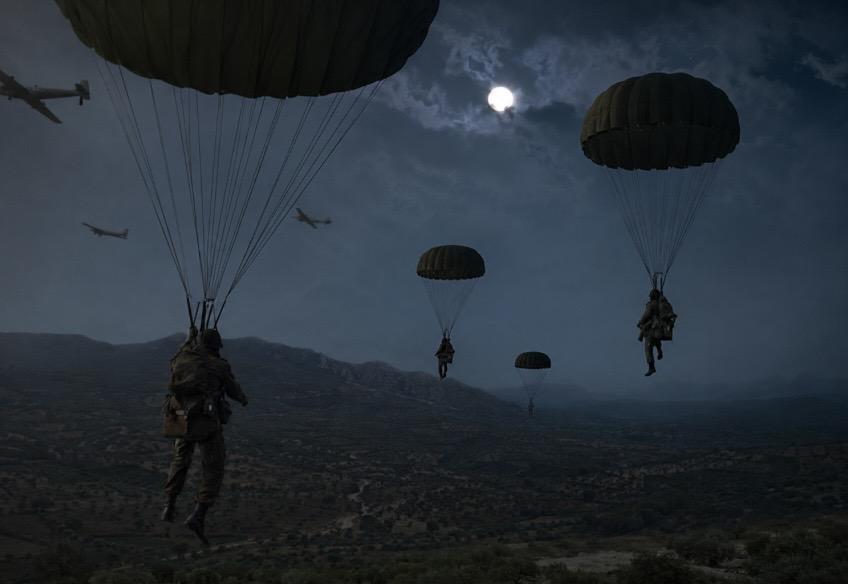
Operation Chestnut was launched on the night of 12 July 1943, only a few days after the main Allied landings. It was planned as a deep airborne raid by 2 SAS into northern Sicily, behind the Axis front and away from the main beachheads. The force was small: two parties of ten men, making twenty SAS soldiers in total. The two groups were known by the code names “Pink” and “Brig”. The “Pink” party was commanded by Captain Philip Pinckney, while the “Brig” party was commanded by Captain R. H. Bridgeman-Evans. Their overall operation was associated with Major Geoffrey Appleyard, the former commander of the Small Scale Raiding Force, who acted as a drop supervisor and was aboard one of the aircraft involved. Some accounts describe Appleyard as commanding or supervising the operation, but the operational parties on the ground were led by Pinckney and Bridgeman-Evans.
The two SAS parties were carried in Armstrong Whitworth Albemarle aircraft, supplied by the 51st Troop Carrier Wing. The Albemarle was not as famous as the Dakota, but it was used in airborne and special operations work as a transport and glider tug. For Chestnut, the aircraft had to take a tiny force of raiders across the sea by night, put them down in hostile country, and return across the Mediterranean. One of the aircraft was lost after the drop. The exact North African departure field is not always clearly stated in public summaries, but the aircraft were operating from the Allied air base network in Tunisia, the same broad North African launch area used for the Sicily airborne operations.
The targets chosen for Chestnut were ambitious for such a small force. “Pink” was to operate in the north-east of Sicily, disrupting roads, railways and communications, including the important transport links leading towards Messina and the eastern side of the island. “Brig” was tasked with attacking enemy convoys and interfering with enemy command and movement around the interior, including the area near Enna. This mattered because the Axis forces in Sicily depended on road and rail movement to shift reserves, ammunition and supplies across difficult country. Sicily’s rugged interior made the main roads and railways especially important. A few bridges blown, wires cut, vehicles ambushed or headquarters disturbed could force German and Italian commanders to hesitate at exactly the moment the Allied armies were trying to break out from the beachheads.
In theory it was a classic SAS job. Twenty men, if inserted cleanly, could cause damage out of all proportion to their numbers. They would not fight a conventional battle. They would move by stealth, hide by day, strike by surprise, use explosives against railways, roads and communications, and then work their way back towards friendly lines or await further help. The idea was to create uncertainty in the enemy rear and make the Germans and Italians look over their shoulders while the main Allied advance pushed inland. It was the sort of mission that had made the SAS name in North Africa, but Sicily was much less forgiving than the desert.
The operation began to go wrong almost as soon as the men reached the ground. The “Pink” party was scattered around the Randazzo area, and containers carrying radio equipment, explosives, ammunition and supplies were damaged or lost in the drop. One of the great weaknesses of airborne special operations at this stage of the war was the fragility of equipment containers. A raiding party could be highly trained and brave, but if its radios, detonators, food and ammunition smashed on landing or disappeared in the dark, the mission was crippled before it had properly begun. Operation Chestnut suffered exactly this problem. Radios were broken and much of the ammunition, explosives and food was lost during the jump.
The “Brig” party also ran into trouble. Instead of landing unseen in open country, the men came down too close to inhabited or defended areas and were quickly detected. Captain Bridgeman-Evans was captured, although he later managed to escape. The party had to concentrate on survival and evasion rather than planned sabotage. The enemy was alerted, and once surprise was lost, twenty men split into two small groups had little chance of carrying out a sustained campaign of destruction. They were deep in enemy territory, without reliable communications, without much of their equipment, and with Axis troops and local security forces aware that parachutists were in the area.
The failure of the radios was especially serious because Chestnut was not meant to end with the first drop. A follow-up reinforcement and supply drop was planned for the night of 13 July, but without working wireless sets the SAS parties could not guide or confirm the arrival of the aircraft. The reinforcement aircraft came but could not establish contact with the men on the ground, and the drop was abandoned. This meant the small parties remained isolated, short of supplies and unable to expand the mission. In special forces operations, communication can be as important as weapons. Without it, headquarters has no picture, aircraft cannot be guided, resupply cannot be arranged, and a planned raiding operation quickly becomes a survival march.
Major Geoffrey Appleyard’s loss gave Operation Chestnut an added tragedy. Appleyard had already built an outstanding reputation through commando and small-scale raiding work. He had served with distinction in the Small Scale Raiding Force and was the sort of officer ideally suited to irregular warfare: bold, intelligent, physically brave and used to operating outside conventional methods. During Chestnut he was aboard the Albemarle connected with the “Pink” party drop. After the men had been dispatched over Sicily, the aircraft failed to return from the mission and disappeared over the Mediterranean. Appleyard was declared missing presumed dead, a heavy loss to British special operations at a time when such men were rare.
For the SAS men on the ground, the days after the drop were a grim test of fieldcraft rather than the planned campaign of sabotage. The parties had to move through hostile country, avoid patrols, find food and water, and try to make their way towards Allied lines. They had been inserted to create chaos among the enemy, but in practice the chaos had fallen mostly on themselves. Some accounts describe the men being scattered over wide areas, losing contact with each other, and being forced to abandon the original objectives. Most eventually made it back or escaped capture, but the operation did not achieve the intended disruption of roads, railways, convoys or headquarters.
Operation Chestnut is therefore usually judged as a failure, but it was not a meaningless failure. It showed with brutal clarity what could go wrong when special forces were dropped without enough rehearsal, reliable communications, accurate navigation and strong arrangements for recovery or resupply. The operation also came at a time when the SAS was still adapting from desert mobility to European terrain. In North Africa, the regiment had often relied on huge distances, empty spaces and the support of the Long Range Desert Group. Sicily offered none of that. Villages, roads, farms, mountains and civilian eyes made concealment difficult. A small group could be reported quickly, and once reported, it could be hunted.
It is also important because it was one of the first parachute missions carried out by 2 SAS. The regiment was still young, and many of its men had limited experience of combat parachuting. The wider Sicily airborne experience was painful for the Allies as a whole. British glider troops in Operation Ladbroke were scattered badly, many landing in the sea, and later parachute drops such as Fustian at Primosole Bridge also suffered from misdrops and friendly fire. Chestnut belongs to that same pattern of early airborne warfare: brave men, bold ideas, but aircraft navigation, communications and coordination still not good enough to match the ambition of the plan.
The story also shows the difference between a raid that sounds simple on a map and the reality of delivering men into war by parachute at night. A map might show roads, railways, bridges and headquarters as neat targets. On the ground, the raider lands hard, perhaps miles from the chosen point, in darkness, tangled in equipment, separated from his party, with containers missing, radios smashed, and the enemy already suspicious. Chestnut was not a failure of courage. It was a failure of conditions, planning and execution. The men chosen for it were exactly the kind of soldiers the SAS needed, but even the best soldiers cannot cut railway lines with explosives that have been lost, call aircraft with radios that have been smashed, or remain secret after landing beside alerted enemy positions.
Yet Operation Chestnut deserves to be remembered because it sits at the beginning of the SAS’s European war. After Sicily, 2 SAS continued to develop its role in Italy and later in occupied Europe, where small teams would again parachute deep behind enemy lines to attack railways, assist resistance groups, gather intelligence and harass German movements. The lessons from Sicily helped shape later operations. Better coordination, better radio arrangements, clearer objectives, improved supply dropping and closer attention to landing areas all became vital. The SAS learned, as airborne forces everywhere learned in 1943, that courage in the aircraft door was only the first requirement. The real success of such missions depended on intelligence, navigation, equipment, signals, local conditions and the ability to vanish after landing.
In the larger story of Operation Husky, Chestnut was only a tiny mission involving twenty men, two aircraft and a few planned targets far behind the lines. It did not change the course of the Sicily campaign. It did not paralyse Axis communications or destroy the enemy’s ability to move. But it remains one of those small wartime episodes that tells us a great deal about the nature of special operations. It was bold, dangerous and imaginative, but also rushed, fragile and vulnerable to bad luck. It cost the life of Geoffrey Appleyard and nearly destroyed the purpose of the mission within minutes of the drop. For readers of SAS history, that is what makes it so interesting. Chestnut was not one of the regiment’s great victories, but it was one of its hard lessons, written in darkness over Sicily in July 1943, when a handful of men jumped into enemy country and found that the modern art of airborne raiding still had much to learn.