On this day in military history…
The Battle of Bazentin Ridge on 14 July 1916 was one of the most dramatic moments of the Battle of the Somme, not only because it brought a rare British success after the terrible losses of 1 July, but because it produced one of the most unusual sights of the Western Front: Indian cavalry and British cavalry riding forward across the broken battlefield towards High Wood. It was a battle that showed both what careful planning could achieve and how quickly opportunity could be lost in the mud, smoke, smashed trenches and confusion of modern war.
The attack was organised by General Sir Henry Rawlinson’s British Fourth Army, operating under the wider command of Sir Douglas Haig. Rawlinson’s plan was very different from the disastrous broad daylight assault of 1 July. Instead of sending infantry forward across long distances in full view of German machine-gunners, the attack on Bazentin Ridge was prepared as a surprise night approach followed by a short, violent artillery bombardment and a dawn infantry assault. The aim was to break into the German second defensive line between Longueval and Bazentin-le-Petit, seize the ridge, and then, if the German line cracked, push mobile forces through before the enemy could recover. The attack was carried out mainly by troops of XIII Corps and XV Corps, including the 3rd Division, 7th Division, 9th Scottish Division and 21st Division. Their task was to strike towards Longueval, Bazentin-le-Grand, Bazentin-le-Petit and the woods that dominated the ground beyond.
The ground mattered enormously. Bazentin Ridge was not just another line on the Somme battlefield; it was high ground overlooking the surrounding area, and behind it lay High Wood, Delville Wood, the Switch Line and the routes towards Flers and Le Sars. If the British could capture the German positions quickly enough, there was a chance, however brief, that cavalry could ride through the gap and turn a local victory into something larger. This was the kind of breakthrough that commanders had imagined before the war, but by 1916 the reality of barbed wire, artillery, machine-guns and trench systems had made cavalry almost impossible to use in the old way.
In the early hours of 14 July, British infantry moved forward in darkness, as close as they dared to the German line. At about 3.25 a.m., after a short but intense bombardment, the infantry attacked. The surprise worked. In places the German defenders were overwhelmed before they could properly organise themselves, and British troops surged into parts of the German second line. Bazentin-le-Petit and Bazentin-le-Grand were attacked, Longueval became a savage fight, and the ridge began to fall into British hands. Compared with the catastrophe of 1 July, this was a far more skilful and successful operation. It showed that the British Army was learning, using night movement, closer starting positions, concentrated artillery and better timing.
Yet success on the Western Front was rarely clean. Longueval and Delville Wood were not fully secured, German machine-guns still covered parts of the battlefield, and the country beyond the captured positions was torn by shell-holes, broken wire, old trenches and debris. Orders moved slowly. Units became mixed up. Commanders received reports that were late, exaggerated or wrong. The cavalry, which had been waiting for the chance to exploit the opening, could not simply gallop through as if on manoeuvres. The battlefield itself had become an obstacle.
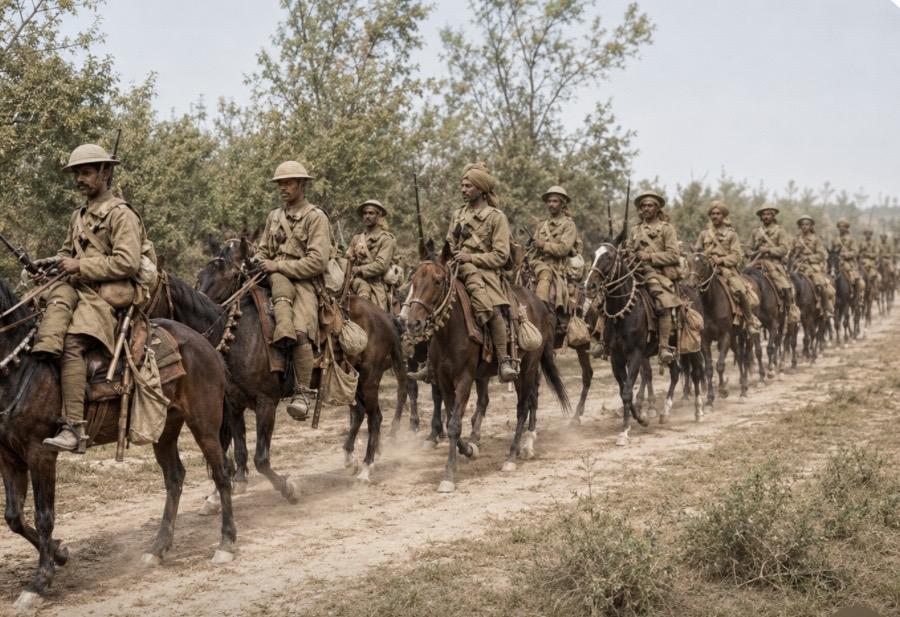
The cavalry force most famously connected with Bazentin Ridge came from the 2nd Indian Cavalry Division. Within it was the Secunderabad Cavalry Brigade, commanded by Brigadier-General F. W. G. Wadeson, and among its regiments were the 20th Deccan Horse and the 7th Princess Royal’s Dragoon Guards. The 20th Deccan Horse was an Indian cavalry regiment with a proud imperial service tradition, made up of Indian soldiers including Sikhs, Jats and Deccani Muslims. Alongside them rode the British 7th Dragoon Guards. Their purpose was not simply to make a romantic charge, but to exploit what the infantry had opened. The wider cavalry objective was to push beyond the captured ridge and help secure a line towards High Wood, Flers and Le Sars if the German defence broke.
The moment came late in the day, when the opportunity was already slipping away. High Wood had not been occupied quickly when it was still lightly held, and by the afternoon German troops were recovering and moving back into the area. British infantry of the 7th Division were ordered forward towards the wood, while cavalry elements were sent up on the right. The 20th Deccan Horse and the 7th Dragoon Guards had to move across a battlefield that was completely unsuited to horses. They passed through shell-holes, wrecked trenches and churned-up ground, trying to reach the open country near High Wood before German resistance stiffened further.
Then came the charge itself. A squadron from the 20th Deccan Horse and men of the 7th Dragoon Guards moved forward near High Wood, with the Indian cavalry riding through standing crops towards German infantry who were concealed in the cornfields. It was a strange and almost unbelievable scene for 1916: lancers and cavalrymen moving across a battlefield dominated by modern firepower. A Royal Flying Corps aircraft from No. 3 Squadron saw German troops hidden in the crops and assisted the attack, with the pilot diving low and firing on the Germans while the observer dropped a sketch of enemy positions to the cavalry below. This combination of cavalry and aircraft on the Somme was extraordinary, almost a clash of two different ages of warfare in the same moment.
The cavalry broke into the German infantry near the eastern edge of High Wood and caused confusion among the defenders. German heavy artillery had already been pulled back, and lighter guns struggled to engage such a fast-moving target. Machine-guns still fired, and the danger was severe, but the cavalry did achieve a local success. German troops in the crops were killed, captured or scattered, and reports spread through German headquarters that British cavalry had broken through between Longueval and Pozières. For a short time the Germans feared that the front had been opened and that cavalry was moving beyond High Wood.
The reality was much smaller, but no less brave. The cavalry had not broken the German Army, and the wider breakthrough never came. The attack had gone in too late, the infantry support was not strong enough, High Wood was not fully taken, and the German Switch Line still blocked the way. The cavalrymen could seize ground and shock the enemy for a moment, but they could not hold and expand the success alone. By nightfall the chance had gone. High Wood would become another bitter killing ground, fought over again and again in the weeks that followed.
The losses showed the cost of the attempt. The 20th Deccan Horse and 7th Dragoon Guards suffered 102 casualties between them and lost 130 horses, a heavy price for a brief action on the edge of High Wood. Eight cavalrymen were killed in the charge itself, with many more wounded, while the loss of horses was severe. The image of the Deccan Horse waiting in Carnoy Valley before moving forward has become one of the most memorable photographs of the Somme, because it captures men and horses on the edge of a battle that belonged increasingly to artillery, machine-guns and aircraft rather than sabres and lances.
What makes Bazentin Ridge so interesting is that it was both a success and a missed opportunity. The infantry assault was well planned and, at first, well executed. It proved that the British Army could learn from disaster and carry out a more modern, more carefully coordinated attack. But it also showed the limits of command and control in 1916. Once the first objectives were taken, speed was everything, yet orders, reinforcements and exploitation forces moved too slowly. High Wood might have been occupied earlier, but delay allowed the Germans to recover. The cavalry was waiting for a breakthrough, but by the time it was pushed forward the battlefield had already started to close again.
For the Indian soldiers of the 20th Deccan Horse, the action at Bazentin Ridge was a remarkable moment in the history of the Indian Army on the Western Front. Thousands of Indian troops served in France and Flanders during the First World War, often in terrible conditions far from home, and the cavalry charge near High Wood remains one of the most striking examples of their service. These men were not relics of an old army blindly thrown into modern war; they were disciplined professional soldiers used in the way commanders still hoped cavalry might be used if the enemy line broke. Their courage was real, even if the opportunity they were given was too brief and too late.