On this day in military history…
On 4th July 1976, Israel carried out one of the most daring hostage rescue missions in modern military history: the Entebbe raid, also known as Operation Thunderbolt. It was a long-range special forces operation launched to rescue hostages from Air France Flight 139, which had been hijacked on 27th June while travelling from Tel Aviv to Paris via Athens. After take-off from Athens, the aircraft was seized by Palestinian and German militants and forced first to Benghazi in Libya, then on to Entebbe Airport in Uganda, more than 2,000 miles from Israel. There, the hijackers were supported by the regime of Ugandan dictator Idi Amin, who allowed the hostages to be held in the old airport terminal while demands were made for the release of imprisoned militants.
The situation quickly became a national crisis for Israel. The hijackers separated many of the Israeli and Jewish passengers from the others, a detail that deeply shocked Israel and much of the world because of its grim historical echo. Over the following days, a number of non-Israeli hostages were released, but the Israeli passengers, several Jewish passengers, and the Air France crew remained behind. The crew’s presence became one of the more striking human details of the story, because they stayed with the hostages rather than leaving once some passengers were released. The captives were kept in the old terminal building at Entebbe while the hijackers threatened to begin killing them if their demands were not met.
At first, Israel appeared to negotiate, partly to gain time. Behind the scenes, however, military officers and intelligence officials were urgently examining whether a rescue could even be attempted. The distance alone made the idea seem almost impossible. Entebbe was far beyond the normal reach of a quick commando raid, and any rescue force would have to cross a huge stretch of hostile or uncertain airspace, land at night, assault a guarded terminal in a foreign country, rescue more than a hundred people, refuel or find a way home, and escape before Ugandan forces could react in strength.
One of the reasons the plan became possible was that Israel had useful knowledge of Entebbe Airport. Israeli firms had previously been involved in construction work there, and Israel had once had close relations with Uganda before Idi Amin turned sharply against it. This helped Israeli planners understand the layout of the old terminal and the surrounding airfield. Intelligence also came from released hostages, who were questioned after they arrived in Europe. They were able to describe the terminal, the guards, the hijackers, the mood inside the building and the way the captives were arranged. These details were vital because the commandos would have only seconds to distinguish hostages from terrorists once the shooting started.
The operation was planned at speed but with remarkable care. The overall military command was given to Brigadier General Dan Shomron, who shaped the rescue plan and commanded the ground operation. The special forces assault element was drawn mainly from Sayeret Matkal, Israel’s elite reconnaissance and counter-terrorist unit. Lieutenant Colonel Yonatan “Yoni” Netanyahu, older brother of future Israeli prime minister Benjamin Netanyahu, commanded the main assault force tasked with entering the terminal and freeing the hostages. Other Israeli units had supporting roles, including paratroopers and Golani troops, who were needed to secure the airfield, protect the transport aircraft, deal with Ugandan soldiers, and help get the rescued hostages back onto the planes.
The aircraft chosen for the mission were Lockheed C-130 Hercules transport planes, known in Israeli service as the Karnaf, meaning rhinoceros. These aircraft were essential because they could carry troops, vehicles, fuel, weapons and rescued hostages over long distances and land on a runway in difficult conditions. Four C-130 Hercules aircraft carried the main force, while Boeing 707 aircraft were also used in support roles, including command, communications and medical support. One of the support aircraft landed in Nairobi, Kenya, where wounded hostages and soldiers could be treated if necessary.
The force set off from Ophir air base at Sharm el-Sheikh in the Sinai, then under Israeli control. The flight itself was a major feat. The Hercules aircraft flew for hours at very low level, in places reportedly around 100 feet, to reduce the chance of radar detection as they moved down the Red Sea and across eastern Africa. The route was dangerous not only because of distance, but because discovery could have caused the entire operation to fail before a single commando reached the terminal. A rescue force intercepted or challenged in the air would have had few good options.
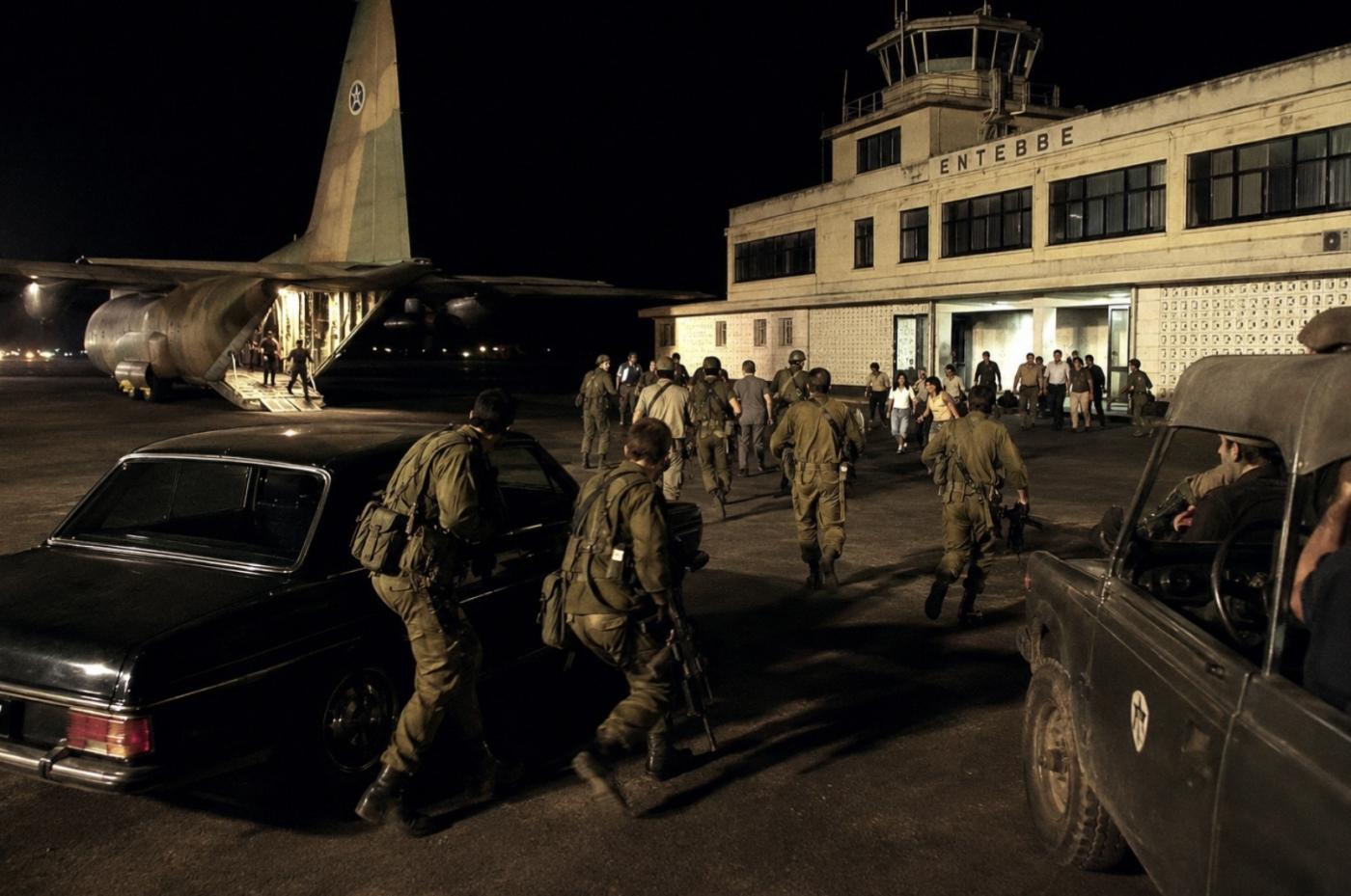
One of the most famous features of the raid was the deception used on landing. The Israelis brought a black Mercedes and Land Rovers inside the first Hercules. The idea was to imitate the style of convoy used by Idi Amin, who was known for travelling in a Mercedes with escort vehicles. The hope was that, in the darkness and confusion, Ugandan guards would hesitate long enough for the Israeli commandos to reach the old terminal before an alarm could be raised. This was a bold piece of theatre as much as military planning, and it showed how much the operation depended on surprise.
Late on the night of 3rd July, crossing into the early hours of 4th July, the first C-130 came down at Entebbe. Its rear ramp opened and the Mercedes-led convoy rolled out. Almost immediately, the plan was tested. Ugandan sentries challenged the vehicles, and the Israelis opened fire. The element of complete surprise was partly lost, but not enough to stop the assault. The commandos accelerated towards the old terminal, knowing that every second now mattered. If the hijackers had enough warning, they could begin killing hostages before the rescuers reached them.
The assault team stormed the building with speed and violence. The commandos shouted instructions to the hostages, ordering them to get down, while firing at the hijackers. In the chaos, some hostages were tragically hit, but the assault succeeded in killing the hijackers inside the terminal before they could massacre the captives. It was an extraordinarily difficult environment: frightened civilians, armed terrorists, darkness, noise, language confusion and the knowledge that a mistake could kill the very people the force had come to save.
Outside the terminal, other Israeli troops fought Ugandan soldiers and secured the airfield. One supporting element was tasked with protecting the Hercules aircraft, because without them the rescue force and the hostages would be stranded deep inside Uganda. Another important task was the destruction of Ugandan MiG fighter aircraft on the ground, to prevent them from taking off and pursuing the Israeli transports after departure. This was one of the details that made the raid more than a simple hostage rescue; it was a complete airfield seizure and withdrawal operation carried out in a very narrow window of time.
The cost to Israel was small in numbers but heavy in significance. Yonatan Netanyahu, commander of the Sayeret Matkal assault force, was killed during the operation, reportedly by fire from the area of the control tower. His death became one of the defining images of the raid, and the operation was later also remembered in Israel as Operation Yonatan in his honour. Several Israeli soldiers were wounded. Among the hostages, three were killed during the rescue itself, and Dora Bloch, an elderly hostage who had earlier been taken to hospital in Uganda, was later murdered after the raid, a brutal act widely attributed to Amin’s regime.
The rescued hostages were rushed out of the terminal and loaded onto the waiting Hercules aircraft. The time on the ground was short, but to those involved it must have felt much longer. The Israelis had to gather civilians who had been held for days, move the injured, count as many people as possible, fight off armed resistance, and leave before heavier Ugandan forces could arrive. Once airborne, the aircraft flew to Nairobi, where Kenyan cooperation proved extremely important. The use of Nairobi for refuelling and medical support helped make the long return journey possible.
The raid stunned the world. Israel had sent a rescue force across a vast distance, into a hostile foreign airport, under cover of darkness, and brought back the great majority of the hostages alive. It was immediately seen as a dramatic demonstration of Israel’s willingness to act unilaterally to protect its citizens, even when the odds looked terrible. It also humiliated Idi Amin, whose support for the hijackers had placed Uganda at the centre of the crisis. The fact that the raid happened on 4th July, America’s Independence Day and also the bicentenary year of the United States, added another layer of symbolism for many observers.
The planning and execution of Entebbe became a case study in special operations. It showed the value of intelligence from released hostages, accurate knowledge of the target, long-range airlift, rehearsals, deception, surprise, and clear division of tasks between assault troops and supporting forces. It also showed the danger of such missions. Had the commandos been delayed, had the aircraft been detected, had the terminal layout been wrong, or had the Ugandan military reacted faster, the result could have been catastrophic.
Operation Entebbe remains famous because it combined audacity with precision. It was not simply a brave charge into danger; it was a carefully built plan carried out at extreme range with aircraft, commandos, vehicles, medical support and diplomatic risk all tied together. The image of Israeli Hercules transports landing in the darkness at Entebbe, a fake presidential convoy racing towards the terminal, and commandos bursting into the hostage hall has become one of the most dramatic stories in modern military history. Its success came from speed, intelligence, surprise and the willingness to attempt what many had thought impossible.