On this day in military history…
Tobruk fell to Erwin Rommel’s German and Italian forces on 21 June 1942, in one of the most dramatic Allied disasters of the North African campaign. The port had enormous military value because it offered a deep-water harbour on the Libyan coast, but it also carried symbolic weight. In 1941, Allied troops had defended it for months against repeated Axis attacks, and the Australian defenders became famous as the “Rats of Tobruk”. That earlier resistance had frustrated Rommel and forced his army to rely on long supply routes across Libya.
By June 1942, the position had changed completely. The fall came after the Battle of Gazala, fought from 26 May to 21 June 1942. Rommel’s Panzerarmee Afrika, made up of German and Italian forces, outmanoeuvred the British Eighth Army west of Tobruk. His armoured units swept around the southern end of the Gazala Line, attacked from the rear, and fought a fierce battle in the area known as the “Cauldron”. After days of hard fighting, British armour was badly weakened and the Eighth Army was forced to retreat eastward.
The fortress was left exposed. Although it had a powerful reputation, its defences were not as strong as they had been in 1941. Some minefields and wire obstacles had been neglected or altered, and the garrison had not been fully prepared for another long siege. Air cover was also reduced because the Desert Air Force had been pushed back toward Egypt. The Allied commander inside the port was Major-General Hendrik Klopper of the 2nd South African Division. His force included South African, British, Indian and other Allied troops, but many were service, transport and support personnel rather than front-line infantry.
Rommel acted quickly. On 20 June 1942, Axis forces attacked the eastern and south-eastern defences after heavy artillery fire and air attacks, including strikes by German dive-bombers. Engineers cleared routes through mines and obstacles, while tanks and infantry pushed through the breach. Once German armour entered the defensive perimeter, the situation deteriorated rapidly. Communications broke down, units became isolated, and the defence lost cohesion.
The speed of the assault was decisive. In desert warfare, a fixed position could collapse quickly once tanks broke through and reached headquarters, supply areas and the harbour. Some Allied troops were still capable of fighting, but many were cut off from orders, ammunition and transport. By the morning of 21 June, Axis forces were already inside the main defensive area, and Klopper decided that further resistance would lead to unnecessary slaughter. He ordered surrender, though some groups attempted to escape and others continued fighting for a short time.
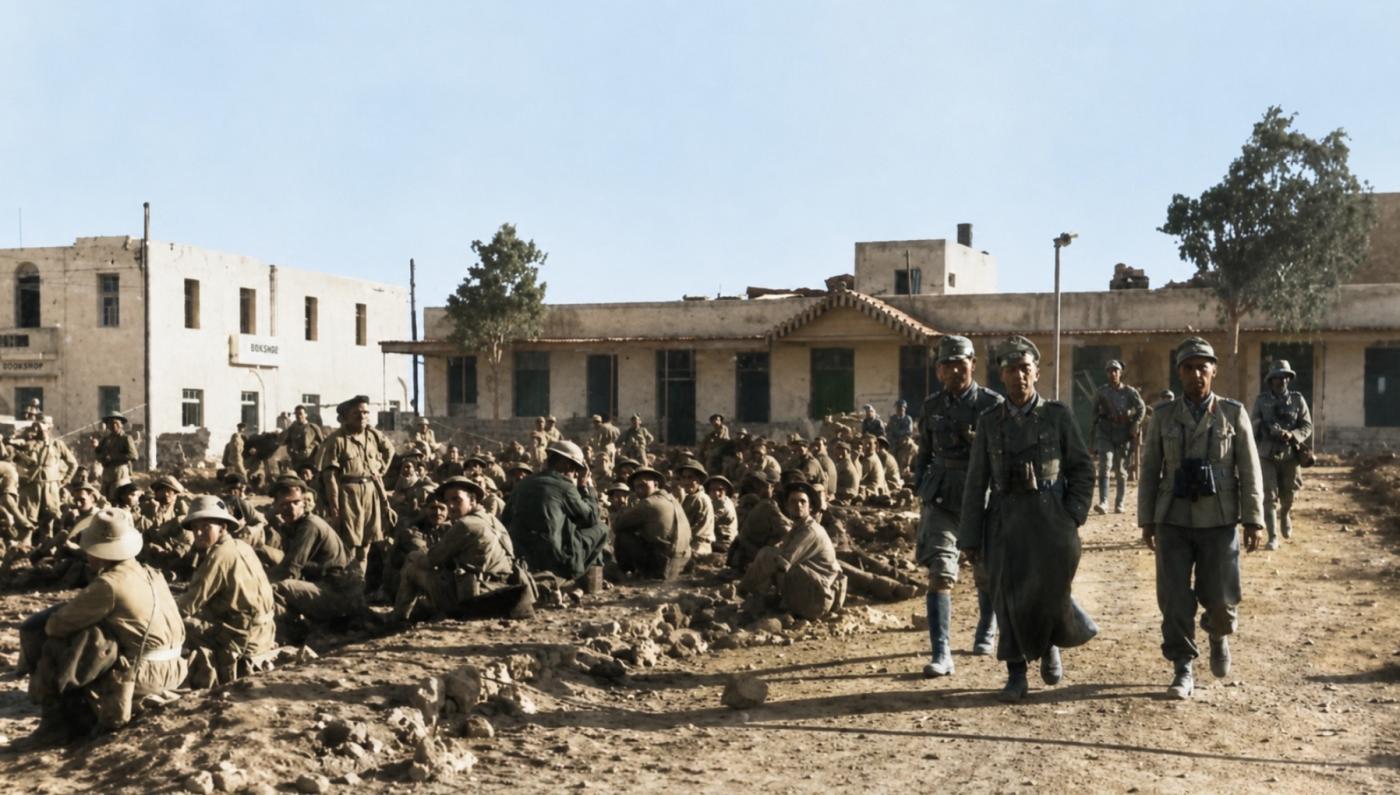
The scale of the capture was enormous. Around 33,000 Allied troops were taken prisoner, though some accounts give the figure as about 35,000. Many were South Africans, but British, Indian and other Commonwealth soldiers were also captured. It was one of the largest British Commonwealth surrenders of the Second World War, second in shock to the fall of Singapore earlier that year. Large quantities of fuel, food, vehicles, ammunition and equipment also fell into Axis hands, helping Rommel continue his advance toward Egypt.
The news caused alarm in London. Winston Churchill was in the United States when he heard of the disaster, and the loss was deeply humiliating because the fortress had been expected to hold. The rapid collapse was caused by several factors: the Allied defeat at Gazala, weak preparation, confusion over whether the port should be held or evacuated, poor coordination, reduced air support, and Rommel’s fast, concentrated attack.
For Rommel, the victory was the greatest triumph of his desert campaign. Adolf Hitler promoted him to field marshal after the capture. Yet the success also encouraged Rommel to push too far. Instead of pausing, he advanced into Egypt, hoping to defeat the British before they could recover. The Axis also postponed the planned attack on Malta, a decision that later hurt their supply situation because Malta continued to threaten convoys crossing the Mediterranean.
After the fall, Rommel drove east toward Mersa Matruh and then El Alamein. There the geography favoured the British, because the line between the Mediterranean and the Qattara Depression left no open southern flank for the Axis to exploit. The First Battle of El Alamein in July 1942 stopped Rommel’s advance, and the Second Battle of El Alamein in October and November broke his army’s momentum. The port was recaptured by the British on 13 November 1942.
The fall of Tobruk showed how quickly a famous fortress could collapse when its field army had been defeated, its defences were not properly prepared, and a determined armoured attack struck before the garrison could organise a long defence. On 21 June 1942, Rommel captured a vital harbour, huge stores of supplies, and around 33,000 Allied prisoners, turning a once-proud symbol of resistance into one of Britain’s darkest moments in the desert war.