SDKFZ Scout Car
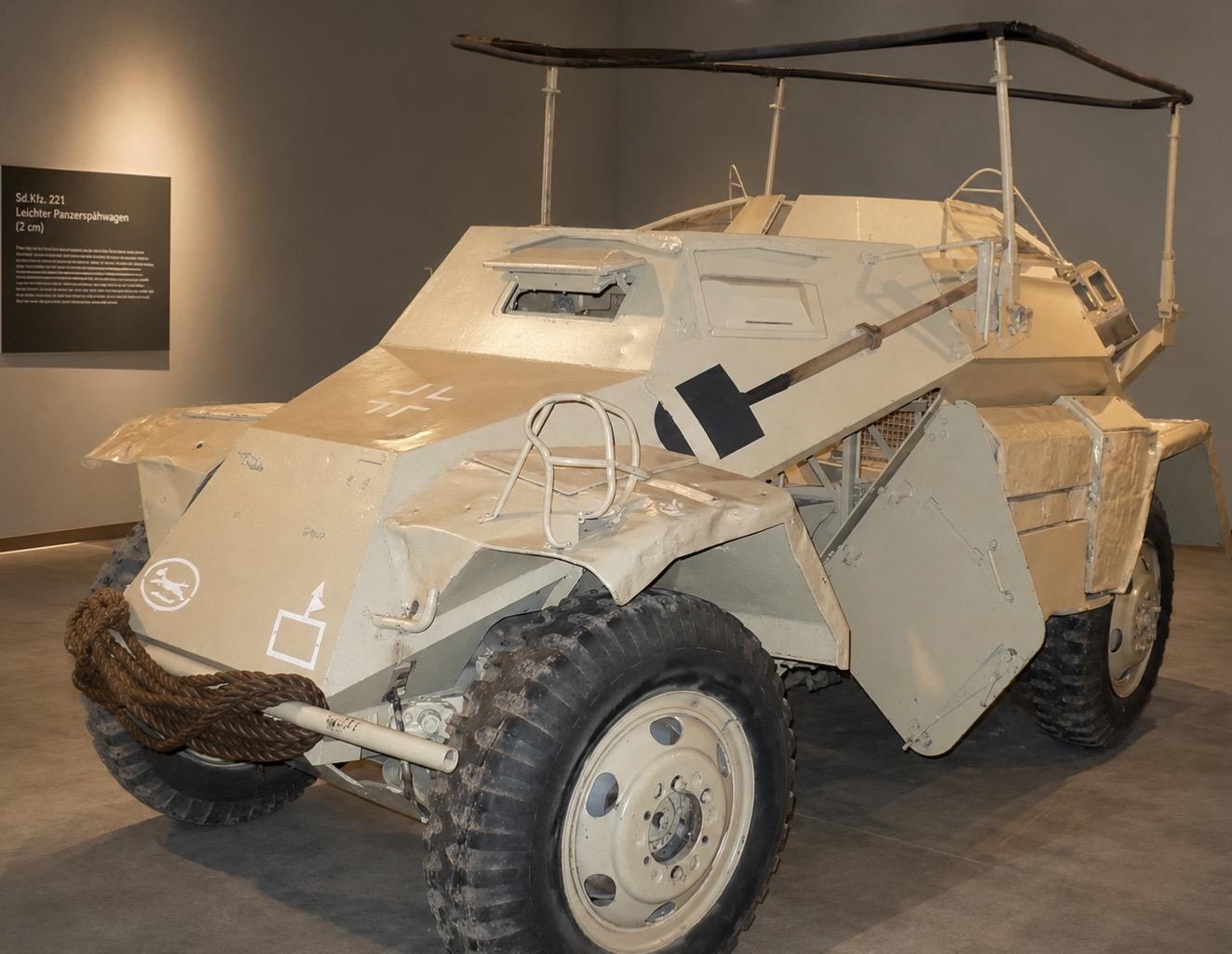
The German Sd.Kfz. 223 scout car was one of the small but important armoured reconnaissance vehicles used by the German Army before and during the Second World War. It belonged to the leichter Panzerspähwagen family, a group of light four-wheeled armoured cars built to give fast-moving German formations eyes and ears ahead of the main force. While some vehicles in the family were intended mainly for scouting and fighting, this version was designed above all as a radio and command car, able to keep reconnaissance patrols in touch with headquarters while on the move.
The design came from the German effort in the 1930s to modernise reconnaissance. Earlier vehicles such as the Kfz. 13 and Kfz. 14 were useful for training and early motorisation, but they were too lightly protected and too limited for the sort of fast armoured warfare Germany was preparing for. A new family of compact armoured cars was therefore developed using a standard four-wheel-drive chassis. The chassis was produced by Horch, part of Auto Union, while the armoured body design was connected with Eisenwerk Weserhütte. Manufacturing was mainly carried out by Auto Union/Horch, with other German firms involved in production of related vehicles and components.
The 223 was closely related to the Sd.Kfz. 221 and Sd.Kfz. 222. The 221 was the basic light scout car, usually armed with a machine gun. The 222 was the more heavily armed version, carrying a 20 mm cannon as well as a machine gun. The 223 filled a different role. It carried radio equipment and an extra crewman so that it could act as a communications vehicle for reconnaissance units. In practice, it would often work with other scout cars, passing information back to commanders and helping control the movement of patrols.
Power came from a Horch V-8 petrol engine, usually listed at around 75 horsepower in early examples, though some later figures for the family give slightly higher output depending on the model and production series. This engine gave the little armoured car good road performance for its time. It could reach about 75 to 80 km/h on roads, which made it well suited to the rapid advances of the early war years. Its road range was roughly 300 to 350 km, while cross-country range was nearer 200 km, depending on terrain, fuel load and conditions.
The vehicle had four-wheel drive and, in early versions of the family, four-wheel steering. This gave it good manoeuvrability, especially on roads and firm ground. It was small, low and quick, which made it useful for scouting, liaison and command work. However, like many light armoured cars, it had limitations. It was not ideal in deep mud, snow, soft sand or broken country. In places such as the Eastern Front and North Africa, crews often found that the conditions could be as dangerous to mobility as enemy fire.
Its armour was light. Early protection was generally around 8 mm in some areas, enough to stop small-arms fire and shell splinters but not much more. Later vehicles in the family received improved armour, with some frontal protection increased to about 30 mm. Even with this improvement, it was not a fighting vehicle in the sense of a tank or heavy armoured car. Heavy machine guns, anti-tank rifles, artillery fragments at close range and certainly anti-tank guns could all be deadly. Survival depended on speed, concealment, good observation and avoiding unnecessary combat.
The normal crew was three men: a driver, a commander who also handled the weapon, and a radio operator. The extra crewman was essential because the main purpose of the vehicle was communication. Inside, space was tight. The men had to share the small hull with radio equipment, ammunition, personal weapons, tools and supplies. Conditions could be uncomfortable, especially in hot climates or during long patrols.
One of the most recognisable features was the large frame aerial fitted above the hull. This rectangular rail-like antenna made the vehicle easy to identify and gave it a very distinctive appearance. The aerial could be folded down when required, but when raised it showed the vehicle’s role at once. Later examples could be fitted with different radio aerial arrangements, including star antennas. Early sets included FuG 10 radio equipment, while later vehicles could carry FuG 12 sets. These radios allowed reconnaissance patrols to report enemy positions, road conditions, bridges, obstacles and movement back to command posts.
Although primarily a radio car, it did carry weapons. Its usual armament was a single 7.92 mm MG 34 machine gun mounted in a small rotating protected position. This was intended for self-defence rather than aggressive fighting. The crew might also carry personal weapons such as pistols, rifles or a submachine gun. Compared with the cannon-armed 222, its firepower was modest, but that was not the point of the design. Its value lay in communication, not in destroying enemy vehicles.
The vehicle served with German reconnaissance units in Panzer divisions, motorised divisions and other mobile formations. It saw service in Poland, France, the Balkans, North Africa, Russia and other theatres where German forces operated. In the early campaigns it fitted very well with the German style of warfare. Fast-moving units needed equally fast reconnaissance elements ahead of them, and information had to be sent back quickly. A patrol that saw an enemy position but could not report it was of little use. This made the radio-equipped car extremely valuable.
Its strengths were speed, compact size and communication ability. It could move ahead of columns, investigate roads and villages, maintain contact between scattered patrols and pass information to higher command. It could also serve as a command link for other light armoured cars operating nearby. In a mobile battle, this was a major advantage. German commanders placed great importance on radio communication, and vehicles like this helped give their reconnaissance units flexibility and control.
Its weaknesses were just as clear. The armour was too thin for serious combat, the armament was light, and the vehicle’s small size made it cramped. The large aerial, while useful, could make it stand out. In bad terrain its mobility was not always enough, and as the war went on the battlefield became more dangerous for light armoured cars. Anti-tank weapons became more common, artillery fire more intense, and air attack a constant threat in many theatres.
Operators were mainly German, though related light armoured cars of the same family were supplied to or used by some other Axis or friendly nations. China, Bulgaria and Romania are often associated with vehicles from this family, although not every reference is specific to the radio version. Captured examples could also be used by enemy forces when found in working order, as happened with many German vehicles during the war.
An interesting point about this scout car is that it shows how advanced German thinking on reconnaissance had become by the late 1930s. The Germans did not simply build scout cars to look around and fire a machine gun. They built a family of vehicles with different roles: one for basic scouting, one with heavier firepower, and one for radio communication. This showed a clear understanding that reconnaissance was not just about seeing the enemy, but about sending that information quickly to the people who needed it.
By the later stages of the war, larger and more capable vehicles gradually became more useful for long-range reconnaissance and command duties. Eight-wheeled armoured cars offered better performance over difficult ground and carried heavier weapons. Half-tracked radio vehicles could carry larger equipment and had better off-road ability in some conditions. Even so, the little radio scout car remained an important part of Germany’s early-war reconnaissance system.
It was not heavily armed, not thickly armoured and not designed to fight a stand-up battle. Its real purpose was to move fast, observe, communicate and survive long enough to bring back information. In that role it was a clever and useful machine. Small, distinctive and purposeful, it remains one of the most recognisable German armoured cars of the Second World War, remembered especially for its frame aerial and its role as the radio link between the eyes of the army and the commanders behind them.