FG 42
The FG 42, short for Fallschirmjägergewehr 42, meaning “paratrooper rifle 42”, was one of the most unusual German small arms of the Second World War. Although often described as a machine gun because it could fire fully automatically, it was officially a select-fire automatic rifle designed for the German Fallschirmjäger, or parachute troops. It tried to combine the roles of rifle, automatic rifle, light machine gun and marksman’s weapon in one compact arm that a paratrooper could carry during a jump.
The need for such a weapon came from German airborne experience, especially the invasion of Crete in May 1941. German paratroopers often jumped with only pistols, grenades and limited personal weapons, while rifles, submachine guns and machine guns were dropped separately in containers. On Crete, many men landed under fire and had to search for their weapons while being shot at. The heavy losses showed that airborne troops needed a powerful arm they could carry during the drop and use immediately on landing.
The rifle was developed from a design by Louis Stange, chief engineer at Rheinmetall-Borsig. The Luftwaffe wanted a compact weapon using the standard 7.92 x 57 mm Mauser cartridge, able to fire single shots accurately, fire automatically when needed, accept optical sights, mount a bayonet and serve as a light support weapon from a bipod. This was an ambitious requirement, because it asked one soldier’s weapon to perform several battlefield roles at once.
Production was limited. Rheinmetall-Borsig was involved in the design, but the main manufacturer became Heinrich Krieghoff Waffenfabrik of Suhl. The first production pattern appeared in 1943, with later versions redesigned to make the weapon easier to manufacture and more controllable. Total production was small, usually estimated at only several thousand, roughly around 7,000, so it remained rare even among airborne units.
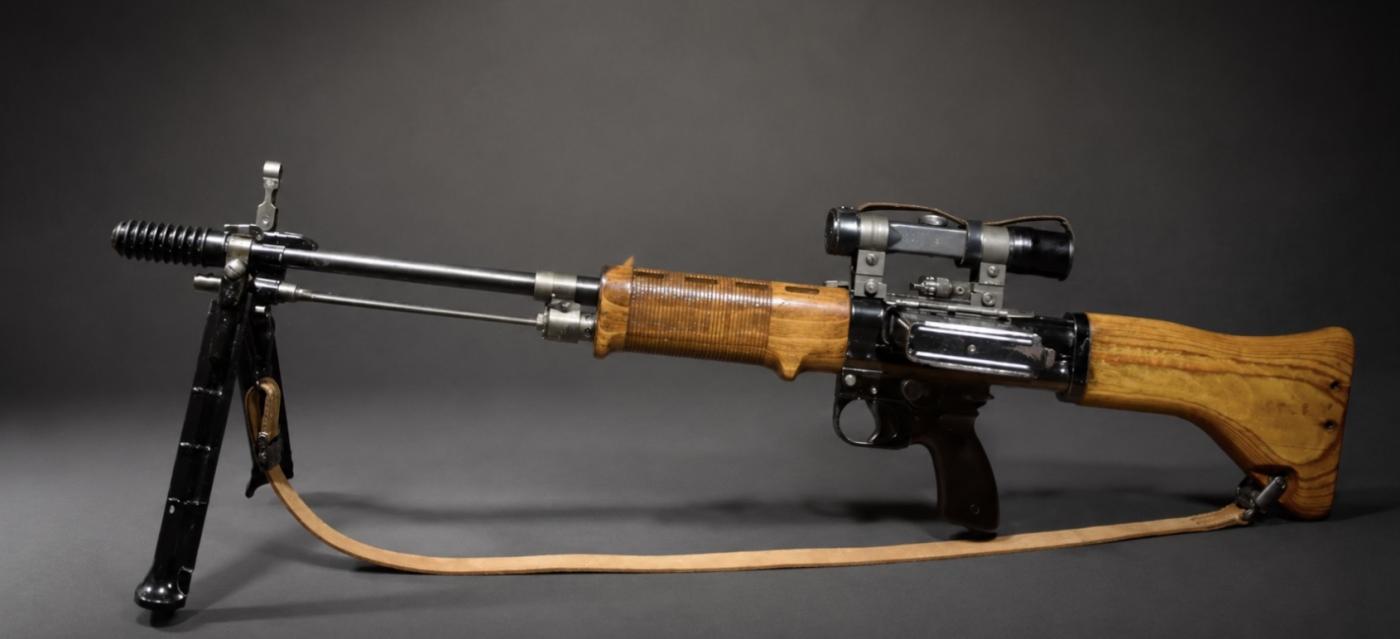
Mechanically, it was gas-operated and used a rotating bolt. One clever feature was that it fired from a closed bolt in semi-automatic mode, which helped accuracy, but from an open bolt in automatic mode, which helped cooling and reduced the danger of cook-off during rapid fire. It fed from a detachable box magazine mounted horizontally on the left side of the receiver, usually holding 20 rounds. The side-mounted magazine looked unusual, but helped keep the weapon compact while still using a full-power rifle cartridge.
Its rate of fire was high. Early models fired at about 900 rounds per minute, while later versions were closer to about 750 rounds per minute. This gave impressive short-burst firepower, but the 20-round magazine emptied quickly. The powerful 7.92 mm cartridge also made automatic fire difficult to control. The muzzle brake, straight-line stock and bipod helped, but the weapon was still best fired in short bursts rather than long streams of fire.
In accuracy, it was strongest as a semi-automatic rifle. Because it fired from a closed bolt on single shots, it could be quite accurate at normal infantry ranges. Its effective range is often given at about 500 to 600 metres, especially when fired carefully. It could also take optical sights such as the ZFG 42, making it useful as a marksman’s weapon. In fully automatic fire, accuracy fell because of recoil, muzzle climb and the high firing speed.
The early version had a sharply angled pistol grip, metal stock, folding spike bayonet, folding bipod and a complex machined receiver. Later versions had a more vertical grip, wooden butt, revised handguard, more stamped parts and a bipod moved closer to the muzzle. These changes made the weapon heavier and more stable, and helped reduce the rate of fire.
It was chosen for German paratroopers because it answered their special problem: they needed immediate firepower after landing. A Fallschirmjäger could carry it during the drop, then use it as a rifle, automatic weapon or light support arm once on the ground. It was not simple, cheap or easy to mass-produce, but it gave elite airborne troops a powerful all-round weapon suited to their dangerous method of fighting.
In service, it was admired but never produced in numbers large enough to make a major difference. It was advanced, compact and powerful, but expensive, complicated and difficult to control in full automatic fire. It was not as steady as a true light machine gun, not as simple as a bolt-action rifle and not as practical for mass issue as the later Sturmgewehr 44. Even so, its design was far ahead of its time, and its straight-line layout, optical sight capability, bipod and mixed closed-bolt/open-bolt firing system made it one of the most technically interesting weapons of the war.