
On this day in military history…
The end of German occupation in Denmark came not through a separate Danish surrender, but as part of a wider agreement in the final days of the Second World War. By early May 1945, Nazi Germany was collapsing, and after the death of Hitler, leadership had passed to Karl Dönitz. His strategy was to surrender to the Western Allies where possible, allowing German forces and civilians to avoid capture by the Soviets advancing from the east.
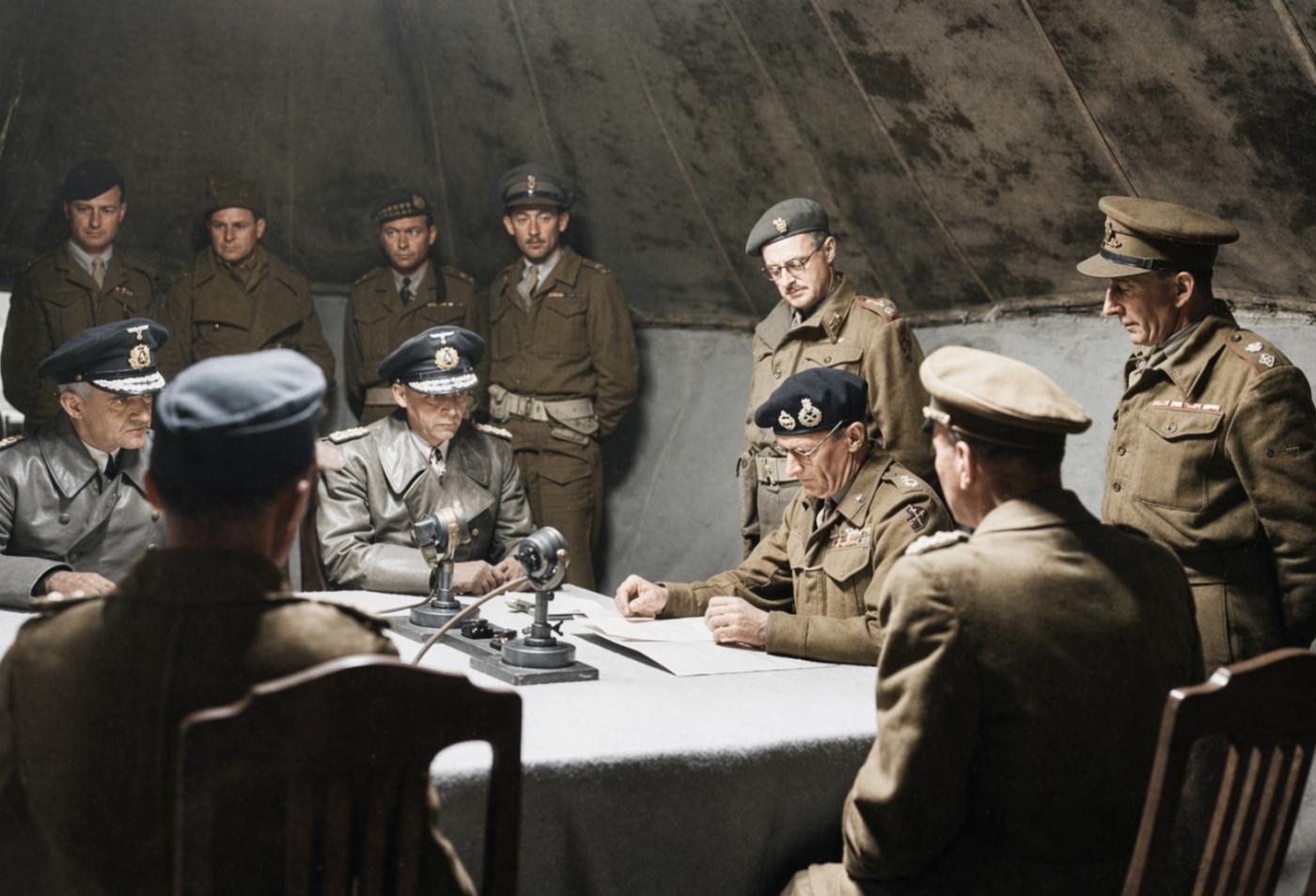
To carry this out, a delegation was sent to meet Field Marshal Bernard Law Montgomery at his headquarters on Lüneburg Heath in northern Germany. The meeting took place on 4 May 1945 in a simple field setup rather than any formal building, reflecting how quickly events were moving. The German side was led by Admiral Hans-Georg von Friedeburg, accompanied by General Eberhard Kinzel and Rear Admiral Gerhard Wagner.
There was little negotiation. Montgomery made it clear that only a full and unconditional surrender would be accepted, covering all German forces in northwest Germany, the Netherlands, and Denmark. The German officers had no real leverage and agreed to the terms. The document they signed brought an end to German control in Denmark, where occupation had lasted since April 1940.
The agreement stated that all fighting would stop at 08:00 on 5 May 1945. News reached Denmark the evening before, broadcast over the BBC. People who had lived under strict restrictions for years reacted immediately. One of the most remembered moments came that night, when candles appeared in windows across the country, marking the return of freedom after years of enforced darkness.
Elsewhere, the surrender was seen as a major step toward the end of the war, though not the final act. That came days later with Germany’s complete capitulation, now remembered as Victory in Europe Day. Dönitz’s attempt to manage separate surrenders in the west ultimately failed, as Allied commanders, including Dwight D. Eisenhower, insisted on total surrender across all fronts.
What makes Denmark’s liberation stand out is how quickly and smoothly it happened at the end. There was no major final battle on Danish soil. Once the order was given, German forces largely complied, and the occupation ended with a sudden shift from control to freedom. Within hours of the announcement, the country moved from silence and restriction to open celebration, marking one of the clearest and most immediate transitions at the close of the war in Europe.