On this day in military history…
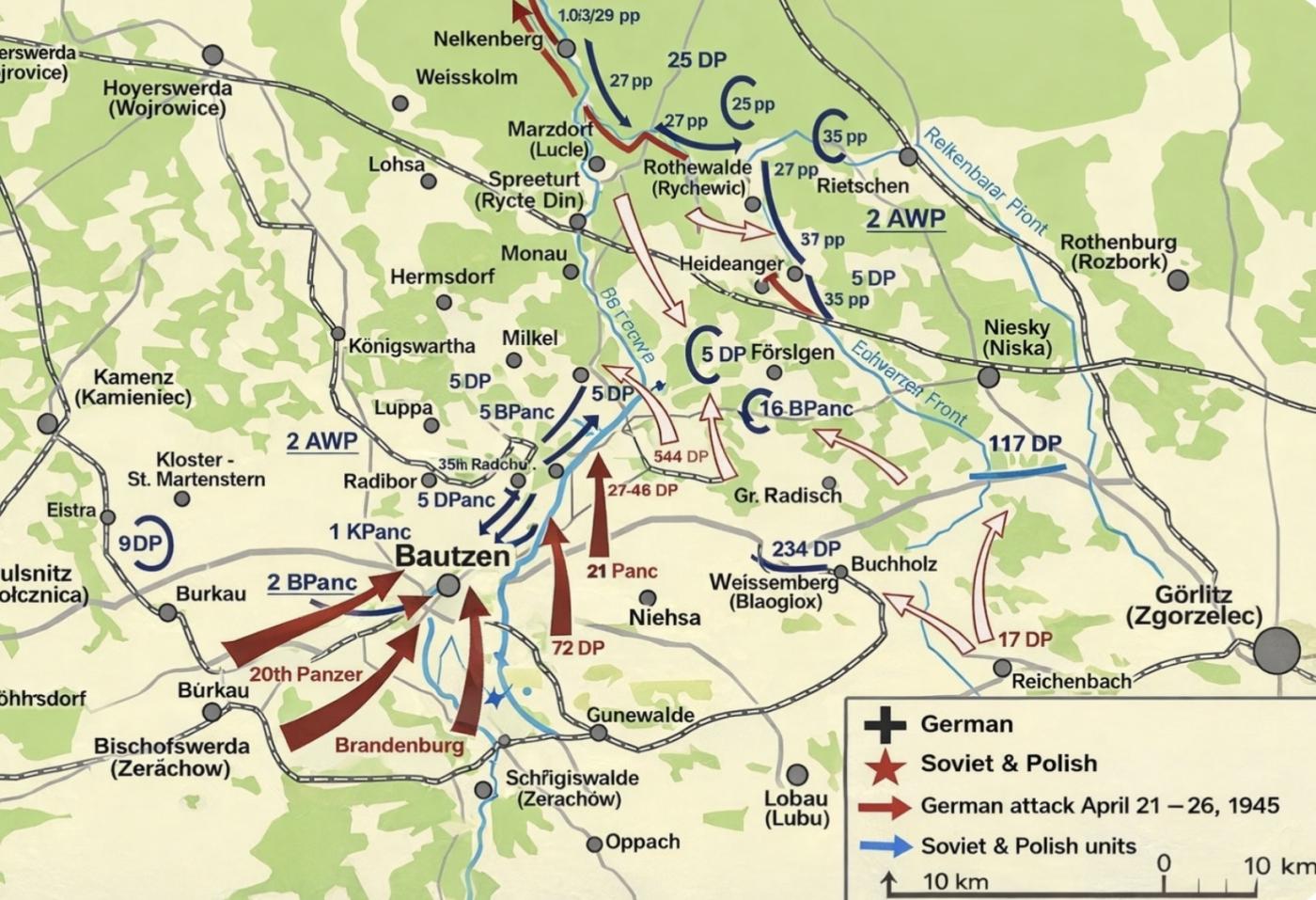
The Battle of Bautzen, fought between 21 and 26 April 1945, was one of the last surprising twists of the Second World War in Europe. At a time when Nazi Germany was collapsing on all fronts and the fall of Berlin was only days away, German forces managed to launch a powerful counterattack that briefly turned the tide in their favour. It took place around Bautzen, a historic town in eastern Germany that became the centre of intense fighting during the final weeks of the war.
The German forces involved were part of Army Group Centre, commanded by Ferdinand Schörner, one of the most hardline and determined commanders in the German army. On the ground, the attack was led by Walther Nehring and elements of the 4th Panzer Army. These included experienced units such as the Panzergrenadier Division “Brandenburg” and the 20th Panzer Division. Although Germany was running out of men and equipment, these formations still retained discipline, mobility, and a strong ability to fight, especially when used in concentrated attacks.
Facing them were Soviet and Polish forces advancing rapidly into Germany. The main Allied formation in this sector was the Polish Second Army, commanded by Karol Świerczewski, operating under the wider command of Ivan Konev and his 1st Ukrainian Front. The Allied advance had been swift, but it came at a cost. Units were stretched out, coordination was uneven, and flanks were left exposed—conditions that created an opportunity for a counterstrike.
That opportunity came on 21 April, when German forces launched a sudden offensive against the vulnerable Polish lines. The attack was fast and aggressive. German armoured units punched through weak points, exploiting gaps between formations and moving quickly to encircle isolated units. The Polish Second Army, caught off guard and spread too thin, struggled to respond effectively.
Fighting quickly intensified around Bautzen itself. The town became the focal point of the battle, with fierce street fighting and repeated clashes for control of key positions. Buildings were destroyed, and the area changed hands more than once. German forces eventually succeeded in retaking the town, pushing back the Polish troops and tightening their grip on the surrounding area.
One of the most dramatic elements of the battle was the encirclement of Polish forces. Several units were cut off and surrounded, leading to chaos and heavy losses. Communications broke down, and attempts to regroup often failed under constant pressure. The Polish Second Army suffered severe casualties, with tens of thousands killed, wounded, or missing. Some formations were effectively destroyed as fighting units.
Despite these successes, the German victory had clear limits. Their offensive disrupted the Allied advance and inflicted serious damage, but it could not change the overall course of the war. Soviet forces continued their push toward Berlin, and Germany’s strategic situation remained hopeless. The resources needed to sustain further offensives simply no longer existed.
Even so, the Battle of Bautzen stands out as a striking example of how German forces could still fight effectively, even in the final days of the war. It showed that experienced units, when used skillfully, could exploit weaknesses and achieve local victories against numerically superior opponents. At the same time, it exposed the risks of rapid advances without secure coordination, particularly for less experienced formations like parts of the Polish Second Army.
By 26 April, the fighting had largely subsided. The front stabilised temporarily, but events elsewhere quickly overtook any local gains. Within weeks, Germany would surrender, bringing the war in Europe to an end.
The Battle of Bautzen is often overshadowed by the larger and more famous battles taking place at the same time, especially Berlin. Yet it remains significant as one of the last successful German counterattacks of the war—an intense and costly clash that briefly showed the lingering strength of an army on the verge of collapse.