On this day in military history…
The landings on the Gallipoli Peninsula began in the early hours of 25 April 1915 during World War I as part of the wider Gallipoli Campaign, a major Allied attempt to force the Dardanelles Strait and open a sea route to Russia. The operation was conceived largely under the influence of Winston Churchill, who believed that knocking the Ottoman Empire out of the war would weaken the Central Powers and potentially bring neutral Balkan states into the conflict on the Allied side. The plan initially relied on naval power alone, but after failed attempts to force the straits in March 1915, it was decided that amphibious landings would be required to capture the heavily fortified Gallipoli Peninsula.
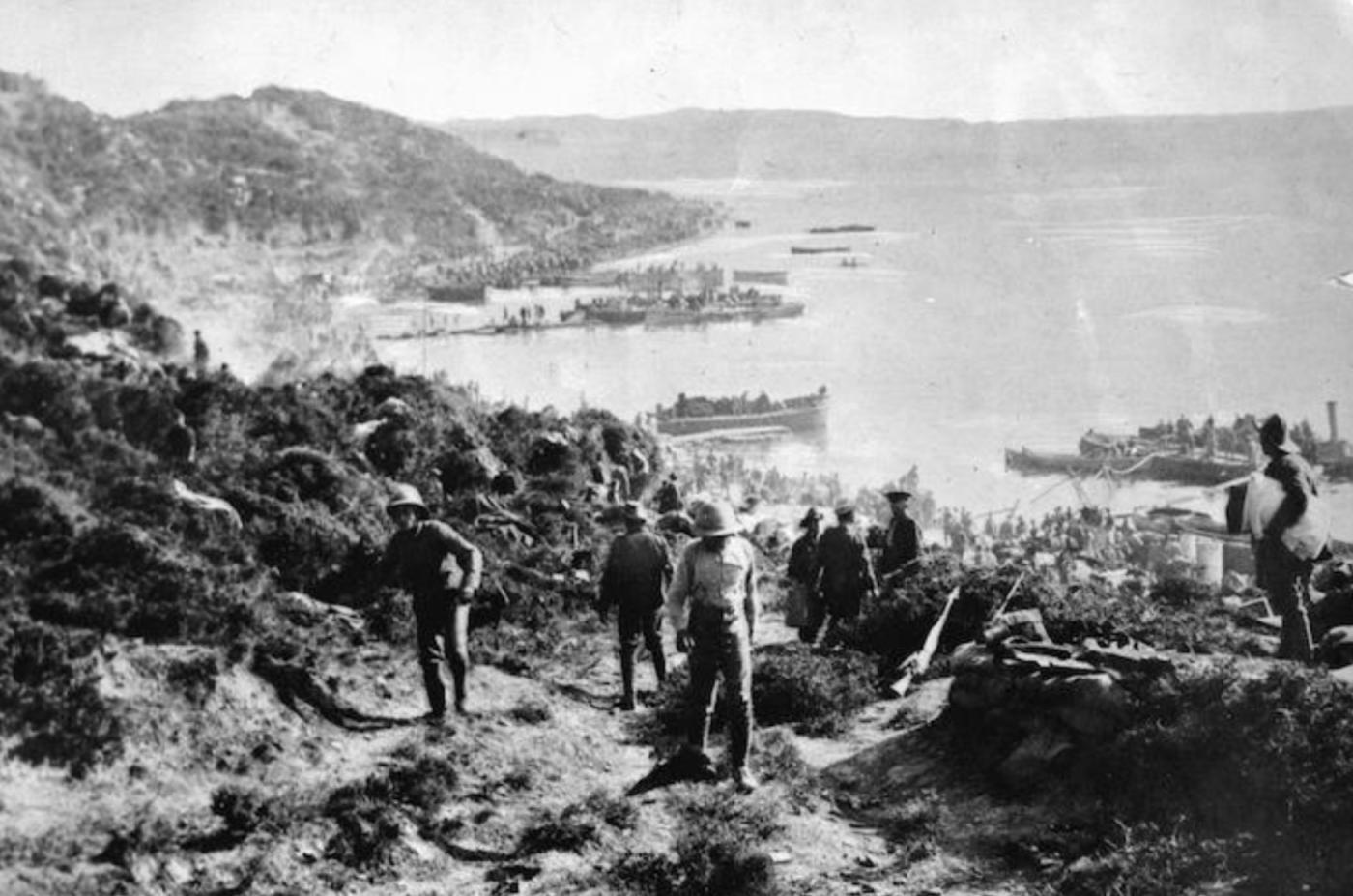
The main landings were carried out by British, French, and troops of the Australian and New Zealand Army Corps, with the ANZAC forces tasked with landing north of the main British assault at Cape Helles. Their objective was to seize the high ground of the Sari Bair range and cut off Ottoman reinforcements moving south. Due to navigational errors and strong currents, the ANZAC troops came ashore at a narrow, rugged stretch of coastline that would later become known as ANZAC Cove rather than the intended landing beaches. The terrain immediately posed severe challenges, consisting of steep ridges, scrub-covered hills, and limited water supply, all of which favoured the defenders.
Opposing the landings were Ottoman forces commanded in part by Mustafa Kemal Atatürk, whose quick decision-making played a decisive role. Without waiting for orders, he moved his troops to the high ground overlooking the landing sites and ordered them to hold their positions at all costs. His famous directive to his soldiers, effectively telling them to die rather than retreat, helped stabilise the defensive line and prevented the ANZAC forces from advancing inland. This immediate response ensured that the Allies would be confined to a small coastal perimeter.
The landings themselves were chaotic and costly. Troops disembarked from small boats under heavy rifle and machine-gun fire, often in darkness or poor visibility. Many soldiers drowned after jumping into deep water weighed down by heavy equipment. Units became mixed and disorganised, and officers struggled to establish control. Despite these difficulties, some groups managed to push inland and briefly reached parts of the high ground, but they were unable to consolidate their gains due to lack of coordination and strong Ottoman counterattacks.
At Cape Helles, British and French forces encountered similarly fierce resistance. Several beaches, designated by letters such as V Beach and W Beach, became scenes of intense fighting. At V Beach, troops landing from the converted collier River Clyde suffered devastating casualties as they attempted to disembark under concentrated fire. The failure to achieve rapid breakthroughs meant that the initial objectives of capturing key positions and advancing across the peninsula were not met.
Logistics quickly became a critical issue. The beaches were cramped and exposed, making it difficult to land supplies, ammunition, and reinforcements efficiently. Water shortages were particularly severe, and the heat, flies, and unsanitary conditions contributed to the spread of disease. Dysentery became widespread among the troops, weakening their ability to fight. The dead often lay unburied for extended periods, adding to the already grim conditions.
As the campaign progressed, trench warfare developed in a manner similar to the Western Front, with both sides digging in along narrow fronts sometimes only a few metres apart. Sniping, grenade attacks, and small-scale assaults became routine. The Allies launched several offensives in an attempt to break the deadlock, including the August Offensive in 1915, but these efforts failed to achieve decisive results. The terrain, combined with determined Ottoman defence and inadequate planning, continued to hinder Allied progress.
The Gallipoli landings and subsequent campaign had significant political and military consequences. For the Allies, the failure led to criticism of leadership and strategy, contributing to the resignation of Winston Churchill from his position at the Admiralty. For the Ottoman side, the successful defence boosted morale and elevated Mustafa Kemal’s reputation, eventually aiding his rise as a national leader.
The campaign ultimately ended with the evacuation of Allied troops, which took place in stages between December 1915 and January 1916. Remarkably, the evacuation was one of the most successful aspects of the operation, carried out with minimal casualties due to careful planning and deception tactics, including the use of self-firing rifles to mislead Ottoman forces into thinking the trenches were still occupied.
In total, the Gallipoli campaign resulted in over 500,000 casualties from both sides, including killed, wounded, and missing. Although a military failure for the Allies, the landings became a defining moment for the national identities of Australia and New Zealand, commemorated annually as ANZAC Day. The campaign also remains a powerful example of the challenges of amphibious warfare, the importance of terrain and logistics, and the consequences of underestimating an opponent.