On this day in military history…
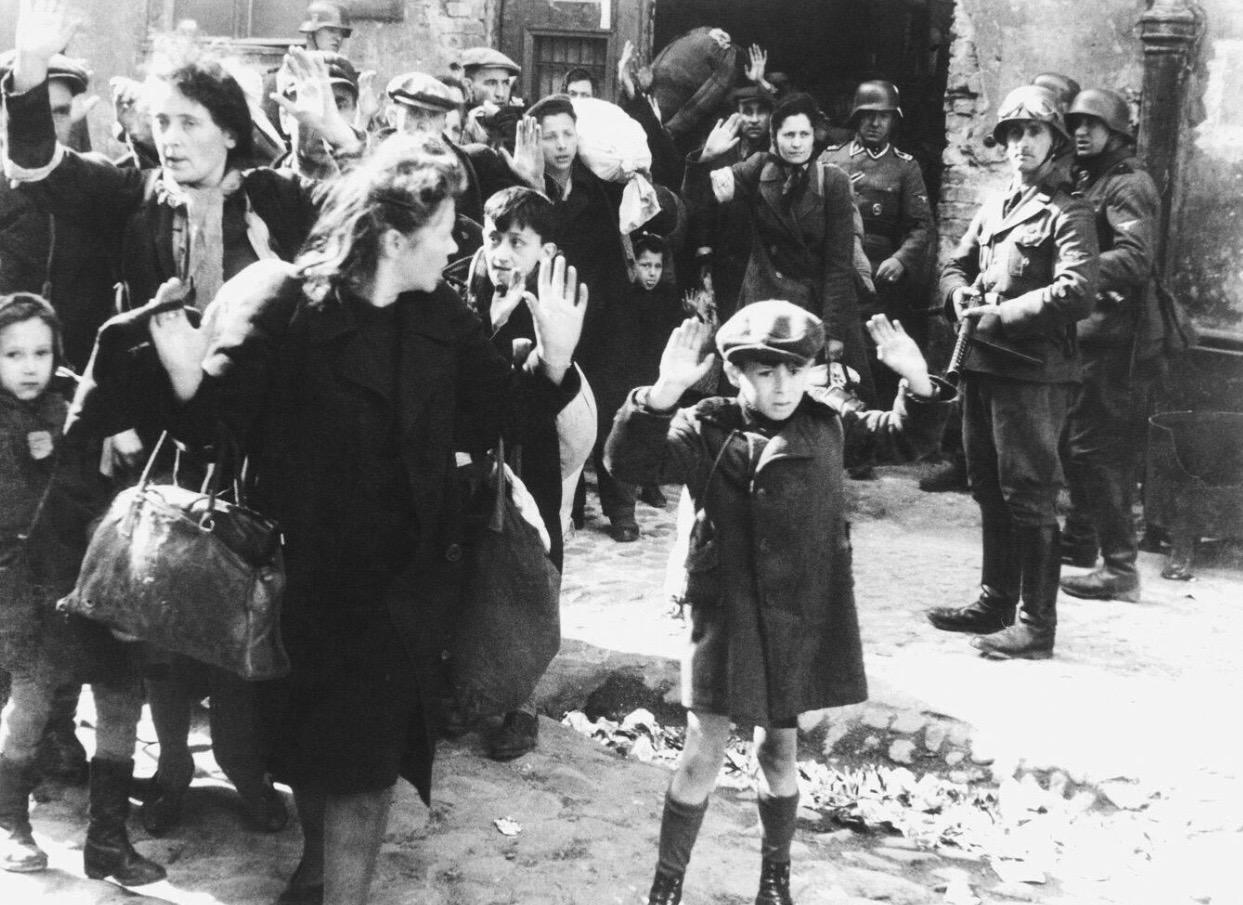
The Warsaw Ghetto Uprising was the largest and most significant act of Jewish armed resistance during the Holocaust, taking place in Nazi-occupied Poland in 1943. It unfolded inside the Warsaw Ghetto, a walled district established by Nazi Germany in 1940 in the city of Warsaw, where over 400,000 Jews were forcibly confined under horrific conditions. Starvation, disease, overcrowding, and constant terror were part of daily life, and by mid-1942 mass deportations to the extermination camp at Treblinka extermination camp had reduced the population drastically.
The uprising did not emerge suddenly but was the result of growing awareness among the remaining Jews that deportation meant certain death. Between July and September 1942, around 265,000 Jews were deported from the ghetto to Treblinka. When the deportations slowed, the survivors—numbering roughly 50,000 to 60,000—began organizing resistance. Two main groups formed: the Jewish Combat Organization (ŻOB) and the Jewish Military Union (ŻZW). These groups were composed largely of young people, many in their teens and twenties, with limited weapons and training but strong determination.
The ŻOB was led by Mordechai Anielewicz, a 23-year-old who became the symbolic face of the uprising. Other notable leaders included Yitzhak Zuckerman and Zivia Lubetkin. The ŻZW, less well known but also significant, had leaders such as Pawel Frenkel. Together, the resistance forces are estimated to have consisted of around 700 to 1,000 fighters, though they had the support of the broader ghetto population who helped build bunkers, hide weapons, and provide supplies.
The uprising began on April 19, 1943, the eve of the Jewish holiday of Passover, when German forces entered the ghetto to carry out its final liquidation. They expected little resistance, but instead were met with gunfire, grenades, and Molotov cocktails. The Jewish fighters, though vastly outnumbered and outgunned, initially succeeded in forcing the German troops to retreat. This early success shocked the German command and demonstrated that even under extreme oppression, organized resistance was possible.
The German response was swift and brutal. The operation was commanded by SS General Jürgen Stroop, who was tasked with crushing the rebellion. He brought in heavily armed troops, including SS units, police, and auxiliary forces, equipped with artillery, armored vehicles, and flamethrowers. Stroop adopted a methodical strategy of destroying the ghetto building by building, systematically burning structures and forcing the fighters and civilians out of their bunkers.
One of the defining features of the uprising was the extensive use of underground bunkers and tunnels by the Jewish population. Many residents had prepared hiding places beneath buildings, some equipped with food and water supplies intended to last weeks. These bunkers allowed fighters to launch surprise attacks and then disappear. However, as the Germans set fire to the ghetto and pumped gas into underground spaces, these hiding places became death traps.
The fighting continued for nearly a month, far longer than the Germans had anticipated. On May 8, 1943, one of the key moments occurred when German forces discovered the ŻOB command bunker at 18 Mila Street. Rather than surrender, Mordechai Anielewicz and many of his comrades chose to die by suicide. This marked the effective end of organized resistance, although sporadic fighting continued for several more days.
On May 16, 1943, Stroop declared the uprising officially crushed. To symbolize the destruction, he ordered the demolition of the Great Synagogue of Warsaw. In his report, later known as the Stroop Report, he detailed the operation with chilling precision, describing the uprising as having been eliminated and the ghetto reduced to ruins. According to his figures, more than 56,000 Jews were captured during the suppression, with many executed on the spot and others deported to concentration and extermination camps such as Majdanek concentration camp and Treblinka.
Casualty figures are difficult to determine precisely, but it is estimated that around 13,000 Jews died during the uprising itself, many burned alive or suffocated as buildings were set on fire. German losses were relatively small, though exact numbers vary; Stroop reported 16 dead and around 90 wounded, though some historians believe the true figures may have been higher.
The Warsaw Ghetto Uprising was militarily doomed from the outset due to the overwhelming superiority of German forces and the lack of external support for the fighters. However, its significance lies not in its military outcome but in its symbolic power. It demonstrated resistance in the face of certain death and became a powerful example of courage and defiance. It also inspired later acts of resistance, including the Warsaw Uprising by the Polish underground the following year.
An interesting and often noted aspect of the uprising is the role of youth movements, which had been active in the ghetto before the war and became the backbone of resistance. These groups, originally focused on cultural and educational activities, transformed into armed units. Another notable point is the limited but important assistance provided by the Polish underground, particularly the Armia Krajowa, which smuggled some weapons into the ghetto and attempted attacks on German positions outside the walls, though this support was constrained and insufficient to change the outcome.
Today, the uprising is remembered as one of the most important acts of resistance during World War II and is commemorated annually. It stands as a testament to human resilience under extreme oppression and remains a defining moment in the history of the Holocaust.