On this day in military history…
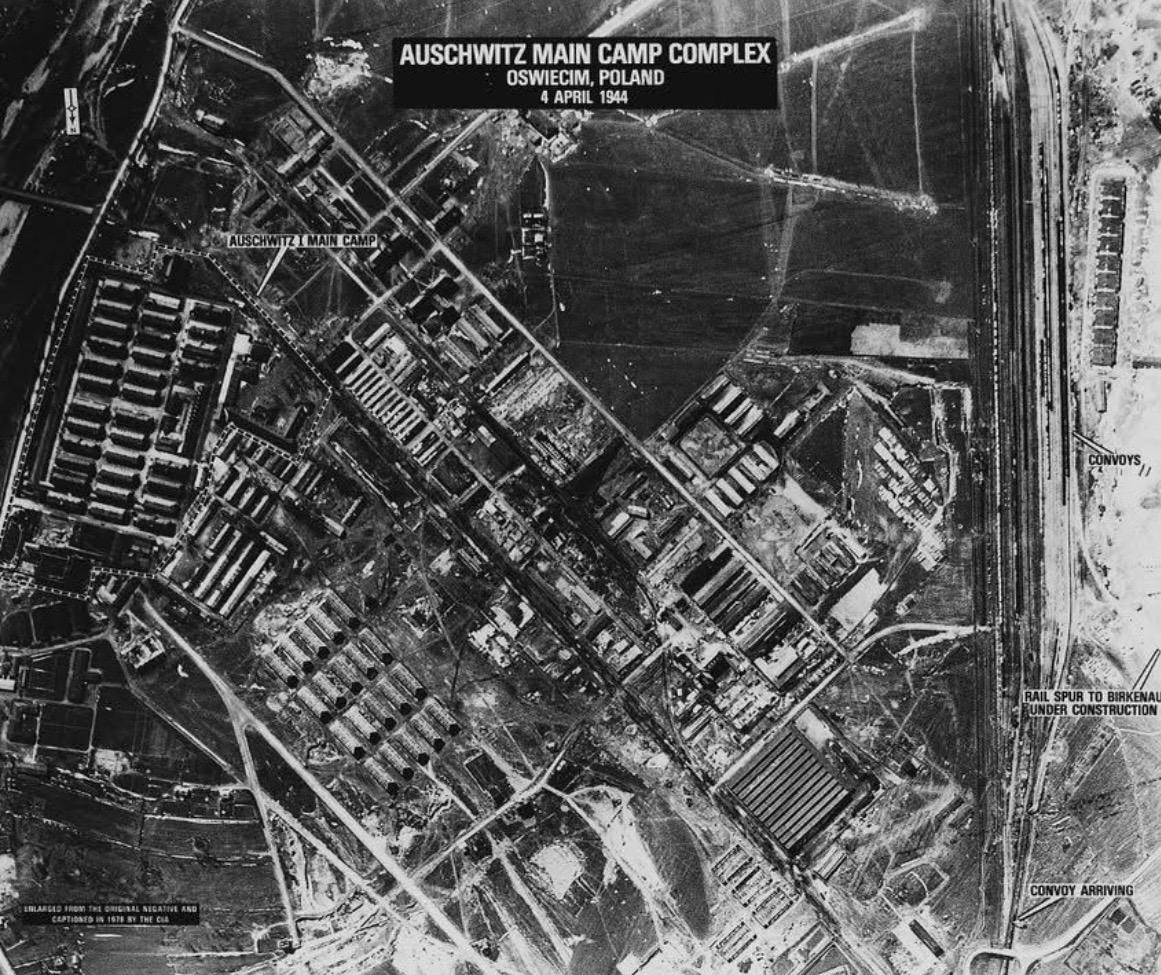
On 4 April 1944, one of the most historically significant reconnaissance flights of the Second World War took place, although its importance would not be fully understood until decades later. On that day, a de Havilland Mosquito photo-reconnaissance aircraft of the South African Air Force (SAAF) flew from Allied bases in southern Italy and unintentionally captured the first aerial photographs of Auschwitz concentration camp.
The aircraft belonged to No. 60 Photo Reconnaissance Squadron, South African Air Force, operating under the Mediterranean Allied Photo Reconnaissance Wing. It took off from the Foggia airfield complex in southern Italy, a major Allied base used for long-range reconnaissance missions over German-occupied Europe. The Mosquito—fast, unarmed, and relying on speed and altitude for survival—was ideally suited for such dangerous missions. On this particular sortie, the crew’s primary objective was not Auschwitz, but the nearby IG Farben synthetic oil and rubber plant at Monowitz, a key German industrial target.
The aircraft was flown by Lieutenant Charles H. H. Barry, a South African pilot, with Lieutenant Ian McIntyre as navigator. They flew an unarmed Mosquito at approximately 26,000 feet on a mission lasting around five hours deep over enemy-held territory. Despite mechanical issues and the constant threat of German interception, they completed multiple photographic runs to ensure coverage. Neither Barry nor McIntyre had any knowledge of Auschwitz’s true purpose at the time.
During the photographic run over the IG Farben plant, the Mosquito’s cameras also captured the nearby Auschwitz-Birkenau camp complex. These images became the first Allied aerial photographs of Auschwitz. They showed rows of barracks, railway lines entering the camp, and chimneys and industrial-looking structures. Later analysis, carried out decades after the war, revealed additional details such as groups of prisoners and crematoria buildings, though these were not recognised at the time.
Although the photographs clearly showed a large camp complex, Allied photo interpreters in 1944 did not recognise Auschwitz as an extermination centre. The mission’s focus was military rather than humanitarian, and photographic interpretation relied heavily on existing intelligence expectations. The concept of industrialised mass murder on such a scale was still not fully understood, and analysts would likely have interpreted the site as a factory complex with associated labour camps.
The true significance of the 4 April 1944 photographs was only realised in the late 1970s, when intelligence analysts re-examined the original reconnaissance film. This reanalysis revealed clear visual evidence of the Auschwitz-Birkenau extermination complex, including features consistent with mass killing operations and the presence of crematoria and prisoner movements. It became evident that the Holocaust had, unknowingly, been photographed from the air while it was happening.
The flight of 4 April 1944 is now regarded as a pivotal moment in the history of aerial reconnaissance and Holocaust documentation.